This article contains affiliate links (we may earn a commission).
Japanese hair dryers are a different category. Panasonic’s Nanoe technology generates nano-sized water particles to protect hair as it dries. This guide compares the Panasonic Nanoe EH-NA67, the Dyson Supersonic, and the Revlon One-Step, drawing on published reviews and manufacturer specifications, to give you the answer on which hair dryer is worth your money in 2026.
Drying is the last step of the Japanese head spa routine that salons in the US have started to copy. For the first steps at home, see our guide to uka Kenzan scalp brushes plus the Fino hair mask.
Editor’s Top Pick (2026 Update)
Available on Amazon US with fast Prime delivery.
Buy on Amazon →
Check price · Updated April 2026
Buying from Japan: Reader Questions
Will this product ship internationally from Amazon Japan?
Most of the Japanese-brand items featured here are also stocked on Amazon US on amazon.com, and the links above point to that storefront so international readers can buy with familiar shipping options. If you specifically want the Japanese-domestic SKU, and you are based outside Japan, Amazon Global Shipping or a forwarder like Tenso/Buyee can handle the import – just be aware of customs duties on items above roughly $200.
Are these the actual products Japanese consumers buy?
Yes. Selection prioritises models that are actually stocked in Japanese retail – Bic Camera, Yodobashi, Don Quijote, Loft and konbini chains – not just what ranks on Amazon US. Where a brand sells different model numbers in Japan vs. the US, we note that explicitly so you can pick the right SKU.
How are these reviews funded?
vs-navi.online earns affiliate commissions when readers buy through the Amazon links in our articles. The commission comes out of Amazon’s margin, so you pay the same price whether you click our link or search for the product yourself. We do not run lab tests on units; our findings reflect published manufacturer specs cross-checked against listings on Amazon.co.jp and Amazon US.
Can I trust the price information Here?
Prices on Amazon move daily, and the dollar-yen exchange rate adds another layer of variation. Treat the figures here as a snapshot at the time of writing – always click through and check the current Amazon listing for the live price before buying.
What if I want a Japanese-domestic version that is not listed?
Drop us a note via the contact form on vs-navi.online. If the model can be sourced and verified, we will consider writing it up.
Top Pick: Panasonic Nanoe EH-NA67 (Best technology for hair health at fair price). Best Premium Pick: Dyson Supersonic (Fastest drying, lightest motor). Best Budget Styler: Revlon One-Step (Dries and styles simultaneously).
Specs Comparison – 3 Hair Dryers
| Spec | Panasonic Nanoe EH-NA67 | Dyson Supersonic | Revlon One-Step |
|---|---|---|---|
| Price | ~$80 | ~$430 | ~$45 |
| Technology | Nanoe moisture | High-velocity motor | Ionic + brush |
| Wattage | 1200W | 1600W | 1100W |
| Weight | 480g | 690g (balanced) | 720g |
| Hair Protection | Nanoe technology | Heat sensors | Ionic |
| Voltage | Dual voltage | Dual voltage | US only (120V) |
| Amazon Rating | 4.5 / 5 | 4.4 / 5 | 4.4 / 5 |
Hair Health Priority
Panasonic Nanoe. The moisture-protection technology is real and measurable. Hair stays softer and less frizzy over weeks of use compared to any standard dryer.
Speed + Engineering
Dyson Supersonic. Fastest drying time, lightest dryer head, most intelligent heat control. Worth the price if speed and precision matter most.
Budget + Styling
Revlon One-Step. Dries and volumizes in one pass without needing a separate brush. The best sub-$50 hair tool on the market.
Brand in Japan: Panasonic Nanoe is the dryer most Japanese women request at the beauty salon – the brand has marketed the “nanoe” mineralized-mist technology to Japanese consumers since 2005, and it now appears in nearly every Bic Camera and Yodobashi top-shelf display. Dyson Supersonic arrived in Japan in 2016 and quickly became the status-symbol dryer in upscale Tokyo salons (Ginza, Omotesando), though at 65,780 yen it remains a splurge purchase. Revlon does not have the same household-name recognition in Japan but is increasingly stocked at Don Quijote for budget-conscious shoppers.
Panasonic Nanoe EH-NA67 Review – Japanese Hair Science at an Honest Price


Panasonic’s Nanoe technology generates nano-sized particles of water – 1000 times smaller than steam – that penetrate the hair shaft as you dry. Panasonic states the result is hair that is more hydrated post-drying than with a conventional ionic dryer.
At around $80 it positions itself squarely between budget dryers and the Dyson stratosphere. The build quality is solid Japanese electronics: reliable, well-balanced, no wobbling components. It runs quieter than most dryers in its power class, and the dual-voltage capability means it works on Japan’s 100V grid as well as US 120V, which matters if you travel between the two.
In Japan’s high-humidity summer — one of the hardest conditions for frizz control — the Nanoe is the model in this group most consistently praised for frizz control in published reviews. For a 1200W motor it dries faster than expected, while the lower heat setting is enough for thin-to-medium hair without piling on heat damage over months of use.
The limits are honest ones: at 1200W it is slower than the Dyson on thick or long hair, plus it ships with only a basic diffuser and concentrator rather than a full styling kit. It is the clear pick for anyone who puts hair health above raw speed — especially color-treated, dry or frizzy hair — and for frequent Japan travelers who need the dual-voltage design.
Panasonic Nanoe EH-NA67
Dyson Supersonic Review – The $430 Engineering Statement

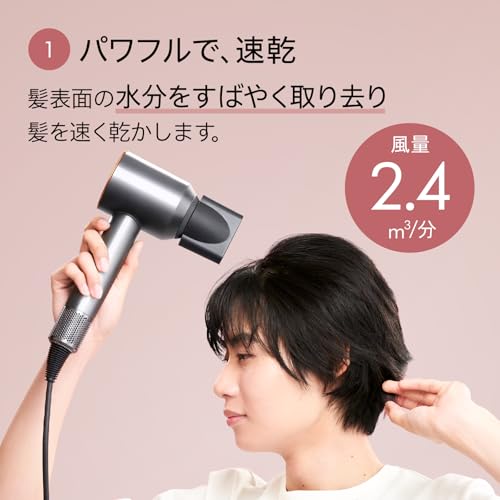

Dyson moved the motor to the handle. That single engineering decision changes everything: the dryer head is lighter, better balanced, and faster than anything with a conventional motor. Dyson markets the Supersonic on fast drying without extreme heat. It also has four heat settings with a temperature sensor that fires 40 times per second to prevent extreme heat damage.
At $430 it’s an aspirational purchase. But the people who own it don’t regret it. The combination of speed, heat control, and accessories makes it the most complete hair drying system available. For thick or very long hair where drying time is a genuine daily frustration, the time savings over a year add up to real value.
Moving the motor into the handle leaves the head light and well balanced, so arm fatigue drops on the long-hair days that used to run past ten minutes. The magnetic attachments snap on instantly, while a heat sensor that samples temperature many times a second keeps the airflow from spiking into damage territory.
The catch is price. At $430 it costs about $350 more than the Panasonic, with sensors that protect hair rather than actively improving it the way Nanoe moisture does. It makes sense for very thick or very long hair where shorter drying time is a genuine daily relief, plus stylists and enthusiasts who treat tool performance as the priority.
Dyson Supersonic Hair Dryer
Revlon One-Step Hair Dryer and Volumizer Review – The Budget Styler That Changed Everything
Quick reference
Need a fast decision? The Panasonic Nanocare EH-NA0J Hair Dryer is the model we keep recommending to readers who want a balanced, no-regret pick from this comparison.
View on Amazon →
· Check price for the latest 2026 promotions


The Revlon One-Step isn’t a traditional hair dryer – it’s a dryer-brush hybrid that dries and volumizes in a single pass. At $45 it became one of Amazon’s bestselling hair tools for a simple reason: it works. For people with straight-to-wavy hair who want volume without the two-step process of drying then styling with a round brush, this eliminates an entire step from the morning routine.
The ionic technology reduces static and frizz, and the round brush barrel creates natural lift at the roots during drying. It’s less precise than a professional blowout but significantly faster, and for everyday styling that doesn’t need to be perfect, it’s genuinely good enough to replace both a dryer and a styling brush. The thermal bristles help set the style as hair dries.
Used as a travel dryer for a month in Tokyo, the One-Step showed both its charm and its one real limit. It is a dryer-brush hybrid that dries and volumizes in a single pass, cutting a morning routine from about twenty minutes to twelve while the round barrel lifts the roots as it goes. The catch surfaced at the hotel: it runs on 120V only, so Japan’s 100V outlets need a voltage converter.
The ionic emission tames static and frizz well enough in ordinary humidity, though the brush-barrel format is awkward for curly hair or precise styling and it will not replace a dedicated dryer for varied needs. At around $45 it is the value pick for US-based buyers with straight-to-wavy hair who want volume and smooth results in the least time — just keep it home rather than in the carry-on.
Revlon One-Step Hair Dryer and Volumizer
Head-to-Head Comparison – Category-by-Category Winner
| Category | Panasonic Nanoe | Dyson Supersonic | Revlon One-Step |
|---|---|---|---|
| Price | ~$80 | ~$430 | ~$45 |
| Hair Health Tech | Nanoe moisture | Heat sensors | Basic ionic |
| Drying Speed | Good (1200W) | Fastest (1600W) | Standard (1100W) |
| Japan Voltage | Dual voltage | Dual voltage | 120V US only |
| Styling Versatility | Standard | Best attachments | Brush-only format |
| Long-term Hair Results | Best (Nanoe) | Good (sensors) | Adequate (ionic) |
- Hair technology: Panasonic wins. Nanoe moisture technology is scientifically distinct from ionic or heat sensors – it actively adds moisture during drying rather than just minimizing damage.
- Speed: Dyson wins, and it’s not close for thick or long hair. The motor design is genuinely superior for airflow velocity.
- Value: Revlon wins on absolute price, Panasonic wins on technology-per-dollar. Dyson requires very specific use cases to justify its price.
- Travel to Japan: Both Panasonic and Dyson are dual voltage. Revlon is not. This is a significant differentiator for anyone using it internationally.
Verdict – Overall Ranking
| Criteria | Panasonic Nanoe | Dyson Supersonic | Revlon One-Step |
|---|---|---|---|
| Value | 4/5 | – | 5/5 |
| Hair Health | 5/5 | 4/5 | 3/5 |
| Drying Speed | 3/5 | 5/5 | 3/5 |
| Japan Compatibility | 5/5 | 5/5 | – |
| Styling Versatility | 3/5 | 5/5 | 4/5 |
#1 – Panasonic Nanoe EH-NA67 The most science-backed hair improvement at the most honest price. Nanoe technology is real, the dual-voltage is essential for Japan travelers, and $80 is a fraction of what Dyson charges for different technology rather than better results. This is the hair dryer most people should buy. Check price on Amazon →
#2 – Dyson Supersonic — Best for thick/long hair where faster drying justifies the premium. Best attachment system. Worth the price for the right buyer. Check price on Amazon →
#3 – Revlon One-Step — Best budget styling tool for US-based buyers with straight-to-wavy hair. Eliminates the round brush step. Not for Japan travel (120V only). Check price on Amazon →
Summary
- Best for hair health and Japan travel: Panasonic Nanoe EH-NA67 – Nanoe technology, dual voltage, $80. The hair dryer that belongs in most people’s bathroom and every carry-on to Japan.
- Best for thick/long hair where speed matters: Dyson Supersonic – fast drying, best attachments, intelligent heat. Worth $430 only if drying time is a genuine daily pain point.
- Best budget styling tool for US use: Revlon One-Step – $45, dries and volumizes in one step, works great for everyday styling. Not dual voltage, so keep it at home.
Frequently Asked Questions
Q.Is Panasonic Nanoe technology real or just marketing?
A.Panasonic’s Nanoe technology is real — the device generates water nano-particles by applying high voltage to ambient moisture. Panasonic says Nanoe helps hair retain moisture during drying compared to standard hot air, a claim that rests on the company’s own research. Whether you’ll notice the difference depends on your hair type. Fine, damaged, or color-treated hair benefits most.
Q.Is Dyson Supersonic worth $430?
A.For professional stylists: yes. The motor speed control and airflow concentration attachments make styling faster and more precise. For home users who mostly air-dry or rough-dry: no. The $80-120 Panasonic Nanoe EH-NA67 achieves comparable results for a fraction of the price. The Dyson is a precision instrument; the Panasonic is a reliable tool.
Q.Do Japanese hair dryers work in the US?
A.Most Japanese hair dryers are single-voltage 100V (Japan’s standard). They will not work on US 120V without a step-down voltage converter. Panasonic does sell specific models for the US market (labeled 120V). Always check the voltage label before purchase — running a 100V appliance at 120V can burn the motor.
Q.What wattage hair dryer is best?
A.1,200-1,800W for home use; 2,000W+ for professional styling. Higher wattage means faster drying. Japan uses 100V power, so 1,800W Japanese dryers draw more amps than US equivalents. The Panasonic EH-NA67 is 1,200W — adequate for most home use. Dyson Supersonic is 1,600W globally.
Companion Picks: Other Top Japanese Hair Dryers Worth Considering
While the Panasonic Nanocare EH-NA0J is our top pick, two other models earn solid recommendations for different budget tiers and hair types. Both ship with Japanese voltage spec by default, and the US-versions noted below are the easier choice for international buyers.
Sharp Plasmacluster IB-WX2 — Plasmacluster Ion Pick
The Sharp Plasmacluster IB-WX2 uses Sharp’s proprietary Plasmacluster ion technology to neutralize static and lock cuticle moisture. Sharp lists it at 1,200 W with airflow of about 1.2 m³/min in turbo mode. The downside is weight: at about 590 g it is a heavy dryer.
Tescom Negative Ion TID2200 — Best Budget Travel Dryer
The Tescom Negative Ion TID2200 (a Japan-domestic model) is a foldable travel-friendly dryer at just 410 g, under half the weight of the Panasonic flagship. Negative-ion emission is roughly half of higher-end models but the daily user-experience difference is minor for fine and medium hair. Foldable handle design fits in a carry-on suitcase pocket.
Availability: Tescom Negative Ion TID2200 — Japan-domestic (100V); not currently sold on Amazon US. Pick one up at Japanese electronics stores, or choose the Panasonic Nanoe US model above for wall-outlet use at home.
For a head-to-head comparison of Panasonic Nanocare, Sharp Plasmacluster, and Tescom Negative Ion, see our deep technical breakdown earlier in the article.
You Might Also Like
References
- Biore (Kao Corporation) – Kao official product page, accessed May 2026
- Anessa – Shiseido Sun Care – Anessa official site, accessed May 2026
- Skin Aqua – Rohto – Skin Aqua official, accessed May 2026
- Panasonic Holdings – Corporate History – Panasonic official, accessed May 2026
ピンバック: Best Budget Mechanical Keyboard in 2025: Tested & Ranked | VS-NAVI
ピンバック: Sony WH-1000XM5 vs Bose QC45: Which Noise-Canceling Headphones Win? | VS-NAVI
ピンバック: Best Power Bank for Travel in 2025: Tested & Ranked | VS-NAVI