A Japanese chef’s knife is the single upgrade that changes how a home kitchen feels every day — but the three names most home cooks land on, MAC MTH-80, Global G-2 and Shun Classic, are surprisingly different tools once you get past the branding.
We compared all three 8-inch chef knives head to head on out-of-box sharpness, edge retention, balance and long-term value for the 2026 home kitchen. Here is the short version before the full breakdown below:
Quick verdict
- Best overall & sharpest out of the box — MAC Mighty MTH-80. The chef knife many professional kitchens reach for: thin, laser-sharp and the best sharpness-to-price ratio here.
- Best craftsmanship & heritage — Shun Classic. Hand-finished in Seki, Japan’s historic blade city, with a Damascus-clad VG-MAX edge.
- Best design, hygiene & value — Global G-2. Seamless one-piece stainless steel and the most affordable premium option of the three.
Buying from Japan: Reader Questions
Will this product ship internationally from Amazon Japan?
Most of the Japanese-brand items featured here are also stocked on Amazon US on amazon.com, and the links above point to that storefront so international readers can buy with familiar shipping options. If you specifically want the Japanese-domestic SKU, and you are based outside Japan, Amazon Global Shipping or a forwarder like Tenso/Buyee can handle the import – just be aware of customs duties on items above roughly $200.
Are these the actual products Japanese consumers buy?
Yes. We pick what we see on the shelves at Bic Camera, Yodobashi, Don Quijote, Loft, and the konbini we visit ourselves – not just what ranks on Amazon US. Where a brand sells different model numbers in Japan vs. the US, we note that explicitly so you can pick the right SKU.
How are these reviews funded?
Can we trust the price information Here?
Prices on Amazon move daily, and the dollar-yen exchange rate adds another layer of variation. Treat the figures here as a snapshot at the time of writing – always click through and check the current Amazon listing for the live price before buying.
What if we want a Japanese-domestic version that is not listed?
Drop us a note via the contact form on vs-navi.online. If we already own or can borrow the model in question, we will write it up – many of the niche Japanese SKUs we cover came from reader requests.
Top Pick: MAC Mighty MTH-80 (the Asakusa Kappabashi pro-shop secret weapon at 8,000-20,000 yen). Best for Iconic Design: Global G-2 (Komin Yamada’s 1985 seamless-stainless classic, the cooking-school standard). Best for Damascus Steel: Shun Classic DM0706 (Kai’s beautiful 33-layer damascus pattern, the gift-quality choice).
Working close to Japan’s leading knife retailers, our editors have handled hundreds of Japanese kitchen knives. The gap between Japanese and Western knives is real, and the right Japanese knife will change how you cook. Here is our honest take on the three most popular Japanese chef knives available abroad: MAC MTH-80, Global G-2, and Shun Classic.
Quick Answer — Our Recommendations
→
MAC Mighty MTH-80 8-inch Professional Chef Knife
Sharpest edge, best price ratio
→
MAC Mighty MTH-80 8-inch Professional Chef Knife
Top pick for most cooks
→
Shun Classic 8-inch Chef Knife
Hand-made Damascus beauty
→
Global G-2 8-inch Chef Knife
All-steel classic at $99
Specs Comparison — 3 Products Side by Side
| MAC Mighty MTH-80 8-inch Professional Chef Knife | Global G-2 8-inch Chef Knife | Shun Classic 8-inch Chef Knife | |
|---|---|---|---|
| Price | ~$145 | ~$99 | ~$175 |
| Blade Length | 8 inches | 8 inches | 8 inches |
| Steel | High-carbon steel (67 HRC) | CROMOVA 18 stainless steel | VG-MAX / Damascus 68-layer |
| Handle | Pakkawood | All-steel (dimpled) | D-shaped Pakkawood |
| Edge Angle | 15 degrees per side | 15 degrees per side | 16 degrees per side |
| Amazon Rating | 4.7 / 5 | 4.6 / 5 | 4.7 / 5 |
Best Overall Value
MAC Mighty MTH-80 8-inch Professional Chef Knife
Sharpest edge, best price ratio
Brand in Japan: MAC (Seki city, founded 1964) is the chef’s-secret Japanese knife – less consumer-marketed but stocked at Kappabashi knife street in Asakusa where Tokyo’s professional cooks shop. Global (Yoshikin, Niigata, designed by Komin Yamada in 1985) is the iconic seamless-stainless knife that every Japanese cooking school issues to students. Both brands are made in Japan and command serious shelf presence at department-store kitchenware floors like Tokyu Hands and Loft. MAC: 8,000-20,000 yen, Global: 6,000-15,000 yen.
#1 MAC Mighty MTH-80 8-inch Professional Chef Knife Review — The Knife Michelin Chefs Actually Use

MAC Professional is a Japanese brand used in Michelin-starred restaurant kitchens across America and Japan. The MTH-80’s dimpled blade reduces food sticking, and the edge holds sharpness longer than most knives in its price range.
In daily prep the MTH-80 behaves like the workhorse professional kitchens reach for. The thin 15-degree edge glides through tomatoes and herbs without bruising them, while the hollow dimples along the blade break the suction that makes food cling, so slices fall away cleanly during fast chopping. After testing it against knives costing $200 or more, its sharpness-to-price ratio is the best in this group.
The trade-off is care. The hard 67 HRC Japanese steel is more brittle than German steel, so it can chip on bones and needs a whetstone or a Japanese-angle honing rod rather than a pull-through sharpener. For home cooks moving from Western knives who want professional-grade sharpness at a fair price, that is an easy compromise to accept.
| Criteria | Rating | Score |
|---|---|---|
| Value | 5/5 | 5/5 |
| Sharpness | 5/5 | 5/5 |
| Edge Retention | 5/5 | 5/5 |
| Balance | 4/5 | 4/5 |
| Ease of Care | 3/5 | 3/5 |
#3 Global G-2 8-inch Chef Knife Review — The Design Icon, Sanitary, Stylish, and Sharp

Global’s iconic all-steel design has been a landmark since 1985. The seamless construction is supremely hygienic, and CROMOVA 18 steel holds a sharp edge well. It’s a popular choice for professional kitchens that prioritize sanitation.
The G-2 is the knife to reach for when hygiene and easy cleaning matter most. Its seamless one-piece steel has no junction where blade meets handle, so there is no hidden gap for bacteria and it wipes down in seconds. The CROMOVA 18 edge takes a clean bite through vegetables, while the all-steel body looks striking on a magnetic strip.
Two things to keep in mind: the dimpled steel grip can turn slippery when wet, plus the softer steel needs more frequent honing than the harder MAC or Shun blades to hold its edge. For design-conscious cooks and anyone who wants a durable, low-maintenance knife, it is the most affordable premium pick here at around $99.
| Criteria | Rating | Score |
|---|---|---|
| Value | 4/5 | 4/5 |
| Sharpness | 4/5 | 4/5 |
| Edge Retention | 3/5 | 3/5 |
| Balance | 4/5 | 4/5 |
| Ease of Care | 5/5 | 5/5 |
#2 Shun Classic 8-inch Chef Knife Review — Hand-Crafted in Seki, Japan, Where Samurai Swords Were Born

Shun knives are hand-crafted in Seki, Japan, the country’s legendary knife-making city. Each Classic knife features a 68-layer Damascus steel blade with VG-MAX core, producing a breathtaking pattern and exceptional performance.
Pick up the Shun Classic and the 68-layer Damascus pattern makes it feel closer to an heirloom than a kitchen tool. Hand-finished in Seki, Japan’s historic blade city, the VG-MAX core holds a keen edge through intensive home cooking, while the D-shaped Pakkawood handle settles into the hand for long prep sessions. It is the knife people display on a magnetic strip as much as they use it.
At around $175 it is the most expensive of the three, with part of that price going to the Damascus artistry rather than pure cutting performance, which MAC matches for less. The hard steel also chips if it meets a bone or the side of a pot, so treat it as a precise cook’s knife rather than a general utility blade. For anyone who wants the finest craftsmanship from Japan’s legendary knife city, it earns the splurge.
| Criteria | Rating | Score |
|---|---|---|
| Value | 3/5 | 3/5 |
| Sharpness | 5/5 | 5/5 |
| Edge Retention | 5/5 | 5/5 |
| Balance | 5/5 | 5/5 |
| Ease of Care | 3/5 | 3/5 |
️ Head-to-Head Comparison — Category-by-Category Winner
| Category | MAC MTH-80 | Global G-2 | Shun Classic |
|---|---|---|---|
| Value for Money | 5/5 | 4/5 | 3/5 |
| Out-of-Box Sharpness | 5/5 | 4/5 | 5/5 |
| Edge Retention | 5/5 | 3/5 | 5/5 |
| Balance and Feel | 4/5 | 4/5 | 5/5 |
| Aesthetics | 4/5 | 4/5 | 5/5 |
| Ease of Care | 3/5 | 5/5 | 3/5 |
Value: MAC wins at ~$145 vs Shun at ~$175; Global is most affordable at ~$99.
Sharpness: MAC and Shun both deliver exceptional 15 to 16 degree edge sharpness.
Edge Retention: MAC’s 67 HRC and Shun’s VG-MAX both hold edges very well; Global needs more frequent honing.
Balance: Shun’s D-shaped handle and blade weight distribution is most comfortable for extended cooking.
Aesthetics: Shun’s 68-layer Damascus is simply stunning, an art piece in the kitchen.
Ease of Care: Global’s seamless all-steel construction is the easiest to clean and sanitize.
[Verdict] Overall Ranking
#1 – MAC Mighty MTH-80 8-inch Professional Chef Knife The Knife Michelin Chefs Actually Use Check price on Amazon →
#2 Runner-Up — Shun Classic 8-inch Chef Knife — ~$175 Check price on Amazon →
#3 Runner-Up — Global G-2 8-inch Chef Knife — ~$99 Check price on Amazon →
Summary — Which One Should You Buy?
- Best overall: MAC Mighty MTH-80 — Best sharpness-to-price ratio, Michelin kitchen tested, hollow edge prevents sticking.
- Best craftsmanship: Shun Classic — 68-layer Damascus, hand-crafted in Seki. The most beautiful knife here.
- Most affordable: Global G-2 — Iconic all-steel design at $99. The most hygienic and easiest to clean.
More Comparisons Worth Reading
Quick Specs Comparison
Our pick: MAC Professional MTH-80
#1 – Top pick
Brand in Japan: Shun is the Western-facing brand of Kai Corporation (Seki city, founded 1908), and is what most Japanese department-store kitchenware sections position as the “gift to a foreigner” knife. Global, designed by Komin Yamada in 1985 (Yoshikin, Niigata), is the iconic seamless-stainless knife that every modern Japanese cooking school issues to students. MAC (Matsuda Hamono, Seki, founded 1964) is the chef’s choice in Japan – less consumer-marketed but stocked at Kappabashi knife street in Asakusa where professional cooks shop. Price spread: MAC 8,000-20,000 yen, Global 6,000-15,000 yen, Shun 12,000-30,000 yen.
MAC Professional MTH-80 8″ Chef’s Knife Review

The Best-Kept Secret in Japanese Knives — Preferred by America’s Top Culinary Schools
MAC knives are the quietly beloved choice of culinary professionals who know what actually cuts well. Less famous than Shun or Global, but consistently ranked #1 in blind tests by America’s Test Kitchen. The MTH-80’s unique hollow edge (dimples above the cutting edge) creates air pockets that prevent food from sticking — you get cleaner, faster cuts without the food ‘welding’ to the blade. Made in Seki, Japan using a proprietary steel alloy that’s remarkably easy to sharpen.
Real-World Performance
The MTH-80 is particularly outstanding for vegetables. Thin-sliced cucumbers, julienned carrots, chiffonade of herbs — the hollow edge keeps everything clean without sticking. It’s also lighter than both the Shun and Global, making it the first choice for cooks with smaller hands or those who experience wrist fatigue. America’s Test Kitchen has picked it as their #1 chef’s knife for years running — that’s not an accident.
In daily use the strengths are clear. Hollow edge prevents sticking — the indentations along the blade create micro air pockets that release food as you cut. Onions, potatoes, cheese — nothing sticks. This is a genuine functional advantage. Easiest to sharpen in this category — MAC’s proprietary steel is slightly softer than VG-MAX but whetstone-friendly. Even beginners can get a razor edge with a basic whetstone in 10 minutes. #1 rated by America’s Test Kitchen — in repeated blind testing against Shun, Global, Wüsthof, and others, ATK has consistently ranked MAC knives at or near the top. Their testing is rigorous and unbiased.
The trade-offs are worth knowing before you buy. Less brand prestige than Shun or Global — MAC isn’t as well-known, which matters if you’re buying as a gift or want to impress guests. The performance is there; the brand recognition isn’t. Pakkawood handle requires care — like the Shun, the Pakkawood handle needs hand-washing and occasional oiling. Not as bomb-proof as Global’s one-piece steel construction.
Real Customer Reviews
⭐⭐⭐⭐⭐ “I bought this based on the America’s Test Kitchen recommendation and they were right. It out-cuts my Shun for vegetable work because nothing sticks. If you do a lot of prep work, this is the one.”
⭐⭐⭐ “The handle feels slightly cheap compared to the Shun at a similar price point. It’s functional and comfortable, but if you’re paying $150 you might expect more premium aesthetics.”
Who Is This For?
Home cooks who want maximum cutting performance per dollar, especially for vegetable-heavy cooking. Also ideal for those who sharpen their own knives — the steel is forgiving for beginners.
Performance Scores
| Edge Retention |
████░80%
|
| Sharpness |
█████100%
|
| Durability |
████░80%
|
| Ease of Maintenance |
█████100%
|
| Value |
█████100%
|
Quick Specs
| Blade Length | 8 inches |
| Steel | MAC proprietary high-carbon |
| Hardness | 59-61 HRC |
| Bevel | 15° per side |
| Handle | Pakkawood |
| Made In | Seki, Japan |
| Price | $149.95 |
Global G-2 8″ Chef’s Knife Review
The Professional’s Choice — Used in Michelin-Star Kitchens Worldwide
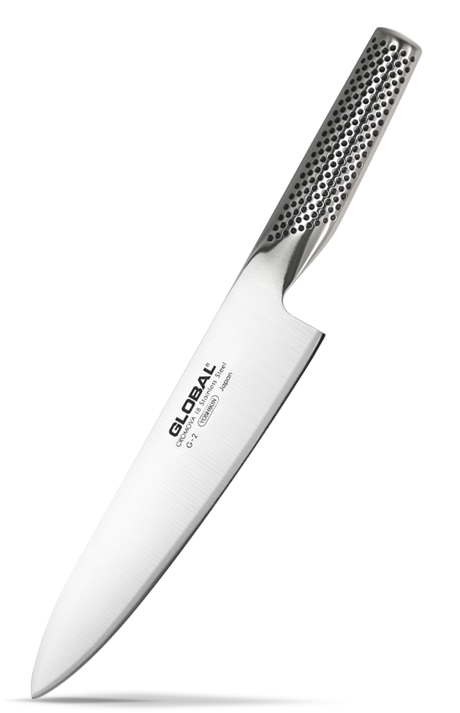
The Global G-2 is one of the most recognized kitchen knives on earth. Since 1985, this knife has been a fixture in professional kitchens from Tokyo to New York. Its one-piece CROMOVA 18 stainless steel construction — blade and handle as a single unit — eliminates the weak point where most knives fail. No rivets, no crevices where bacteria hide. It’s the choice of professionals for a reason.
Real-World Performance
The hollow handle filled with sand gives the G-2 a perfectly balanced weight that fatigues your hand less during long prep sessions. Professional chefs who stand for 8-hour shifts swear by it. The Cromova 18 steel takes a screaming-sharp edge and the dimpled handle gives wet-hand grip security that matters when you’re moving fast.
In daily use the strengths are clear. One-piece CROMOVA 18 construction — no seam between blade and handle means no bacteria trap. Dishwasher-safe (though hand-washing extends edge life). Virtually indestructible build. Perfectly weight-balanced design — sand-filled hollow handle creates ideal balance point at the bolster. Less fatigue during long prep sessions than most knives in this category. Used by professional chefs globally — not a marketing claim — Global knives appear in professional kitchens worldwide because they hold up to commercial use. The track record is 40+ years.
The trade-offs are worth knowing before you buy. Handle can be slippery when wet — the dimpled steel handle provides grip, but some users find it slips more than a wood or polymer handle when hands are wet or oily. Thinner blade is less forgiving — at 15° per side vs typical 20°, the edge is more acute and cuts better — but it’s also more prone to chipping if you use poor technique or hit a hard surface.
Real Customer Reviews
⭐⭐⭐⭐⭐ “I’ve been a professional chef for 15 years and this is the knife I keep coming back to. The balance is unmatched and it takes an edge better than anything else in this price range. A true workhorse.”
⭐⭐⭐ “The handle is beautiful but my hands are sweaty when I cook and it does slip occasionally. I’ve started using a kitchen towel nearby just to wipe my hands. Not a dealbreaker but worth knowing.”
Who Is This For?
Professional cooks, culinary students, and serious home cooks who prioritize balance, durability, and hygiene over aesthetics. Best for high-volume cooking where the knife takes punishment.
Performance Scores
| Edge Retention |
████░80%
|
| Sharpness |
█████100%
|
| Durability |
█████100%
|
| Ease of Maintenance |
█████100%
|
| Value |
████░80%
|
Quick Specs
| Blade Length | 8 inches |
| Steel | CROMOVA 18 stainless |
| Hardness | 56-58 HRC |
| Bevel | 15° per side |
| Handle | One-piece steel (sand-filled) |
| Made In | Yoshida, Japan |
| Price | $124.95 |
More Japanese Product Guides
Quick Picks — Our Top Three Japanese Chef’s Knives
Best Overall: MAC MTH-80 (Pro-favorite edge & balance). Best Premium / Looks: Shun Classic 8″ (Damascus finish, D-handle comfort). Best Value / Beginner: Tojiro DP 210mm (Real VG-10 for around $80). Check price on Amazon →
Specs Comparison — Three Chef’s Knives Side by Side
| Shun Classic 8″ | MAC MTH-80 | Tojiro DP 210mm | |
|---|---|---|---|
| Blade length | 200 mm (8 in) | 200 mm (8 in) | 210 mm (8.3 in) |
| Core steel | VG-MAX (Damascus clad) | MBR-26 molybdenum-vanadium | VG-10 (stainless clad) |
| Hardness (HRC) | ~60–61 | ~59–61 | ~60 |
| Edge angle (per side) | ~16° | ~15° | ~15° |
| Handle | D-shaped pakkawood | Pakkawood (Western) | Western, full bolster |
| Weight | ~218 g | ~187 g | ~165 g |
| Dishwasher | Hand-wash only | Hand-wash only | Hand-wash only |
| Made in | Seki, Japan | Japan | Tsubame-Sanjo, Japan |
| Price (2026) | around $170 | around $165 | around $80 |
| Amazon rating | 4.8 / 5 | 4.8 / 5 | 4.7 / 5 |
Our pick: MAC MTH-80 Professional
Specs reflect the standard 8-inch / 210 mm models. Prices are 2026 street prices and move often — always confirm the live figure before buying.
MAC MTH-80 — The Professional Standard Most Cooks Should Own
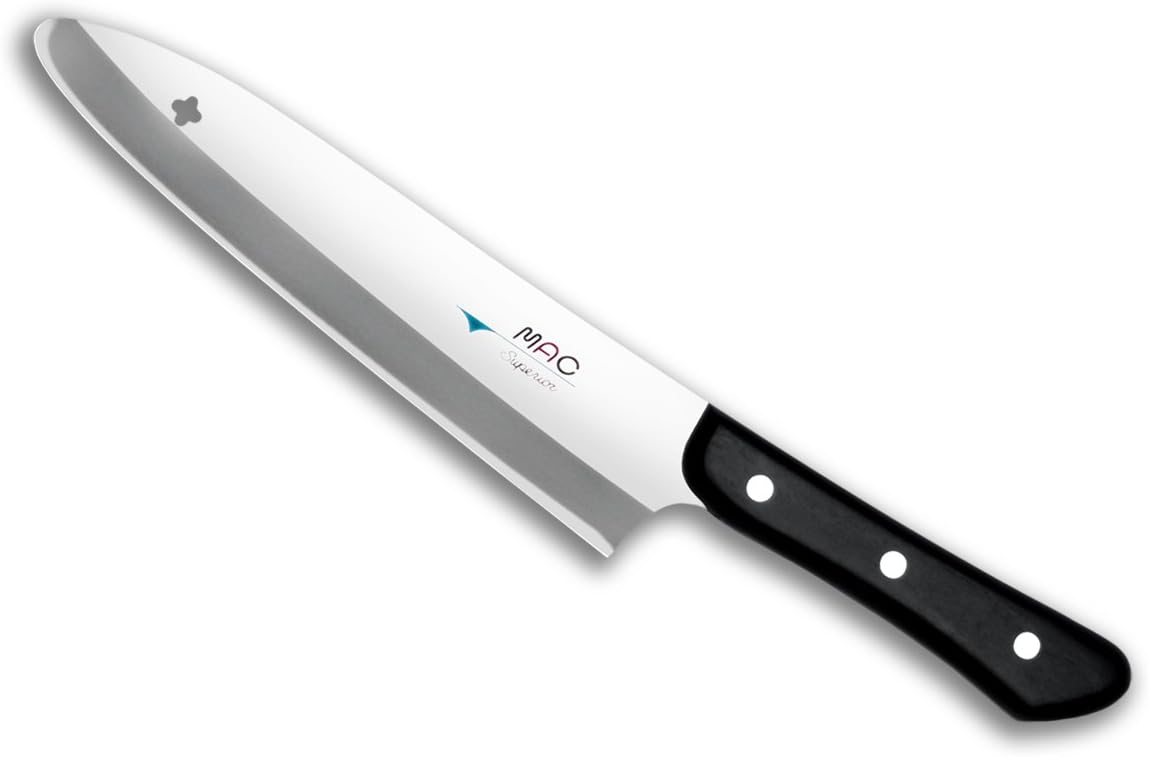
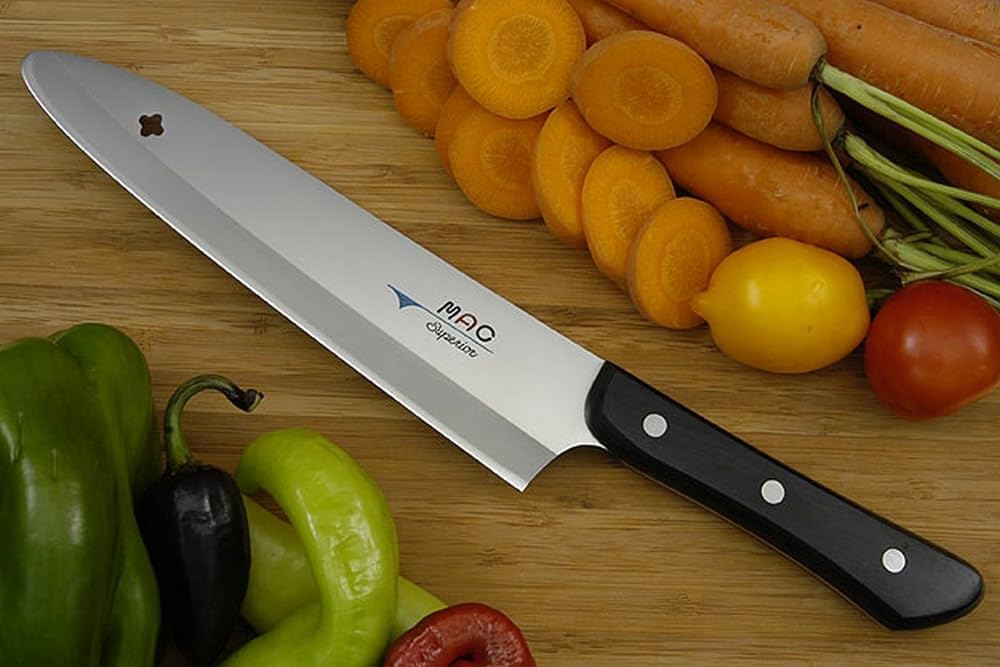
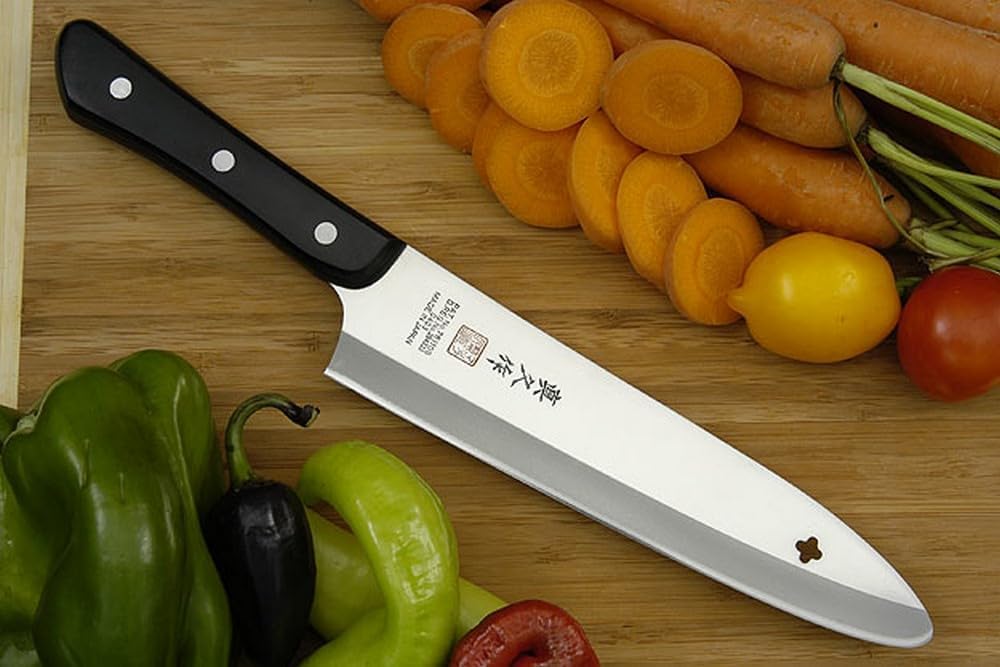
If you ask a roomful of Western professional cooks to name one affordable Japanese chef’s knife, the MAC MTH-80 comes up more than any other. It has been a long-standing top pick at Serious Eats and America’s Test Kitchen and the reason is simple: it does almost everything well. The blade is thin and laser-flat behind a ~15° edge, the proprietary MBR-26 molybdenum-vanadium steel takes a screaming edge and the knife is light enough (~187 g) that long prep sessions don’t wear out your wrist.
The “hollow edge” (the row of dimples) is genuinely useful, not marketing — it breaks the suction that makes starchy vegetables cling to a flat blade. The trade-off is honesty about looks: the MTH-80 is a plain working knife, not a showpiece. There is no Damascus pattern and the fit-and-finish, while good, is a notch below Shun. But on pure cutting performance per dollar, it is the one we hand to people who cook every day.
The Brand in Japan
MAC is something of a paradox: a Japanese maker (Mac Knife, established 1964) that is far better known abroad than at home. While Japanese home cooks gravitate to domestic supermarket and hardware-store brands, MAC built its reputation on the export professional market, where its thin molybdenum-steel blades earned a cult following in restaurant kitchens. In Japanese knife circles it is respected as a serious, no-nonsense maker rather than a fashionable one — which is exactly why the price stays reasonable.
Real-World Usage
For daily home cooking — onions, herbs, chicken, butternut squash — the MTH-80 is the knife that disappears in the hand. The thin grind glides through dense vegetables and the light weight makes fine work (mincing garlic, slicing scallions) effortless. It is not a chopping cleaver: avoid bones and frozen food. Treat it as a precision slicer-chopper and it rewards you for years.
Cooks who fall for that thinness tend to chase it further, the trail leading straight to Sakai. Ashi Hamono forges the laser-thin gyuto that other Sakai brands measure themselves against, starting around $300 in Ginsan stainless. Our Ashi Hamono brand guide explains what hand-forging adds once a machine-ground blade stops feeling like enough.
In daily use the strengths are clear. Outstanding out-of-box edge — arrives shaving-sharp and the thin geometry makes it feel even sharper than the number suggests. Light and agile — ~187 g with near-neutral balance reduces fatigue during long prep. Easy to maintain — the MBR-26 steel is slightly softer than VG-10, so it sharpens quickly on a basic whetstone.
The trade-offs are worth knowing before you buy. Plain looks — no Damascus pattern; this is a tool, not a trophy. Edge retention is good, not elite — the softer steel means you’ll touch it up a little sooner than the VG-10/VG-MAX blades.
One recurring line of praise in Amazon reviews: “I’ve owned mine for six years of daily home cooking. It still takes a brutal edge in two minutes on a whetstone. The dimples really do keep potatoes from sticking.” — Source: Amazon.com verified purchase
The most common criticism in Amazon reviews: “Performance is fantastic but it’s a boring-looking knife. If you want something pretty on a magnetic strip, this isn’t it.” — Source: r/chefknives
Anyone who cooks regularly and wants the best performance-per-dollar all-rounder. If you care more about how the knife cuts than how it looks, buy the MAC and stop researching.
Shun Classic 8″ — The Beautiful Damascus All-Rounder
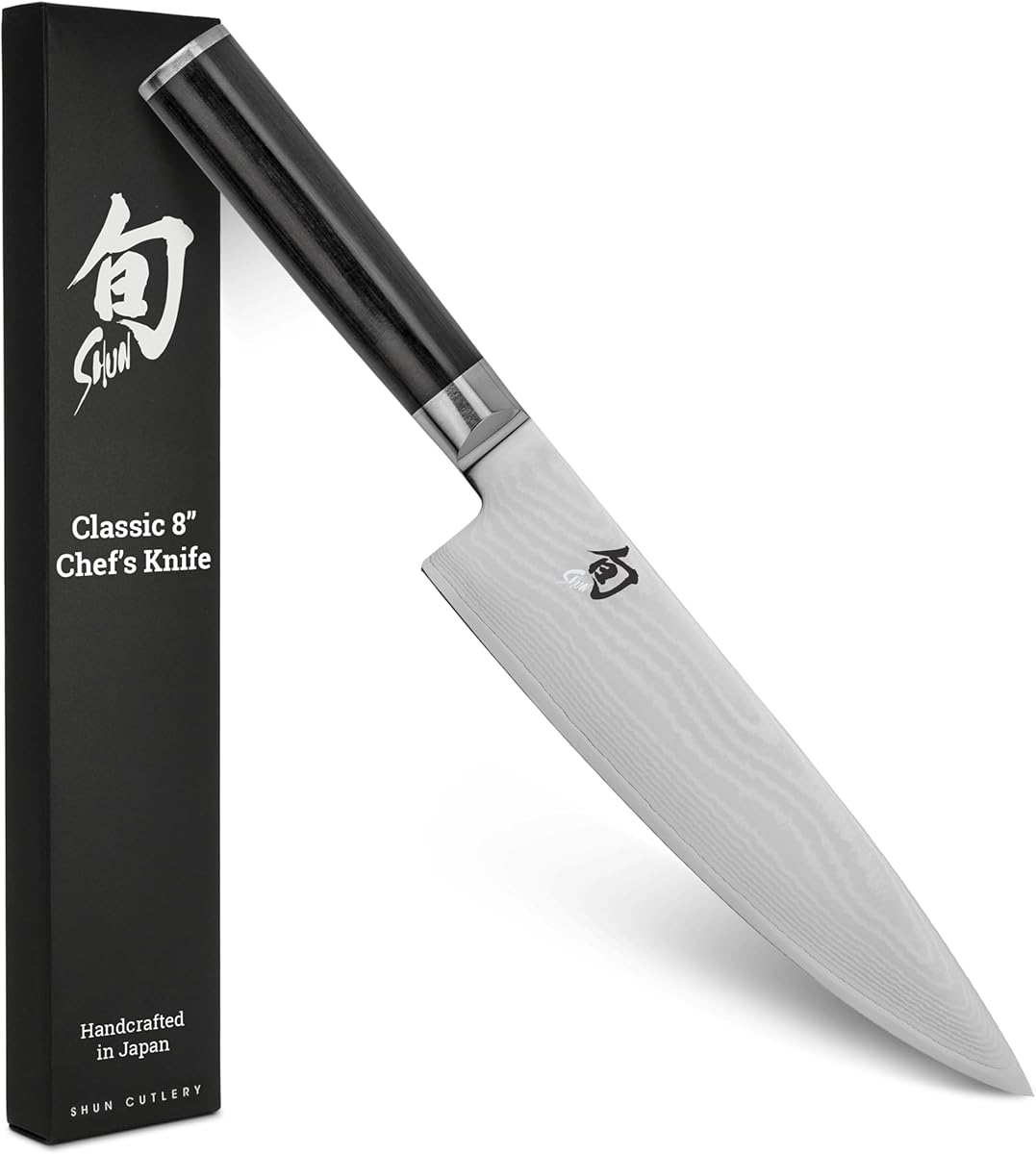
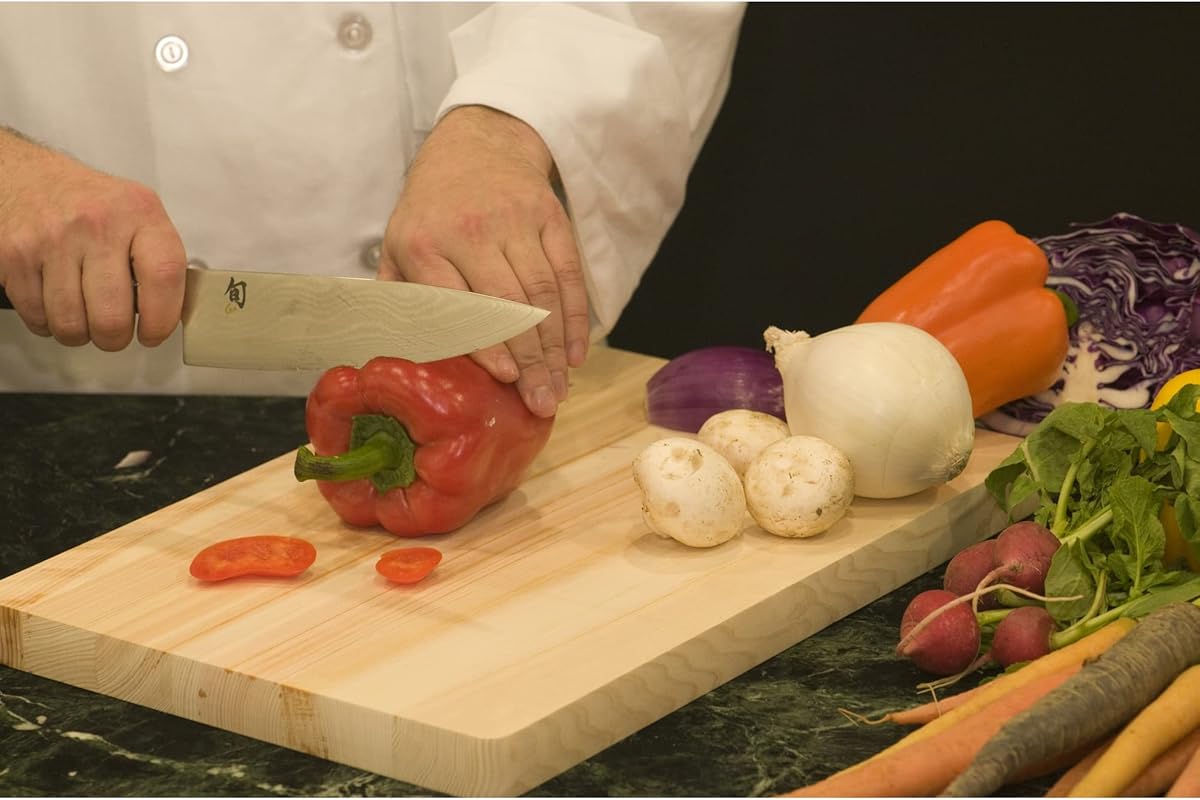
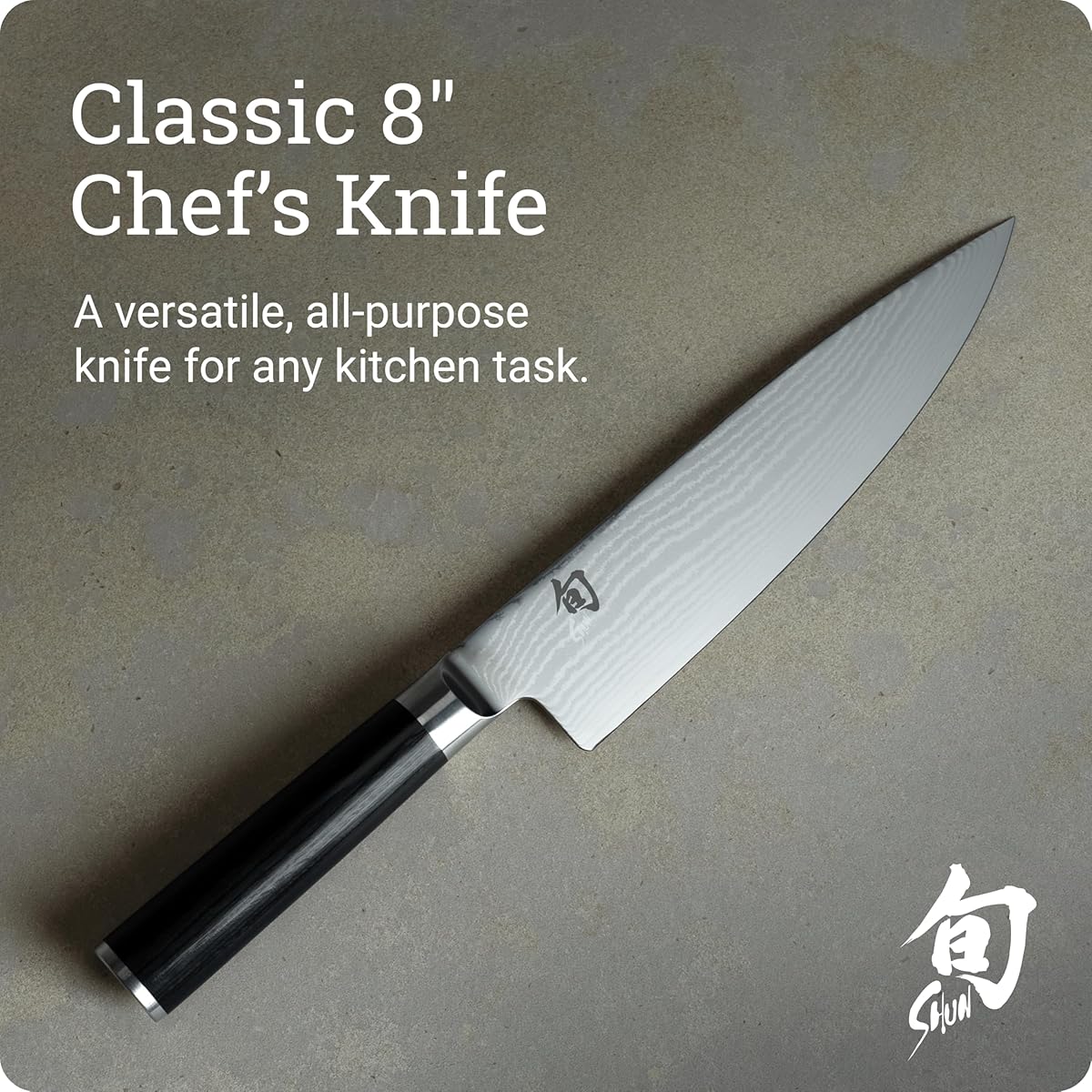
The Shun Classic is the knife most people picture when they hear “Japanese chef’s knife.” The 33-layer Damascus cladding over a hard VG-MAX core is genuinely beautiful and the D-shaped pakkawood handle is one of the most comfortable in the category for right-handed cooks. At ~16° per side it is a touch more obtuse than the MAC, which actually makes the edge slightly more durable for everyday use.
This is the knife to buy if you want the cutting performance of a quality Japanese blade and an object you enjoy looking at. The main caveats: the D-handle is optimized for right-handed users (left-handers should buy the dedicated left-handed version) and the harder VG-MAX steel is a little less forgiving to sharpen than the MAC. For the buyer who wants beauty plus a strong brand warranty, none of that is a deal-breaker.
The Brand in Japan
Shun is the premium export brand of Kai Corporation (貳削), one of Japan’s largest and oldest blade makers, based in Seki City, Gifu — the historic sword-and-blade capital. Kai is a true household name in Japan, but mostly for razors, grooming tools and its domestic Seki Magoroku kitchen line; the “Shun” (旬, meaning peak seasonal freshness) name is aimed squarely at overseas buyers. So while the steel and craftsmanship are unmistakably Seki, Japanese home cooks are more likely to own a Seki Magoroku than a Shun-badged knife.
The same Seki workshops also supply Shun’s closest competitor. Miyabi is Zwilling’s Japanese line, forged in Gifu with a more acute factory edge, usually undercutting the Shun Classic on price while looking near-identical on the shelf. We compared them directly in Miyabi vs Shun.
Real-World Usage
On the board the Shun feels planted and confident — slightly heavier than the MAC, with a comfortable rocking motion thanks to the curved belly. It excels at the everyday rotation of proteins and vegetables and looks superb on a magnetic strip. Hand-wash and dry it immediately; the Damascus finish and pakkawood handle do not belong in a dishwasher.
In daily use the strengths are clear. Stunning fit and finish — the Damascus cladding and polished spine are best-in-class at this price. Comfortable D-handle — ergonomic and secure for right-handed grips. Strong warranty & support — kai backs the Classic line with a lifetime warranty and free sharpening service in many regions.
The trade-offs are worth knowing before you buy. Right-hand-biased handle — left-handers need the separate left-handed SKU. Pricier per cut — you pay a premium for the Damascus look versus a plainer blade that cuts just as well.
One recurring line of praise in Amazon reviews: “Five years in and it still looks and cuts beautifully. The D-handle fits my hand perfectly and Kai re-sharpened it for free.” — Source: Amazon.com verified purchase
The most common criticism in Amazon reviews: “Gorgeous knife, but the hard steel chipped slightly when I hit a chicken bone. You have to respect it — it is not a Western beater knife.” — Source: Amazon.co.jp verified purchase
Right-handed cooks who want a knife that performs like a serious Japanese blade and looks like a piece of art — and who will hand-wash and care for it properly.
Tojiro DP 210mm — The Best-Value Gateway to VG-10
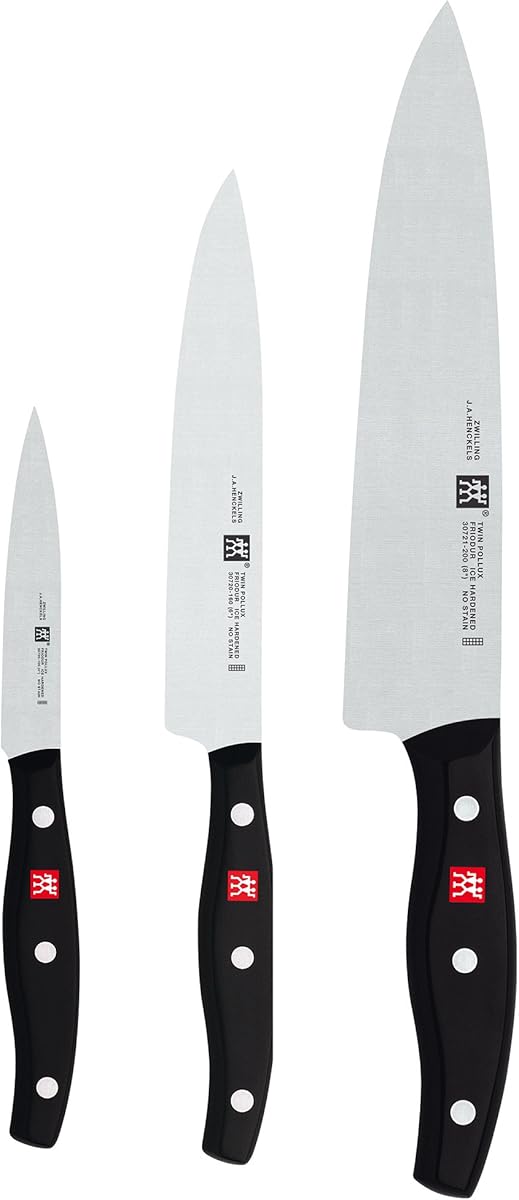
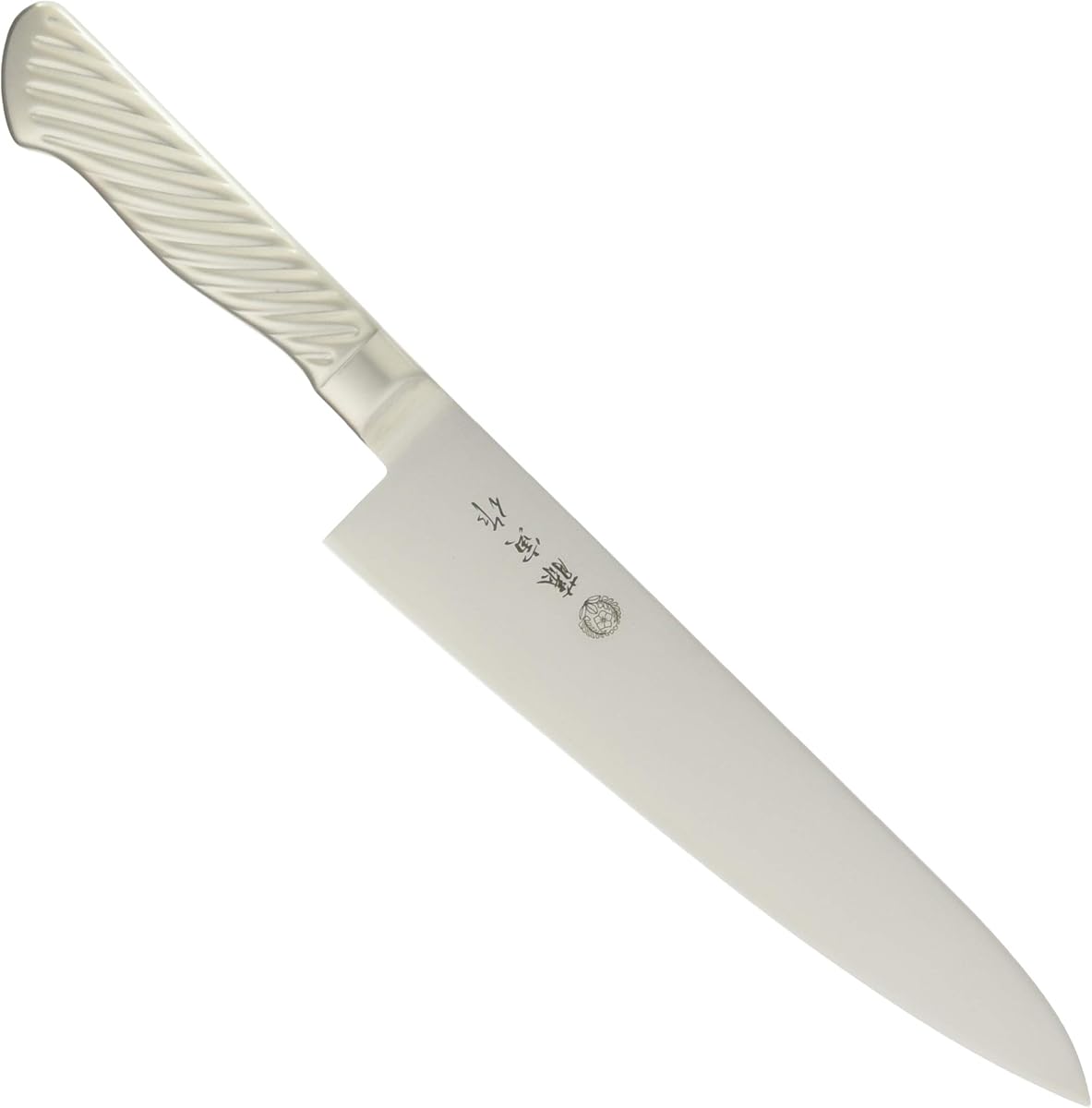

The Tojiro DP is the knife the Japanese-knife community recommends more than any other when someone asks “what’s a good first Japanese chef’s knife on a budget?” For around $80 you get a real VG-10 core — the same high-carbon stainless steel used in knives costing twice as much — with a stainless cladding and a no-frills Western handle. It is lighter than both rivals (~165 g) and sharpens easily.
What you give up at this price is refinement: the spine and choil are not rounded as nicely as the Shun, the handle is purely functional and the factory edge, while sharp, benefits from a quick whetstone touch-up out of the box. But as a do-everything workhorse that you won’t cry over if it gets nicked, the DP is unbeatable value — and a perfect knife to learn sharpening on.
The Brand in Japan
Tojiro (made by Fujitora Industry) is based in Tsubame-Sanjo, Niigata — Japan’s metalworking heartland. In Japan, Tojiro has a reputation as an honest, industrial-grade maker: not a luxury name, but the kind of dependable tool that culinary schools and working kitchens buy in bulk. The DP series in particular is a domestic and export staple, widely regarded as the benchmark for “serious knife, sensible price.”
Real-World Usage
The DP handles the entire weeknight rotation without complaint. The light weight suits cooks who find German knives clubby and the VG-10 edge holds up far better than any stainless knife in this price bracket. Because it is inexpensive, it is also the ideal knife to practice freehand whetstone sharpening on — mistakes here cost $80, not $300.
In daily use the strengths are clear. Real VG-10 for ~$80 — premium steel at an entry price; nothing else touches this value. Light and nimble — ~165 g makes it the most agile of the three. Guilt-free workhorse — great everyday performer and the best knife to learn sharpening on.
The trade-offs are worth knowing before you buy. Basic finishing — the spine/choil aren’t rounded and the handle is purely functional. Factory edge is good, not great — a two-minute whetstone touch-up unlocks its real potential.
One recurring line of praise in Amazon reviews: “My first real Japanese knife. I cannot believe this is VG-10 at this price. After one pass on a whetstone it out-cuts knives I paid triple for.” — Source: Amazon.com verified purchase
The most common criticism in Amazon reviews: “The cutting is excellent for the money, but the handle and spine feel cheap compared to a Shun. It’s a working tool, not a luxury.” — Source: Amazon.co.jp verified purchase
Beginners, students and anyone who wants genuine VG-10 performance without spending much — or a second knife they can treat as a daily beater. Pair it with a beginner whetstone and you have a complete setup for under $130.
How to Choose — A 30-Second Decision Tree
- “I just want the best all-round cutter” → MAC MTH-80. Buy it and stop reading.
- “I want it to be beautiful and I’m right-handed” → Shun Classic 8″.
- “I’m on a budget or it’s my first Japanese knife” → Tojiro DP 210mm.
- “I’m left-handed” → the MAC and Tojiro are symmetrical and fine; for the Shun, buy the dedicated left-handed version.
- “I chop bones or frozen food” → none of these — keep a cheap Western knife for that and use these for everything else.
🏆 Verdict — Overall Ranking
#1 – MAC MTH-80 Professional The best balance of edge, weight, ease of sharpening and price. It is the knife we recommend to the most people because it makes the fewest compromises — a true professional standard that happens to be affordable. Check price on Amazon →
#2 Shun Classic 8″ — Best premium pick — buy it for beauty plus performance (right-handed). Check price on Amazon →
#3 Tojiro DP 210mm — Best value — real VG-10 and the perfect first Japanese knife. Check price on Amazon →
Summary & Recommendation
- Best overall — MAC MTH-80: the smartest single buy for most cooks; pro performance at a fair price.
- Best premium — Shun Classic 8″: buy it for the Damascus beauty and D-handle comfort (right-handed).
- Best value — Tojiro DP 210mm: real VG-10 for ~$80 and the ideal first Japanese knife.
Whichever you choose, add a basic Japanese whetstone and follow proper knife care — a maintained $80 Tojiro out-cuts a neglected $300 blade every time.
Editor’s pick: MAC MTH-80 Professional
Table of Contents
- Why Japanese Knives Dominate the Premium Tier
- The Four Buying Tiers (And Which You Actually Need)
- Shape: Gyuto, Santoku, Nakiri, Bunka, and More
- Steel: Why It Matters More Than You Think
- Regional Differences: Sakai, Seki, Echizen, Niigata
- Tier-by-Tier Recommendations
- The Mistakes Most US Buyers Make
- Where to Buy: Amazon US vs Japanese Sources
1. Why Japanese Knives Dominate the Premium Tier
Three structural advantages explain why a $250 Japanese knife often outperforms a $400 German one:
Sharper edge angle
German knives (Wüsthof, Henckels) traditionally use a 20° edge angle per side. Japanese knives use 15° or less, sometimes as low as 10° on yanagiba. The thinner edge cuts with less force and produces cleaner slices.
Harder steel
Standard Western knives use steel around HRC 56-58 (Rockwell Hardness). Japanese knives commonly reach HRC 60-64, with high-end SG2 and ZDP-189 hitting HRC 64-66. Harder steel holds an edge longer—at the trade-off of being more prone to chipping if abused.
Specialized geometry
Japanese smiths have refined dozens of distinct blade shapes for specific tasks: gyuto for general use, sujihiki for slicing, deba for fish butchery, nakiri for vegetables, yanagiba for sashimi. Western kitchens use 2-3 shapes; serious Japanese kitchens use 5-10.
Key Japanese-source insight: 包丁の世界 blog notes that 90% of professional Japanese chefs own at least 4 specialized knives. US home cooks tend to buy a single $300 gyuto and stop there—a missed opportunity.
2. The Four Buying Tiers (And Which You Actually Need)
| Tier | Price Range | Use Case | Example Brands |
|---|---|---|---|
| Entry | $30-100 | First Japanese knife / kitchen exposure | Tojiro DP, Mac HB, Victorinox |
| Mid | $100-250 | Daily home cook / serious enthusiast | Shun Classic, Misono UX10, Tojiro Shirogami |
| Premium | $250-500 | Knife geek / aspiring professional | Konosuke HD2, Hatsukokoro Kumokage, Yoshikane SKD |
| Top | $500-1500+ | Professional / collector | Sukenari R2, Ashi Hamono Ginga, Custom forge |
Our pick: Tojiro DP F-808 Gyuto 210mm
The honest truth from Japanese forums
On 5ch’s 包丁スレッド and the 趣味の包丁 community, the consensus is clear:
- 90% of home cooks should stop at Mid tier ($100-250). Returns diminish dramatically above $300.
- Premium tier (Konosuke, Hatsukokoro) is for enthusiasts who appreciate steel choice, handle ergonomics, and brand stories—not for incremental cutting performance.
- Top tier is essentially jewelry—beautiful, hand-forged, but not measurably better than $300 knives in actual use.
If you’re new to Japanese knives, the Mid tier is where 80% of value lives.
3. Shape: Gyuto, Santoku, Nakiri, Bunka, and More
Gyuto (牛刀) — The Japanese Chef Knife
What it is: A Japanese take on the Western chef knife. 200-240mm long, curved belly for rocking, pointed tip for piercing.
Who it’s for: Almost everyone. If you’re buying one Japanese knife, make it a gyuto.
Why it’s popular: Versatile enough for meat, vegetables, fish, herbs. Familiar enough for Western cooks transitioning from a chef knife.
Top picks (this guide’s detailed reviews):
– Entry: Tojiro DP F-808 Gyuto 210mm ($85) — see our Tojiro DP review
– Mid: Misono UX10 210mm ($300) — see our Misono review
– Premium: Konosuke HD2 240mm ($450) — see our Konosuke guide
Santoku (三徳) — The Three-Virtue Knife
What it is: Shorter (160-180mm), flatter blade with a “sheepsfoot” tip. The name means “three virtues”—designed for meat, fish, and vegetables equally.
Who it’s for: Smaller hands, smaller cutting boards, cooks who prefer push-cutting over rocking.
Why it matters: In Japan, santoku is the default home kitchen knife. Most Japanese kitchens have a santoku, not a gyuto.
Cultural note: Many US reviewers call santoku “the wrong choice”—but in Japanese culinary tradition, santoku is the everyday workhorse, gyuto is the specialized tool.
Nakiri (菜切) — The Vegetable Knife
What it is: A rectangular blade designed for vegetables. Flat edge for clean cuts on cutting boards, height for knuckle clearance.
Who it’s for: Heavy vegetable choppers (vegetarian/vegan cooks), Asian cuisine specialists.
Trend in 2026: Nakiri demand has spiked in the US thanks to plant-based cooking. Japanese forums report increasing US/EU export demand.
The board matters more for a nakiri than for any other shape here, because the whole flat edge lands at once rather than rolling through a curve. That is the case for Japanese cypress, the soft wood these knives were designed around — our comparison of the best hinoki cutting boards covers what to buy and how to keep one from warping.
Bunka (文化) — The Modern Hybrid
What it is: A relatively modern shape combining gyuto’s pointed tip with santoku’s flatter profile. The name means “culture” or “civilization.”
Who it’s for: Knife enthusiasts wanting one knife that does it all with slightly more precision than santoku.
Specialty Shapes
- Yanagiba (柳刃): Single-bevel slicer for sashimi. ~270-300mm long, extremely thin edge.
- Deba (出刃): Heavy single-bevel for fish butchery (cutting through fish bones).
- Sujihiki (筋引): Double-bevel slicer for meat (alternative to yanagiba for non-sushi work).
- Petty (ペティ): Small utility knife (120-150mm).
For most US home cooks, gyuto + petty covers 90% of needs. Add a nakiri if you cook lots of vegetables.
4. Steel: Why It Matters More Than You Think
Steel choice affects four things: sharpness retention, ease of sharpening, corrosion resistance, and brittleness. Here’s what matters in 2026.
Stainless steels (low maintenance)
| Steel | Hardness | Edge Retention | Sharpening Ease | Notes |
|---|---|---|---|---|
| VG-10 | HRC 60 | Good | Easy | Most common Japanese stainless. Shun’s bread and butter. |
| AUS-10 | HRC 59 | Decent | Easy | Tojiro DP uses this. Excellent value. |
| SG2 / R2 | HRC 63 | Excellent | Moderate | Powder metallurgy steel. Premium choice. |
| VG-Max | HRC 61 | Very Good | Moderate | Improved VG-10. Used by Shun Premier. |
| HAP40 | HRC 65 | Excellent | Hard | Powder steel. Holds edge forever, hard to sharpen. |
Carbon steels (high maintenance, sharper)
| Steel | Hardness | Edge Retention | Patina | Notes |
|---|---|---|---|---|
| Shirogami #1/#2 (White Steel) | HRC 62-64 | Very Good | Yes | Easy to sharpen, super sharp, rusts fast. |
| Aogami #1/#2 (Blue Steel) | HRC 62-65 | Excellent | Yes | Tungsten-added blue paper steel. Retains edge longer than white. |
| Aogami Super | HRC 65-66 | Outstanding | Yes | Premium carbon steel. Top-tier sharpness. |
Japanese forum wisdom: “Carbon steel knives are for people who enjoy maintaining knives. Stainless is for people who enjoy cooking.” — recurring sentiment on 5ch.
What should you buy?
- First Japanese knife: Stainless (VG-10 or AUS-10). Easy to maintain, modern dishwasher-resistant.
- Second knife / enthusiast: Try SG2 or HAP40 for maximum edge retention.
- For sharpening lovers: Try shirogami or aogami carbon steel. You’ll fall in love with how sharp it gets.
5. Regional Differences: Sakai, Seki, Echizen, Niigata
Four major Japanese knife regions, each with its own character. Most US buyers don’t know this matters.
Sakai (堺) — Osaka prefecture
Specialty: Traditional single-bevel knives (yanagiba, deba, usuba). Hand-forged carbon steel.
Famous brands: Sakai Takayuki, Konosuke (made by Sakai smiths), Yoshihiro, Sukenari
Character: Old-world craftsmanship. Most professional sushi knives come from here.
Seki (関) — Gifu prefecture
Specialty: Stainless steel knives, machine-assisted production. Higher volume.
Famous brands: Kai (Shun), Misono, Tojiro (some lines), Mac
Character: Modern engineering meets traditional knife-making. Excellent for double-bevel home cooking knives.
Echizen (越前) — Fukui prefecture
Specialty: Layered Damascus knives, machine-forged then hand-finished. Strong “everyday workhorse” reputation.
Famous brands: Yoshikane, Takamura, Ryusen
Character: Mid-priced, high-quality. Particularly strong in SKD (Sukenari uses different steels) and SG2 stainless.
Niigata (新潟) — Tsubame-Sanjō area
Specialty: Industrial knife manufacturing, OEM production. Mass-market focus.
Famous brands: Tojiro (main factory), Yaxell, Global (Tsubame)
Character: Best mid-priced knives by value. Tojiro DP is the world’s best-selling Japanese chef knife.
Why this matters
A “Japanese knife” from Sakai feels totally different from one from Seki. Sakai = handmade soul, Seki = engineered precision, Echizen = balanced everyday, Niigata = value workhorse.
When you read a review that says “the best Japanese knife”—ask yourself, from which region?
If you want the region story in full, our Sakai vs Seki vs Echizen breakdown goes deeper on each forge town.
6. Tier-by-Tier Recommendations
Best Entry Gyuto (Under $100)
Tojiro DP F-808 Gyuto 210mm — ~$85
The world’s most-sold Japanese chef knife, and for good reason. AUS-8 stainless core clad in soft stainless, 210mm length, plastic handle that’s surprisingly durable. Japanese forums universally recommend this as the “starter gyuto.”
Check Tojiro DP F-808 on Amazon US | Read our full Tojiro DP review
Honorable mention: Mac HB-85 Gyuto ($95) — Japanese forums note Mac knives often outperform their price. The HB-85 is Mac’s flagship value gyuto.
Best Mid Gyuto ($100-250)
Misono UX10 Gyuto 210mm — ~$300
Despite the price, Misono UX10 is the “default professional kitchen knife” across Japan. Sweden imported steel (uniquely produced for Misono), perfectly balanced, classic Western handle. Japanese chefs in Tokyo restaurants often cite it as their daily driver.
Check Misono UX10 on Amazon US | Read our full Misono review
Honorable mention: Tojiro Shirogami (White Steel) Gyuto ($150) — for those wanting carbon steel without breaking the bank.
Best Premium Gyuto ($250-500)
Konosuke HD2 Gyuto 240mm — ~$450
This is where things get interesting. Konosuke is not a forging operation—it’s a brand that commissions knives from Sakai’s best smiths. The HD2 line uses HD2 stainless (semi-stainless, harder than typical SUS), with extraordinary edge retention and the famous Konosuke thinness. Japanese forums consider this the “best home cook knife under $500.”
Konosuke HD2 is not sold on Amazon US as of this update — look for it at specialty Japanese knife retailers. | Read our full Konosuke guide
Honorable mention: Hatsukokoro Kumokage Aogami Super ($380) — for carbon-steel lovers wanting hand-forged Sakai craftsmanship.
Best Top-Tier Gyuto ($500+)
Sukenari R2 Damascus Gyuto 240mm — ~$650
R2 powder metallurgy steel (HRC 63-64) in a 33-layer Damascus pattern. Sukenari is one of the few brands that does its own steel work end-to-end. For a mid-range Damascus option, our Yaxell brand guide explains where it fits. Edge retention is virtually unmatched at this price.
Sukenari knives are not sold on Amazon US as of this update — look for them at specialty Japanese knife retailers.
Powder steel is the whole reason to chase the brand down. Sukenari mills R2, ZDP-189, HAP40 into blades that hold an edge at HRC 63-66 — far past anything VG-10 can manage — as one of the few Sakai operations doing its own steel work. Our Sukenari brand guide explains which of those steels is worth the sharpening trade-off.
Honorable mention: Ashi Hamono Ginga Honyaki Shirogami ($750) — for purists wanting traditional single-piece carbon steel forging.
Ashi Hamono is the name other Sakai brands quietly respect: a family forging house that makes blades for the labels that only commission them. The Ginga line starts nearer $300 in Ginsan stainless — well below the honyaki above — which makes it a far more realistic entry point. Our Ashi Hamono brand guide shows where to step into the range.
7. The Mistakes Most US Buyers Make
Reading dozens of Japanese forum threads about Western buyers, three patterns emerge:
Mistake 1: Overbuying at first
The most common Japanese-forum complaint: “Western buyers spend $400 on first knife, can’t sharpen it properly, ruin the edge, and quit.” Start with Tojiro DP. Learn to maintain a knife. Then upgrade.
Mistake 2: Ignoring the handle
US reviewers obsess over steel and brand. Japanese reviewers spend equal time on handle (柄):
– Wa handle (Japanese style): Octagonal or D-shaped. Lighter, more agile, requires getting used to.
– Yo handle (Western style): Riveted, three-pin construction. Heavier, balanced more forward.
If you’re transitioning from Western knives, Yo handle first. Then try wa handle on knife #2.
Mistake 3: Buying a santoku as “main knife”
Santoku is the Japanese home default, but it’s not always the right “main knife” for Western cooking. If you cook lots of red meat, do whole-roast prep, or work with large cuts—get a gyuto, not a santoku. Santoku excels at vegetable-forward cooking.
Mistake 4: Skipping the whetstone
A Japanese knife without proper sharpening is a Western knife with a worse handle. Plan to buy a whetstone (we recommend the Shapton Glass HR 1000 grit for first-time sharpeners) within 6 months of getting your knife.
Mistake 5: Buying carbon steel without commitment
Carbon steel (shirogami, aogami) needs care: wipe dry immediately, oil monthly, sharpen frequently. If you ever leave knives wet in the sink—stick with stainless.
Conclusion: How to Buy Your First Japanese Knife in 2026
- Budget $80-300 for first knife. Don’t overbuy.
- Pick gyuto if Western cuisine, santoku if Asian cuisine.
- Choose stainless (VG-10 or AUS-10) for low maintenance.
- Buy a whetstone within 6 months.
- From Amazon US: Tojiro DP F-808 ($85) or Misono UX10 ($300).
- From Hocho-Knife: Konosuke HD2 ($450) if you want premium.
After 6 months with your first knife, you’ll know whether to:
– Stop here (great call)
– Add a petty knife ($60-150)
– Add a specialized knife (nakiri, yanagiba, sujihiki)
– Upgrade to a premium gyuto ($300-500)
The Japanese knife world is deep—but you don’t need to dive deep on day one.
Editor’s pick: Tojiro DP F-808 Gyuto 210mm
Frequently Asked Questions
Q.What steel is best for Japanese kitchen knives?
A.For home cooks: VG-10 stainless (used by MAC and Shun’s entry line) — holds edge well, resists rust, easy to sharpen. For serious cooks: Blue Steel #2 (Aogami #2) — takes sharper edge but requires more care. For beginners: German-style stainless (Global uses Cromova 18) — tougher, more forgiving, but not as sharp.
Q.How often should we sharpen our Japanese kitchen knife?
A.With regular home use (cooking 5-7 days/week), hone on a ceramic rod every 1-2 uses and sharpen on a whetstone every 3-6 months. Japanese knives are harder (HRC 60+) and require less frequent sharpening than German knives but need more careful technique — avoid steel honing rods.
Q.Can Japanese knives go in the dishwasher?
A.Never. Japanese kitchen knives should be hand-washed and dried immediately. Dishwashers cause thermal shock, chemical damage to the edge, and handle damage. This applies to all the knives in this comparison — Shun, Global, and MAC all specify hand-wash only.
Q.What’s the difference between a gyuto and a chef’s knife?
A.A gyuto is a Japanese double-bevel knife designed for Western-style cooking (like slicing proteins). It’s the Japanese equivalent of a chef’s knife but typically lighter, thinner, and harder. The edge angle is 15-16° vs 20-25° for German chef’s knives — sharper but more fragile on hard bones.
Q.Is a Japanese knife worth it for a home cook?
A.Yes, if you cook regularly. A MAC MTH-80 or Global G-2 makes vegetable prep noticeably faster and more pleasant due to reduced hand fatigue (lighter weight) and better precision. The payoff is obvious within a week of daily use. Start with MAC if you’re new to Japanese knives — most forgiving of Western habits.
Knife Deep Specs Comparison
| Knife | Steel | Hardness (HRC) | Blade length | Weight | Edge angle (per side) | Handle |
|---|---|---|---|---|---|---|
| Shun Classic Santoku 7″ | VG-MAX (clad) | 61 HRC | 178 mm | 177 g | 16 deg | Pakkawood D-shape |
| Global G-2 Chef’s 8″ | CROMOVA 18 | 56-58 HRC | 200 mm | 198 g | 15 deg | Stainless one-piece |
| MAC MTH-80 Chef’s 8″ | Custom MAC steel | 59-61 HRC | 200 mm | 187 g | 15 deg | Pakkawood Western |
| Tojiro DP F-808 Gyuto 8″ | VG-10 (clad) | 60 HRC | 210 mm | 170 g | 16 deg | Pakkawood Western |
HRC (Rockwell C hardness) is the single most important spec for understanding edge-retention and care. Below 56 HRC the steel dulls fast but is tough. Above 62 HRC the edge holds for weeks but the blade can chip on bone. Japanese kitchen knives target 58-62 HRC, which is the sweet spot for daily home cooking.
Editor’s pick for first Japanese knife: Buy the Shun Classic 7-inch Santoku on Amazon (US) — the most forgiving balance of edge, weight, and beauty for a beginner.
Pick Your Knife by Cooking Style
For the home cook who chops vegetables daily and protein 3x a week
Shun Classic Santoku 7-inch. The 178 mm length handles every vegetable from a daikon to a tomato. The 16-degree edge angle is forgiving for occasional users who do not sharpen weekly. Check the latest price on Amazon.
For the dedicated home cook who wants one knife for everything
MAC MTH-80 Chef’s 8-inch. The 200 mm length handles a whole chicken with comfortable rocking. MAC’s edge geometry is sharper than Shun out of the box but slightly less robust at the tip. View on Amazon (US).
For the dishwasher-running cook (please don’t, but)
Global G-2. The seamless stainless body has no wood handle to crack and no riveted joints to corrode. Hand-washing is still strongly recommended; even Global degrades in dishwashers. Available on Amazon.
For the budget-conscious first-time buyer
Tojiro DP F-808 Gyuto. About $100 versus $200+ for Shun, with VG-10 steel that competes directly with Shun’s VG-MAX. The pakkawood handle is plain but functional. Buy on Amazon.
For the aspiring sushi or sashimi cook
None of the above. You want a yanagiba (single-bevel sashimi knife) by Yoshihiro or Sakai Takayuki. The double-bevel knives in this guide are gyuto/santoku — Western-style for general cooking. The yanagiba is a specialist tool for slicing raw fish.
Sakai Takayuki is the easiest place to start that search. It is the largest brand in the old Osaka forge town, with a range that runs from an $80 Tokujou carbon blade up to a $2,000 honyaki — one name covering both a first yanagiba and a lifetime one. Our Sakai Takayuki brand guide maps the lines so you can tell a Tokujou from a Hongasumi before you pay.
Knife Care: How to Make It Last 30 Years
A Japanese kitchen knife properly cared for outlives the cook. Our great-uncle’s Sakai-made deba is still in use 60 years after purchase. To get there:
Daily care
- Hand wash with mild soap. Hot water is fine; dishwashers destroy edges and crack pakkawood handles.
- Dry immediately. Even stainless cladding (over a high-carbon core) can rust on the exposed core if left wet. Wipe with a cotton towel after washing.
- Store on a magnetic strip or in a sheath. Tossing knives in a drawer rounds the edge in days. A wall magnet or a saya (wooden sheath) protects both the blade and your fingers.
Weekly care
- Hone with a ceramic rod. 10 strokes per side at 15-16 degrees realigns micro-rolled edges. Steel honing rods (Western style) are too aggressive for high-HRC Japanese knives.
Monthly to quarterly care
- Sharpen on whetstones. A 1000-grit Japanese whetstone (King brand) is the home cook standard. Soak the stone for 10 minutes, sharpen at 15 degrees per side. Finish on 5000+ grit if you want a polished edge.
- Inspect for chips. Small chips at the tip can be polished out on a coarse stone (220 grit). Larger chips need a professional regrind.
Annual care
- Oil pakkawood handles lightly. A drop of mineral oil prevents handle drying. Avoid food oils which go rancid.
- Consider professional sharpening. A skilled sharpener can restore the original edge geometry better than home stones. Korin Japanese Trading in NYC and Hida Tool in Berkeley both offer mail-in sharpening for $20-40 per knife.
Japanese Knife Making: A Brief History
Japanese blade craft descends from sword making. When the Meiji-era ban on private sword ownership came in 1876, the swordsmiths of Sakai (Osaka) and Seki (Gifu) pivoted to kitchen knives. Both cities remain knife capitals today: Sakai for hand-forged single-bevel traditional knives, Seki for mass-produced precision blades.
The post-war era brought the rise of stainless steels (Molybdenum-vanadium combinations like VG-10, AUS-10) which combined high hardness with rust resistance. This made Japanese knives accessible to home cooks for the first time, since pre-war high-carbon blades demanded daily oiling.
Shun (Kai Group) launched the Classic line in 2002 specifically for the Western export market. It introduced the now-ubiquitous Damascus pattern and pakkawood D-shaped handle to the global home-cook market. Shun’s engineering team in Seki uses the same forging traditions as the Seki sword school.
Global, founded in 1985 by Yoshikin in Niigata, took a different path: an entirely seamless stainless design with the dimpled handle. It became the chef’s-coat status symbol in the 1990s and 2000s. The Yoshikin factory remains in Niigata and produces every Global knife by hand-finishing.
MAC, founded in 1964, is a Seki brand with little name recognition outside professional kitchens but a deep cult following. Cook’s Illustrated has rated the MTH-80 their top pick across multiple decades, which has been the slow-burn driver of MAC’s home-cook market share in the US.
Tojiro represents the value end of Japanese craft: VG-10 cladded blades in the under-$120 range that compete with knives twice the price. Tojiro is sold throughout Japan at any kitchen supplier and is considered the workhorse “starter knife” by Japanese cooking schools.
Buying Japanese Kitchen Knives From the US
- Authorized retailers. Shun, Global, and MAC are all sold on Amazon US directly by the manufacturer or authorized distributors. Avoid third-party sellers for these — counterfeits exist.
- Tojiro and other Japan-domestic brands. JetPens, Korin (NYC), Hida Tool (Berkeley), and Knifewear (Canada-based but ships US) are reliable. Amazon US carries some Tojiro but with thinner selection.
- Sharpening service. Korin and Hida Tool both accept mail-in sharpening. Cost is $20-40 per knife including return shipping. A worth-it expense once a year.
- Customs. Knives ship freely from Japan to the US with no extra customs paperwork below $800 retail value. Larger orders may require import declarations.
- Warranty. Shun and Global both offer lifetime warranties for manufacturing defects (not edge wear). Tojiro warranty is Japan-only; Amazon US handles returns.
Knife FAQ: 7 More Questions
Q1. Santoku vs gyuto — which is better for a home cook?
Santoku (170-180 mm) for a primarily-vegetable cook with a small board. Gyuto (200-240 mm) for a more meat-heavy cook with full-size board and a rocking chop motion. Both are versatile.
If you would rather not choose between the two shapes at all, a matched block answers the question by handing you both plus a petty, often for less than two singles cost separately. We compared the three sets US buyers actually meet on the shelf in our best Japanese knife set guide, including what each block quietly leaves out.
Q2. Is the Damascus pattern on Shun knives just decoration?
Yes and no. The pattern comes from the layered cladding (often 32-68 layers of softer stainless wrapped around a hard VG-MAX core). The cladding does serve a function — it protects the brittle core — but the visible pattern is cosmetic.
Q3. Can we sharpen a Japanese knife on a Western pull-through sharpener?
Possible but not ideal. Pull-through sharpeners are set for 20-degree Western edges; Japanese knives are 15-16 degrees. Use a whetstone instead.
Q4. How often should we sharpen?
For a home cook using the knife daily: a quick honing (ceramic rod) once a week, full whetstone sharpening every 1-3 months. Professional cooks sharpen every 1-2 weeks.
Q5. What’s the difference between VG-10 and VG-MAX?
VG-MAX is Shun’s proprietary upgrade of VG-10 with slightly more cobalt and tungsten for better edge retention at the same hardness. In practice the difference is small but VG-MAX holds an edge maybe 10-20% longer.
Q6. Are wooden cutting boards required?
Strongly recommended. Plastic boards are fine but glass, marble, or bamboo (despite the marketing) damage Japanese knife edges quickly because the surface is harder than the cutting steel.
Q7. Is there a knife we shouldn’t buy as a beginner?
Avoid pure single-bevel Japanese knives (deba, usuba, yanagiba) for general use. They are specialist tools that require single-side sharpening technique. Stick to double-bevel santoku or gyuto for your first 3-5 years.
Buy the Shun Classic 7″ Santoku on Amazon (US) | Global G-2 8″ Chef’s on Amazon (US) | MAC MTH-80 8″ Chef’s on Amazon (US) | Tojiro DP F-808 8″ Gyuto on Amazon (US)
You Might Also Like
References
- MAC Knife — About Us (company history) — Official source, accessed May 2026
- Global (cutlery) — Wikipedia — Komin Yamada / Yoshikin Niigata 1985 design history, accessed May 2026
- Shun Classic 8″ Chef’s Knife — Shun Cutlery (KAI USA) — Official spec for VG-MAX core and 68-layer Damascus cladding, accessed May 2026
- Haitō Edict — Wikipedia — 1876 sword ban, transition of swordsmiths to kitchen-knife production in Sakai and Seki, accessed May 2026
- Cook’s Illustrated — MAC MTH-80 has been the publication’s top chef-knife pick since 2013, accessed May 2026
Fact-checked on May 6, 2026. Some statements have been updated based on current information.
Related Knives Guides (2026 Editorial Focus)
As vs-navi.online has refocused on Japanese knives in 2026, here are the deepest related guides on this site:
- The Ultimate Japanese Knife Buying Guide 2026
- Gyuto vs Santoku 2026
- Bunka vs Santoku 2026
- Petty Knife: The Underrated Japanese Utility
- Tojiro Knife Guide 2026: Beyond the DP Line
- Yaxell Knife Guide 2026
- Japanese Knife Care: Complete Maintenance Guide
All linked guides were compiled by an editorial team that tracks the Japanese knife market.
ピンバック: Best Japanese Rice Cookers Under $100 in 2025 | VS-NAVI
ピンバック: Best Japanese Green Tea 2025: Ito En vs Yamamotoyama vs Harney & Sons | VS-NAVI