vs-navi.online is a participant in the Amazon Services LLC Associates Program. Purchases made through links on this page may earn us a commission at no extra cost to you.
Picture a board of scallions. One knife rocks on its curved belly, tip resting on the wood. The other glides forward in long flat strokes, its angled point slipping into the last thin slices. Both are Japanese chef’s knives. They just ask your hand to move differently.
That is the whole kiritsuke vs gyuto debate. The gyuto is the all-round Japanese chef’s knife. The kiritsuke is its flatter, sharper-pointed cousin, with a reputation in Japan as the knife of the head chef.
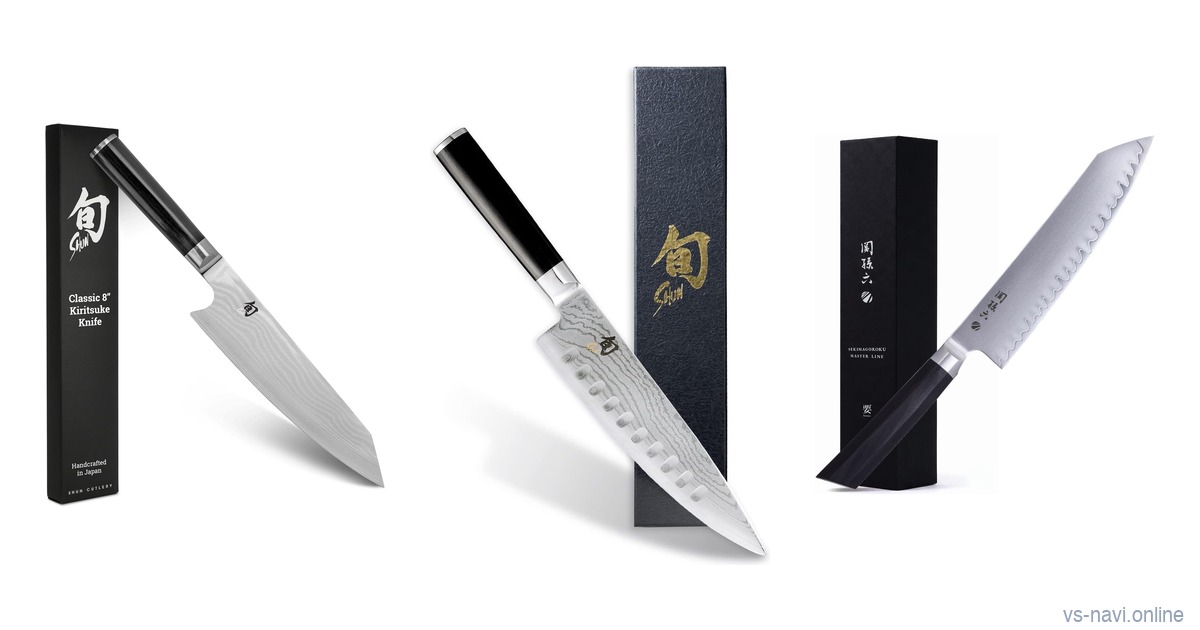
To keep the comparison honest, we compared two knives from the same line: the Shun Classic 8-inch Kiritsuke and the Shun Classic 8-inch Chef’s Knife. Same steel, same handle, same price. Only the shape changes. We added a lower-cost kiritsuke from Shun’s parent company Kai. Everything below is based on manufacturer specifications, the brands’ own product imagery and current Amazon.com listing data.
Kiritsuke or Gyuto? Our Picks for 2026
The short version, before the detail:
- Shun Classic 8″ Chef’s Knife (gyuto) — around $140. The best pick for most home cooks. The curved belly rocks through herbs and garlic. The hollow-ground scallops help food fall away.
- Shun Classic 8″ Kiritsuke — around $140. For cooks who already push-cut and want a flatter edge plus a fine angled tip for detail work.
- Kai Seki Magoroku Kaname Kiritsuke 195 mm — around $98. The lower-cost way to try the kiritsuke shape, with a harder VGXeos core and a light 161 g build.
Check price on Amazon: Shun Classic Chef’s Knife →
What Actually Separates a Kiritsuke From a Gyuto?
The gyuto (牛刀, literally “beef sword”) is Japan’s version of the Western chef’s knife. It arrived with Western cooking in the late 19th century. Japanese makers slimmed it down with thinner blades and harder steel. The edge curves up toward the tip, so the knife can rock.
The kiritsuke (切付) comes from the other side of the Japanese kitchen. The traditional version is a single-bevel blade that blends the yanagiba slicer with the usuba vegetable knife. In professional Japanese kitchens it is closely associated with the head chef, partly because a single-bevel kiritsuke is hard to master.
The kiritsuke sold to home cooks today is a hybrid. It keeps the long flat edge and the clipped, angled “K-tip” of the traditional knife. It uses a double bevel like a gyuto, so it works for right- and left-handed cooks. All three knives in this article are double-bevel.
In practice the difference is the edge profile. A gyuto favors rocking cuts. A kiritsuke favors push cuts and long pull cuts. Its flat edge meets the board along more of its length, which makes clean julienne and paper-thin slices easier. The angled tip is also handy for scoring and for trimming small details.
Shun Classic 8″ Kiritsuke (Around $140 on Amazon)
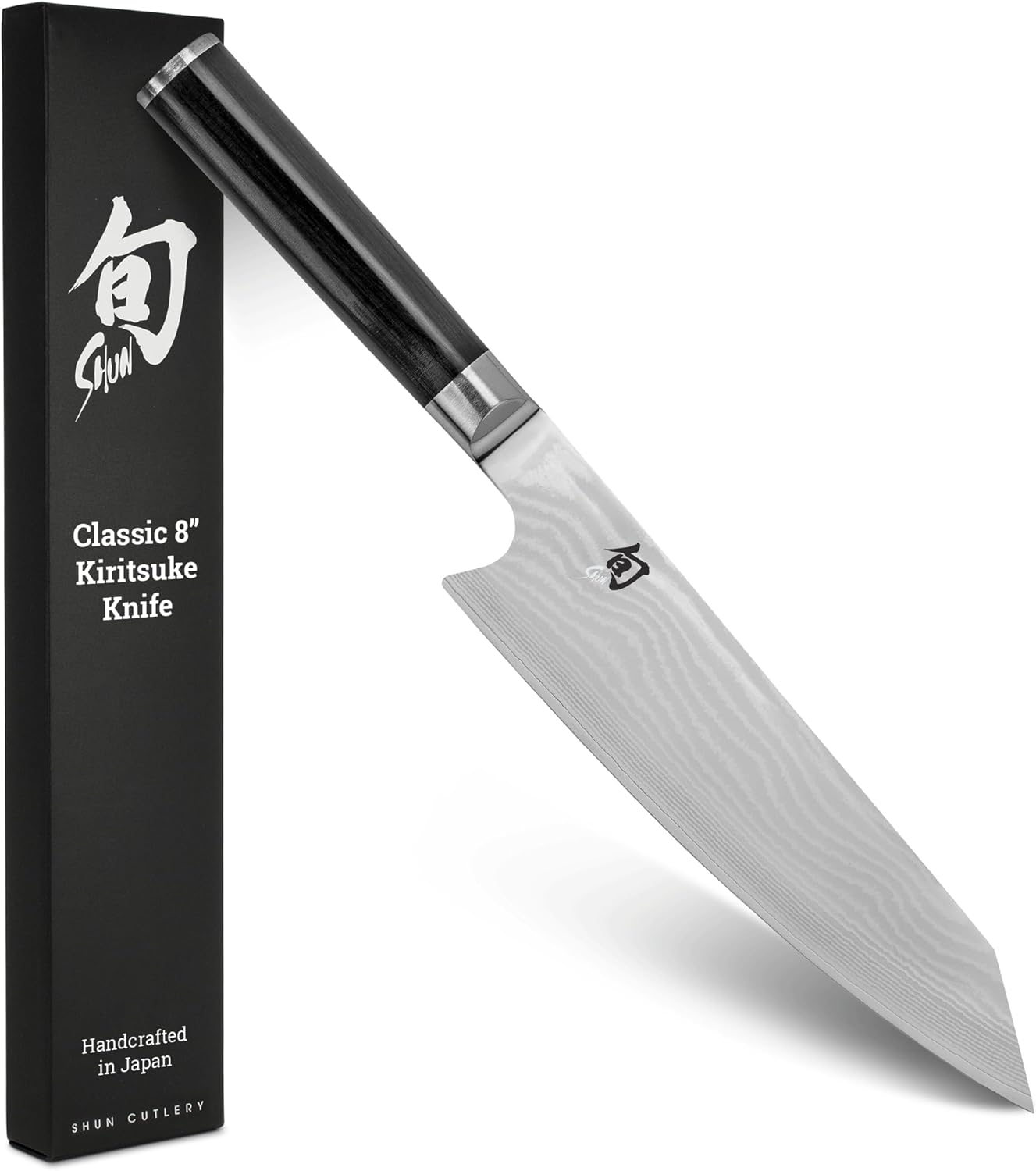
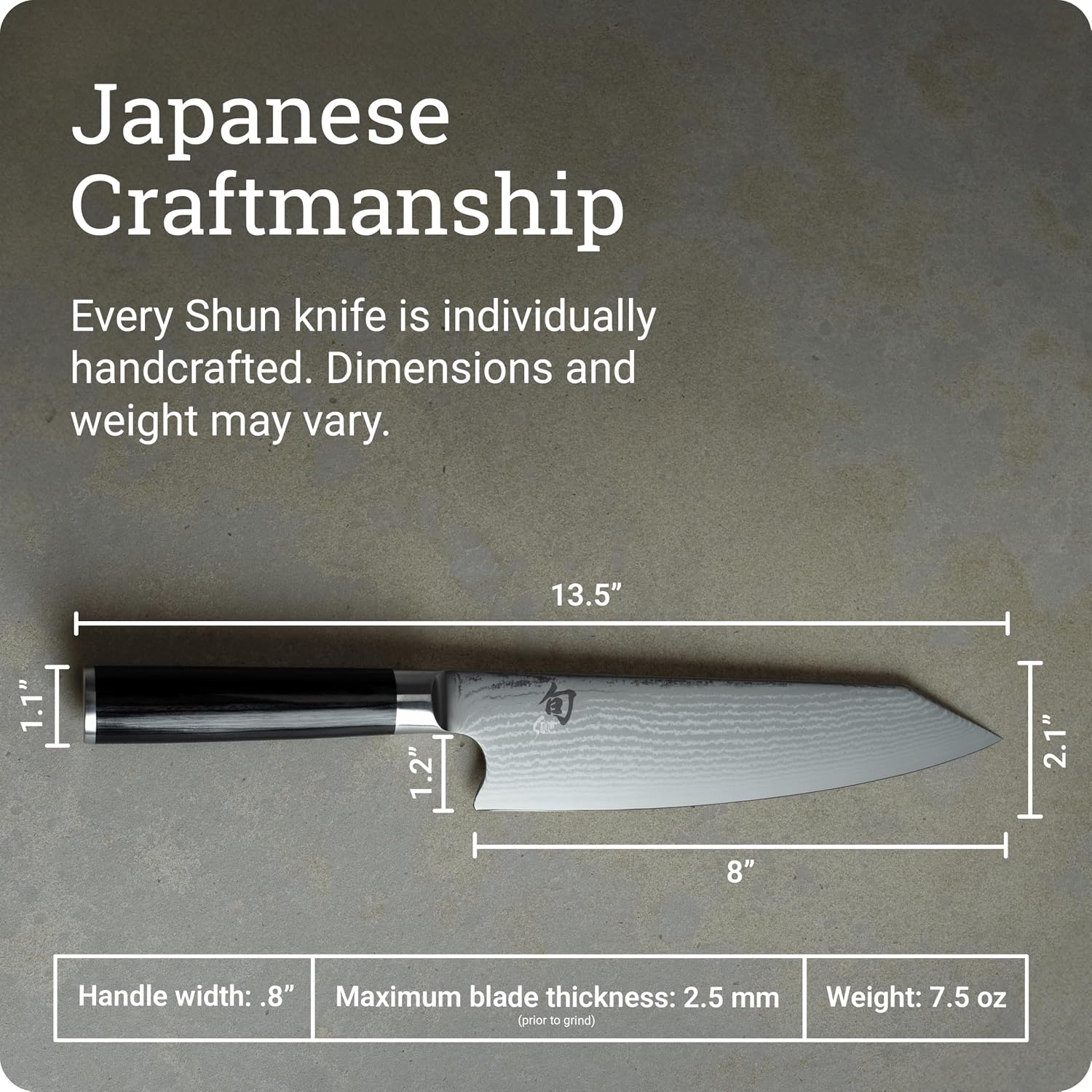
This is the kiritsuke most American buyers meet first. It shares everything with the Shun Classic chef’s knife below: a VG-MAX steel core, 68 layers of Damascus cladding, a 16-degree edge on each side and a D-shaped ebony PakkaWood handle.
The shape is where it differs. Shun’s own dimension sheet lists a 2.1-inch blade height against 1.9 inches for the chef’s knife. The extra height gives your knuckles more room over the board. The edge runs flatter for longer before the angled tip, which suits push cuts through onions, carrots and boneless proteins.
The honest downside: the flat profile does not rock well. If you mince herbs by pivoting on the tip, a kiritsuke will feel stiff at first. The long angled point also needs more care near cabinet doors and drying racks.
In Japan, Shun is best known as the export line of Kai, a knife maker founded in Seki, Gifu Prefecture in 1908. The Classic series was the first Shun line sold in the United States. Shun’s listing also notes free sharpening and honing for its knives, which is useful for a first premium Japanese knife.
Best for: cooks who already cut with a forward push stroke and want one knife for fine vegetable work plus slicing boneless meat.
Shun Classic 8″ Chef’s Knife — Gyuto (Around $140 on Amazon)
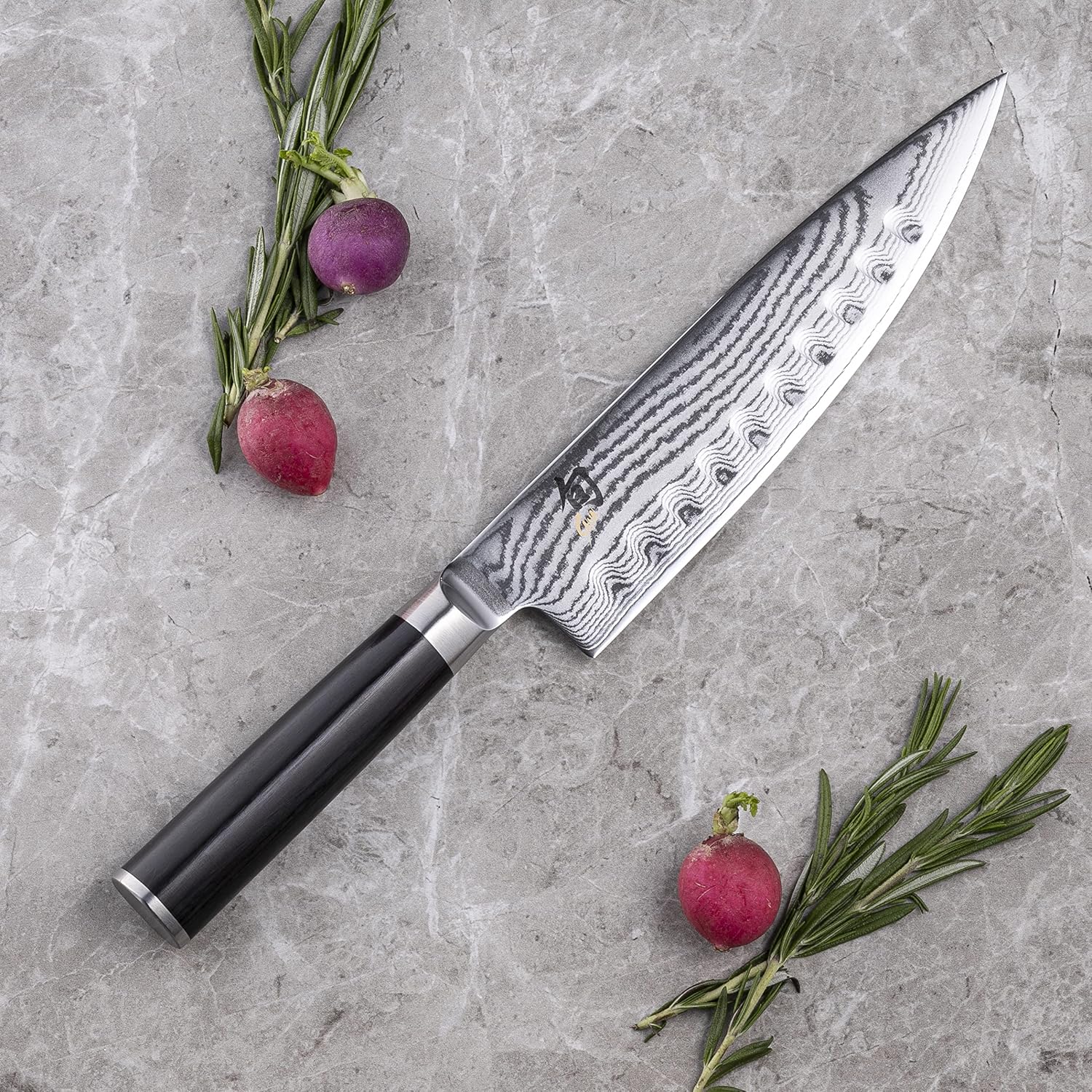
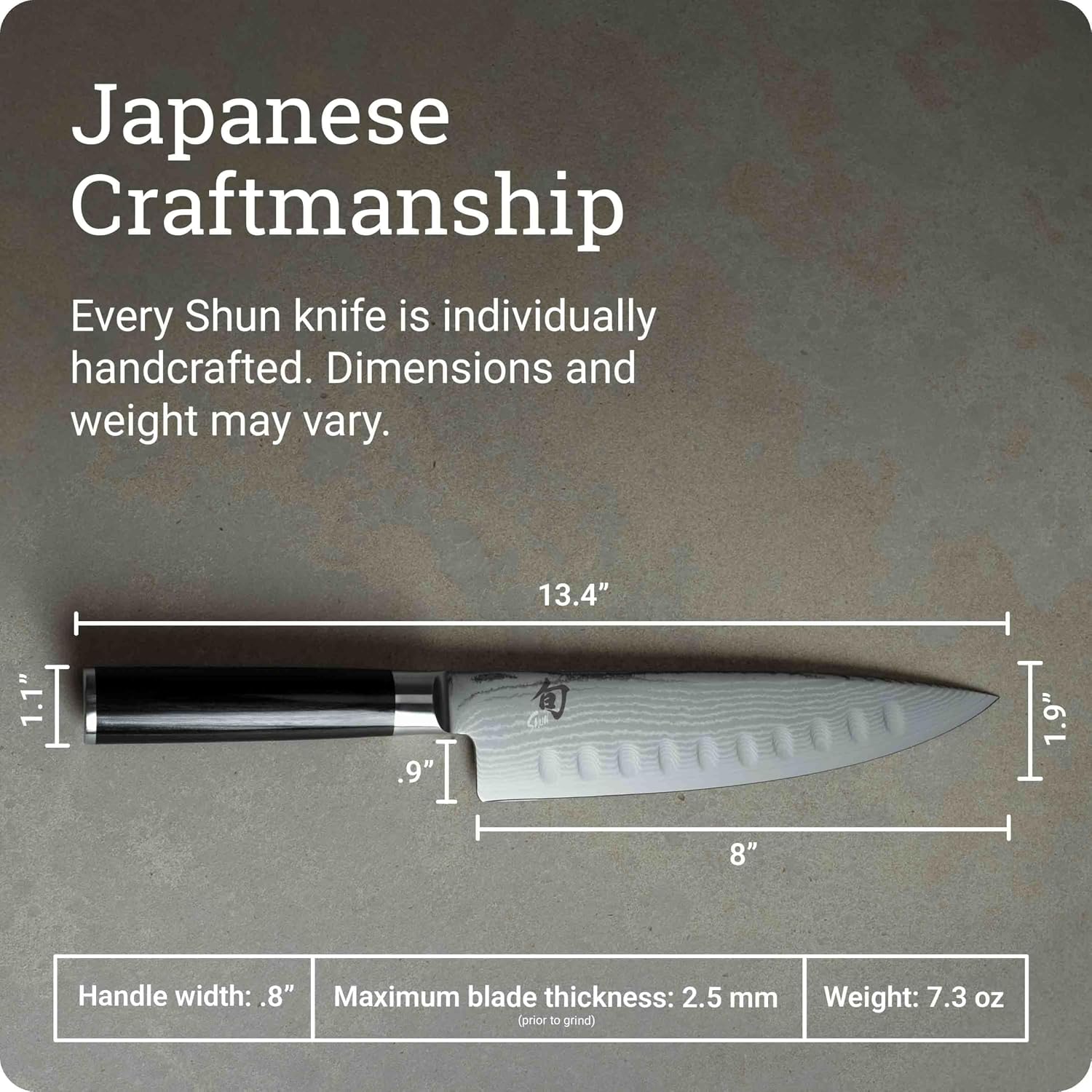
This is the gyuto in its most familiar American form. The steel, cladding, edge angle and handle match the kiritsuke above. The listing weights are also close: 7.3 oz here against 7.5 oz.
What you get instead is a curved belly that rises toward a centered point. That curve lets you rock through parsley or garlic without lifting the heel. This version is hollow ground, with scallops along the side of the blade that help sticky slices of potato or cheese fall away.
The honest downside: the narrower tip is less precise for scoring or fine trimming than the kiritsuke’s angled point. The slightly lower blade also leaves a little less knuckle room.
The gyuto is the default chef’s knife in Japanese home kitchens alongside the santoku. It is also the shape professional cooks most often start with. If you are coming from a German chef’s knife, this is the shape your hands already know.
Best for: most home cooks, especially anyone who rocks the knife when mincing.
Kai Seki Magoroku Kaname Kiritsuke 195 mm (Around $98 on Amazon)
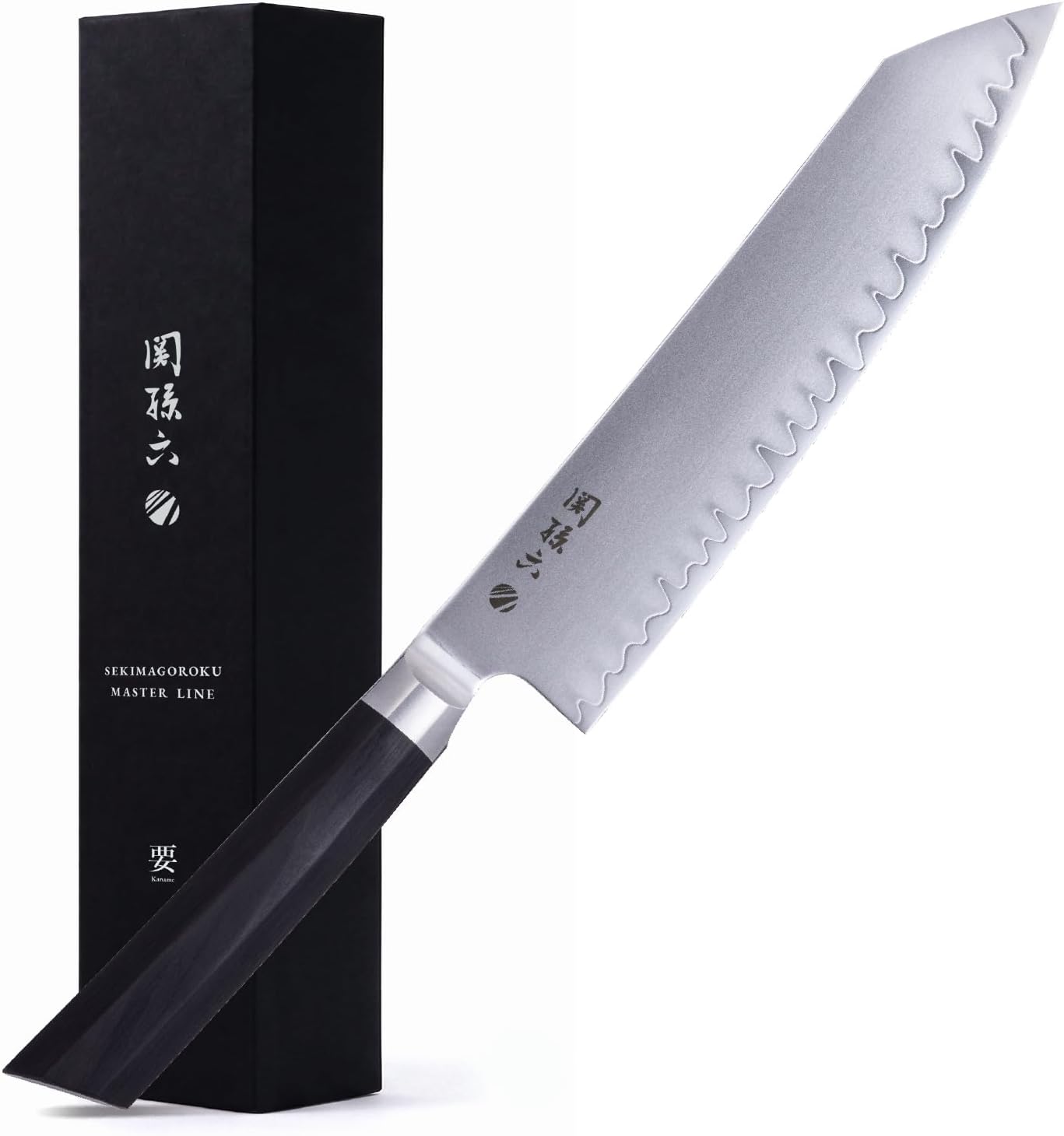
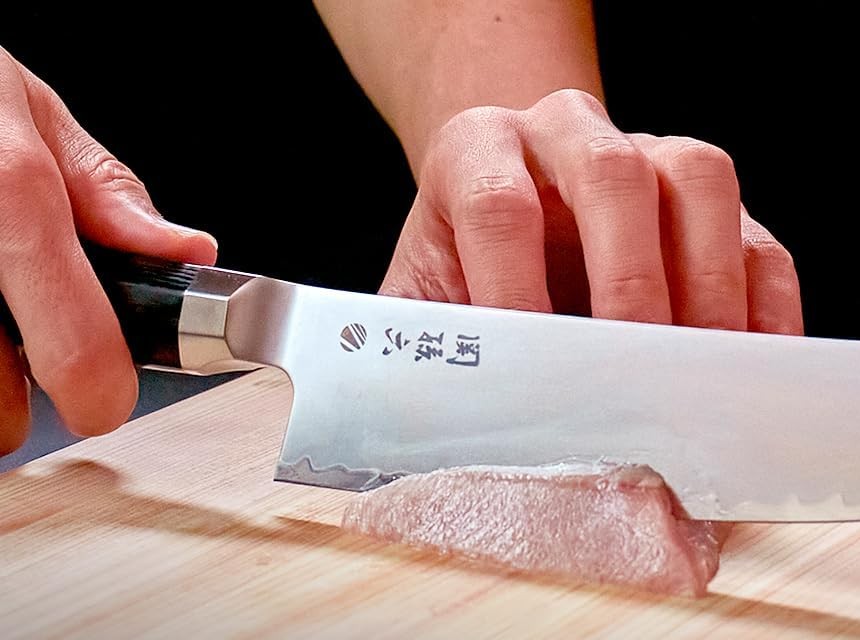
Seki Magoroku is Kai’s brand for the Japanese home market. It is named after Magoroku Kanemoto, a swordsmith from Seki whose name Japanese cooks still connect with sharp blades. Kaname is the top line in the range. Kai’s own product material says it won a Red Dot design award in 2023.
The blade is 195 mm (about 7.7 inches) of three-ply steel with a VGXeos core. Kai rates it at 60–62 HRC, slightly above the Shun Classic range. The finish is satin rather than Damascus. The handle is octagonal black PakkaWood. Kai’s spec sheet lists it as usable by right- or left-handed cooks.
At 161 g (about 5.7 oz) it is noticeably lighter than either Shun. That makes it quick for long sessions of slicing vegetables. The shorter blade also fits smaller cutting boards. The honest downside is the plainer look plus the shorter length, which limits it on large melons or big roasts.
Best for: anyone curious about the kiritsuke shape who does not want to spend premium-line money on an experiment.
Compare the Three
| Shun Classic Kiritsuke | Shun Classic Chef’s (Gyuto) | Kai Kaname Kiritsuke | |
|---|---|---|---|
| Price seen | ~$140 | ~$140 | ~$98 |
| Blade length | 8 in (203 mm) | 8 in (203 mm) | 195 mm (7.7 in) |
| Blade height | 2.1 in | 1.9 in | about 2.0 in (51 mm max width) |
| Weight | 7.5 oz | 7.3 oz | 5.7 oz (161 g) |
| Core steel | VG-MAX, 68-layer Damascus | VG-MAX, 68-layer Damascus | VGXeos 3-ply, 60–62 HRC |
| Edge profile | Flat, angled K-tip | Curved belly (rocks) | Flat, angled K-tip |
| Handle | D-shaped PakkaWood | D-shaped PakkaWood | Octagonal PakkaWood |
| Best cutting style | Push cuts, fine tip work | Rocking, general prep | Push and pull cuts |
Watch how you cut before you choose. If your knife tip stays on the board while the handle bobs up and down, buy the gyuto. The Shun Classic Chef’s Knife is the safe first Japanese knife for most people.
If you lift the whole blade and drive it forward, the kiritsuke will feel more natural. Choose the Shun Classic Kiritsuke if you want the Damascus look plus the free sharpening. Choose the Kai Kaname if you want a lighter knife for less money.
For a wider look at kiritsuke options, see our best Japanese kiritsuke knife comparison. If you are still deciding between shapes, the gyuto vs santoku guide covers the other common choice.
FAQ
Is a kiritsuke better than a gyuto?
Neither is better overall. The kiritsuke suits push cuts and precise tip work. The gyuto suits rocking cuts and is more forgiving as an all-round knife.
Can left-handed cooks use a kiritsuke?
Yes, if it is double-bevel. All three knives here are double-bevel. Traditional single-bevel kiritsuke are sharpened for one hand, so check the listing before buying one.
Why is the kiritsuke called the head chef’s knife?
In traditional Japanese kitchens the single-bevel kiritsuke is associated with the most senior cook. It does the work of two specialist knives but takes skill to use well.
Can these knives go in the dishwasher?
No. Kai lists the Kaname as hand wash only. Hand washing plus drying right away is the standard advice for Japanese knives. Our Japanese knife care guide covers the routine.
Why do Shun and Seki Magoroku look so different if they come from the same company?
Both are made by Kai in Seki. Shun is designed with export markets in mind. Seki Magoroku is Kai’s brand for Japanese home cooks, with a more restrained style.
Summary
The kiritsuke vs gyuto choice comes down to how you cut. Rockers should buy the Shun Classic Chef’s Knife. Push-cutters should try a kiritsuke, either the Shun Classic or the lighter Kai Kaname.
Prices are approximate US dollar figures from Amazon.com at the time of writing (September 2026) and they change often.