vs-navi.online is a participant in the Amazon Services LLC Associates Program. Purchases made through links on this page may earn us a commission at no extra cost to you.
A Japanese gyuto that cost $150 is sliding off a tomato skin instead of biting into it. The whetstone is in a drawer somewhere. A pull-through sharpener would fix this in thirty seconds, except that every knife shop says a pull-through will ruin a Japanese blade.
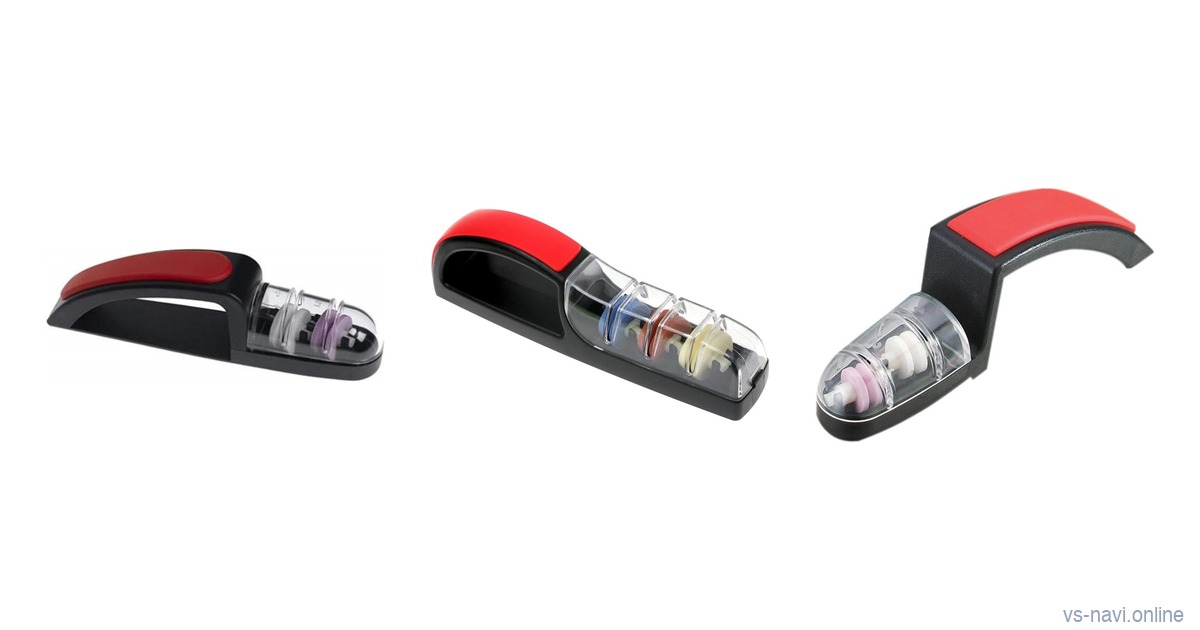
The MinoSharp line is the exception that knife makers themselves sell. It comes from Yoshikin, the Niigata company behind GLOBAL knives, which is why its wheels are set to the shallow 15-degree edge that Japanese knives carry. Three versions reach Amazon.com: the two-wheel MinoSharp Plus, the three-wheel MinoSharp 3 plus the compact Shinkansen water sharpener.
We compared the three listings on the manufacturer’s published specifications, Japanese market information plus Amazon listing details with ratings. This is a desk comparison of public information, not a hands-on test.
Our Pick: Which MinoSharp Should You Buy
All three showed a live U.S. price with stock when we checked Amazon.com in October 2026, though stock on two of them was down to single digits. Prices move often, so treat the figures below as rough.
- MinoSharp Plus, two wheels — about $44, 4.6 out of 5 from more than 340 ratings. The pick for most owners of double-bevel Japanese knives. Larger wheels, a coarse white stage plus a pink finishing stage, sold under the Global brand name.
- MinoSharp 3, three wheels — about $45, 4.6 out of 5 from more than 640 ratings. The pick if you want a polishing stage after the two cutting wheels, or if you also sharpen Western knives at home. Stock was down to the last unit when we checked.
- Shinkansen Water Sharpener — about $31, 4.6 out of 5 from more than 120 ratings. The budget pick with the same two-stage water system in a smaller, lighter body with a curved handle.
Why Pull-Throughs Worry Japanese Knife Owners
The warning you hear in knife shops is not superstition. Most budget pull-through sharpeners fix the blade at about 20 degrees per side, which suits a German chef’s knife. A Japanese gyuto or santoku is usually ground at 15 degrees or less. Dragging it through a 20-degree slot grinds a new, blunter shoulder onto a thin edge.
The second problem is the abrasive. Many cheap sharpeners use tungsten carbide blades that scrape steel off in curls. Japanese knife steel is hard, often above 60 on the Rockwell scale, which makes it brittle at the very edge. Carbide can chip that edge in a single hard pass. Retailers that sharpen knives for a living report that an existing chip tends to grow when it catches in a V-shaped slot.
MinoSharp attacks both problems. The wheels are ceramic rather than carbide, they sit at the 15-degree angle GLOBAL grinds its own knives to, plus the whole unit runs with water in the reservoir. Water carries the swarf away so the wheels cut without heating or clogging. Yoshikin’s own advice is to use almost no downward pressure. The wheel does the work.
What it cannot do is also clear from the listings. MinoSharp says its sharpeners are not for serrated knives or for single-bevel knives such as a yanagiba, a deba or its own Bunmei series. Those need a whetstone. A badly chipped or heavily dulled edge also belongs on a stone first. Think of a MinoSharp as the tool that keeps a sharp knife sharp for months, not the tool that rescues a neglected one.
The Brand in Japan
Yoshida Metal Industry, known as Yoshikin, was founded on December 27, 1954 in Tsubame, Niigata Prefecture. Tsubame-Sanjo is Japan’s metalworking district, the region behind a large share of the country’s cutlery plus kitchen tools. Yoshikin started with tableware, moved to stainless blades in 1960, then in the 1980s hired industrial designer Komin Yamada to create a knife with no visible seam between blade and handle. The result was GLOBAL, the dimpled all-steel knife now sold worldwide. The company still employs about 110 people at the Tsubame factory.
GLOBAL blades are stamped from CROMOVA 18 steel, ground thinner than European knives plus finished at a 15-degree edge. The manufacturer tells owners to maintain that edge on whetstones or ceramic, never on a grooved European steel. MinoSharp is the sharpener label Yoshikin uses overseas for exactly that job. Retailer descriptions credit the design to a sharpening specialist named Minoru Tsuchida, a name that also appears among the key figures of the GLOBAL brand, though Yoshikin’s own pages do not tell that story.
In Japan the same sharpeners carry the GLOBAL name rather than MinoSharp. The two-wheel ceramic water sharpener is sold there as the GLOBAL G-91, with a three-year warranty on wheels made in Japan. The brand also has a mainstream following at home: in 2026 the Japanese consumer-testing magazine LDK ranked the GLOBAL Speed Sharpener GSS-01, a 65-gram alumina-ceramic model priced around 2,200 yen, first among fifteen sharpeners for the sharpness it restored on tomatoes plus sea bream. That is unusual company for a pull-through, which Japanese cooking culture normally treats as a compromise next to the whetstone.
MinoSharp Plus, Two Wheels (Around $44 on Amazon)
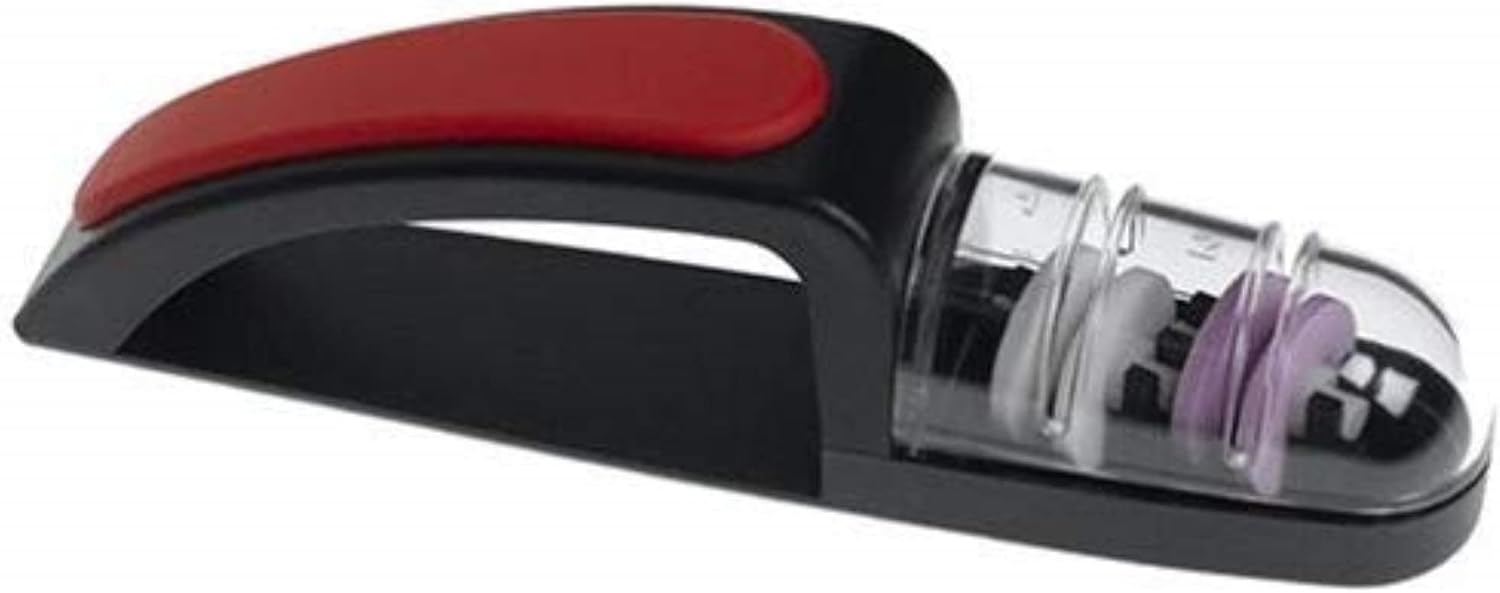
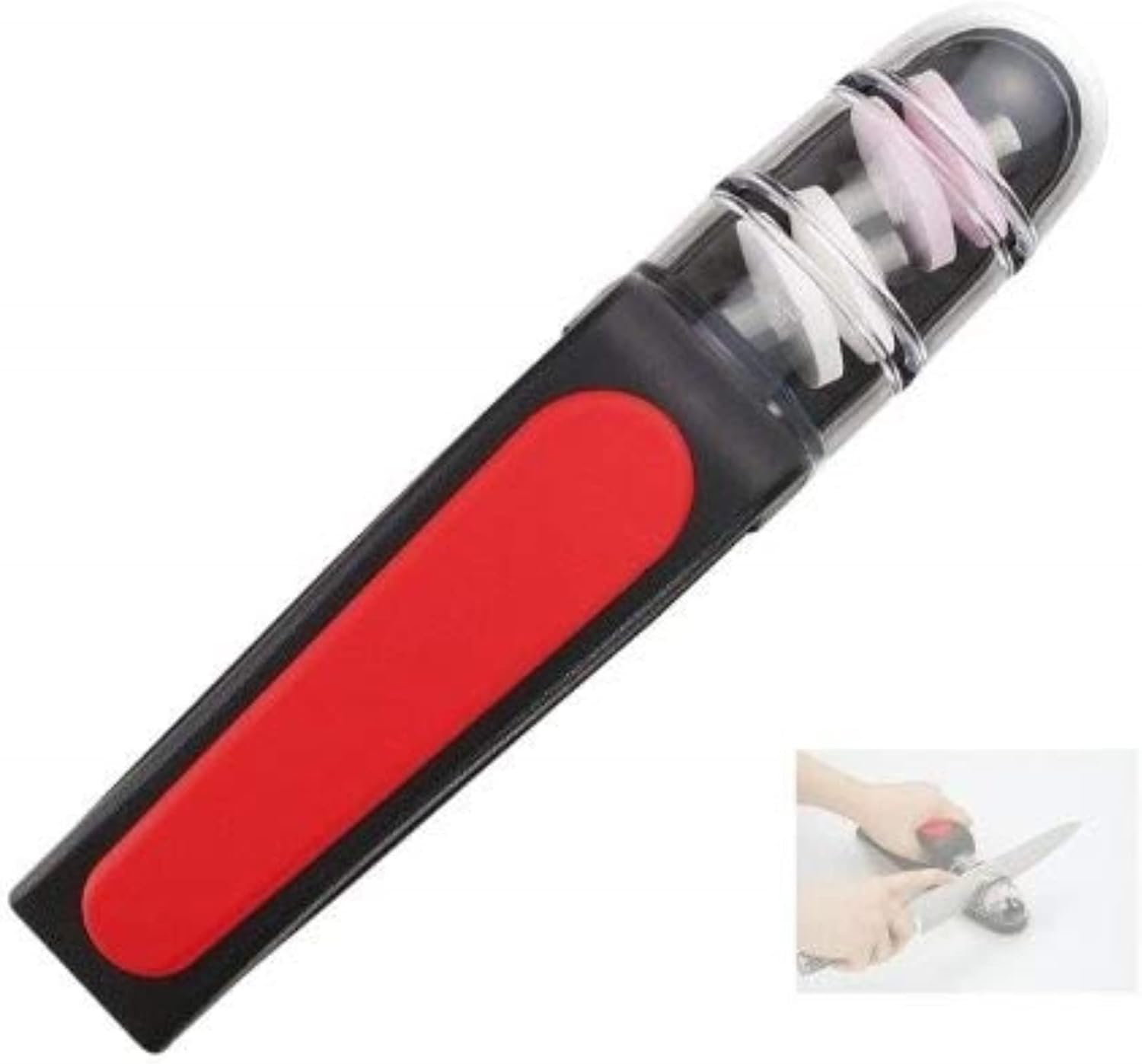
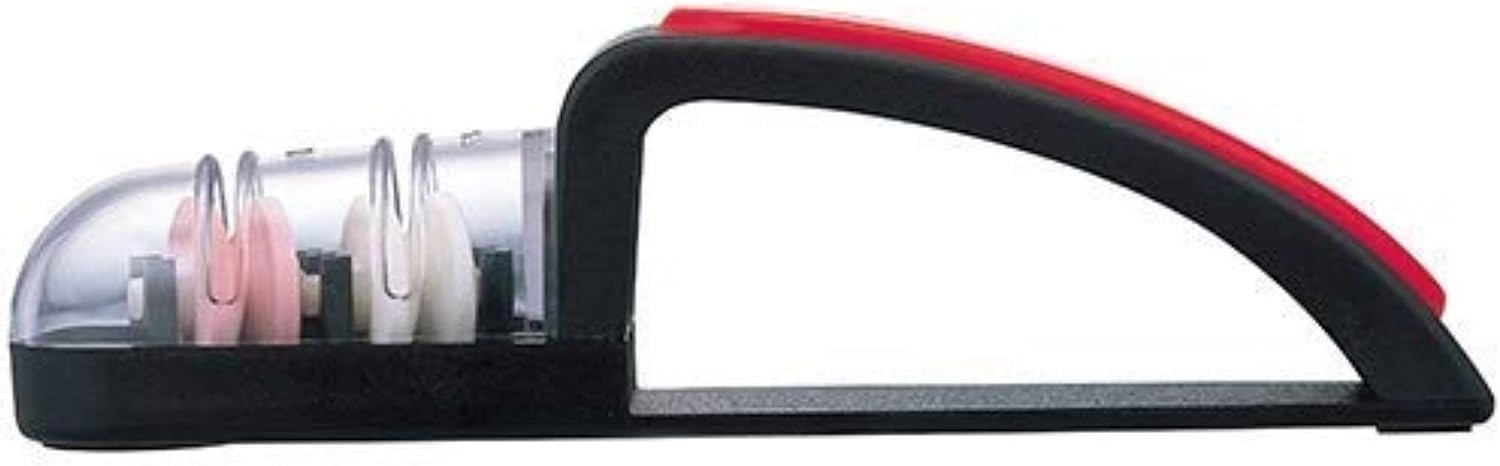
The Plus is the model Yoshikin positions as the easy choice. It has two wheels: a white one that is coarse for raising a fresh edge, then a pink one that is finer for finishing. The wheels are larger than on the other two models, which the maker says puts a longer-lasting edge on the knife because more of the wheel surface meets the steel on each pass.
Use is the same across the line. Fill the reservoir, rest the heel of the blade in the slot, then pull toward you a handful of times with the weight of the knife alone. The water turns grey as it collects steel, which is the sign the wheels are cutting. Rinse the unit, wash the blade in hot water, dry it.
Buyers on Amazon.com rate it 4.6 out of 5 across more than 340 ratings, with roughly four in five giving five stars. Public reviews on retailer sites in Europe praise how little pressure it needs plus how well it suits GLOBAL knives in particular. The recurring complaint is that it maintains rather than restores: an edge that has gone truly dull does not come back fully on the Plus alone.
One more caution from the listing itself. The Plus is for double-bevel knives only. Single-bevel Japanese blades, serrated bread knives plus the Bunmei series are excluded. The Amazon page listed about 16 units in stock when we checked, sold under the Global brand name.
MinoSharp 3, Three Wheels (Around $45 on Amazon)
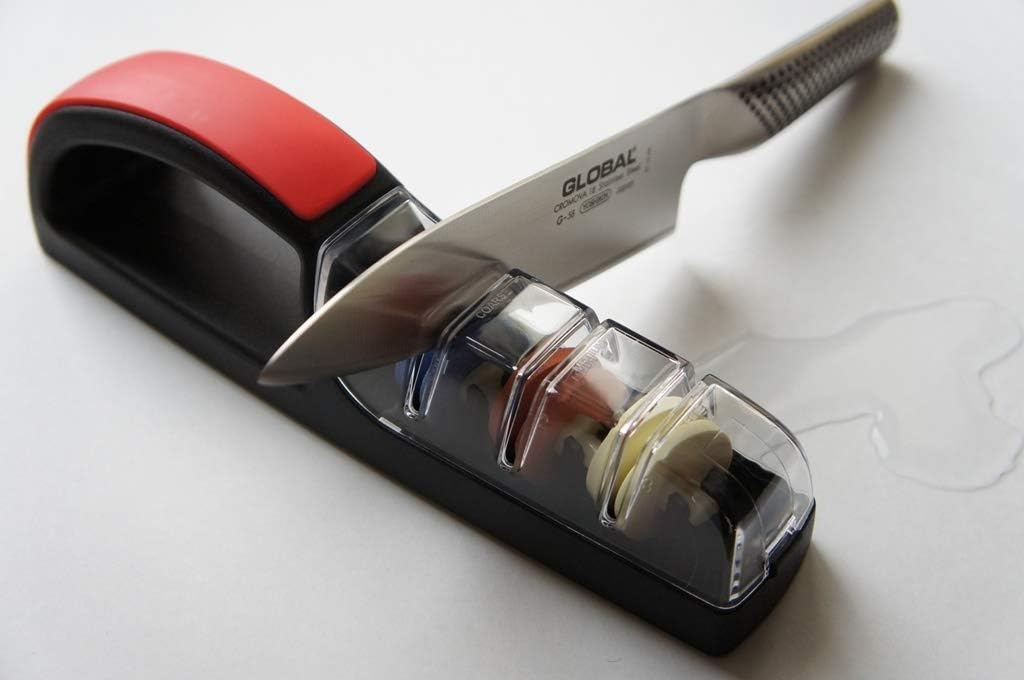
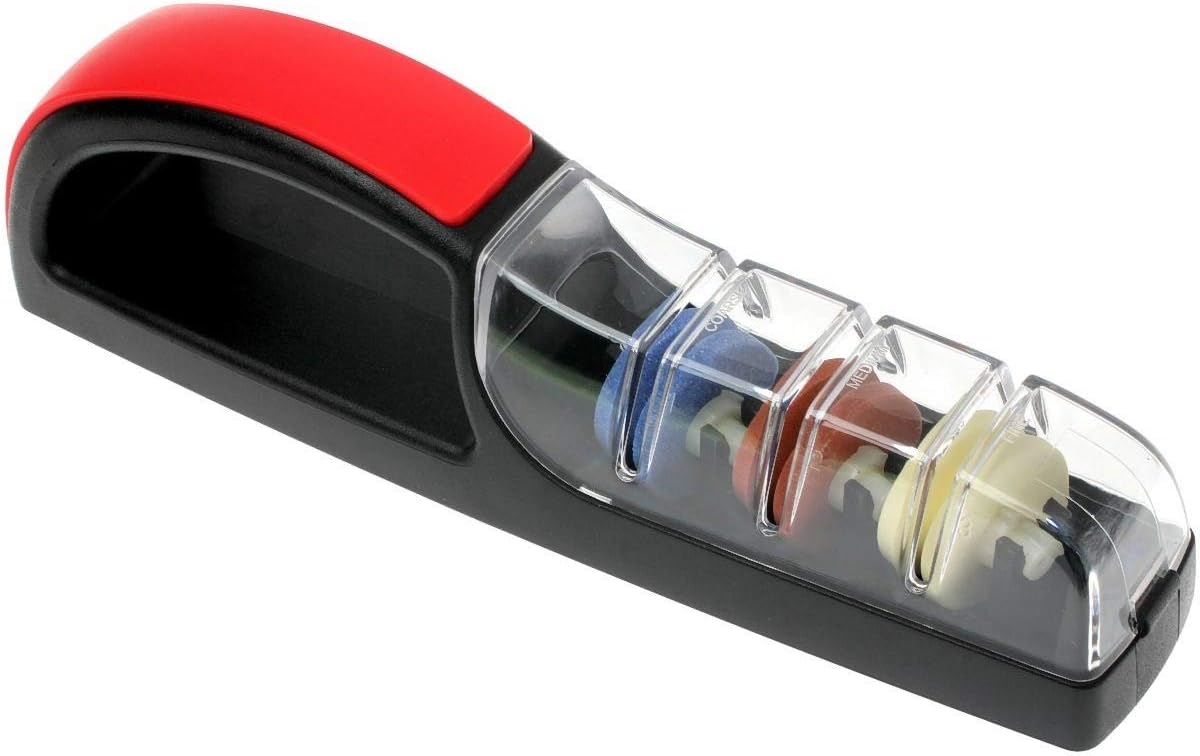
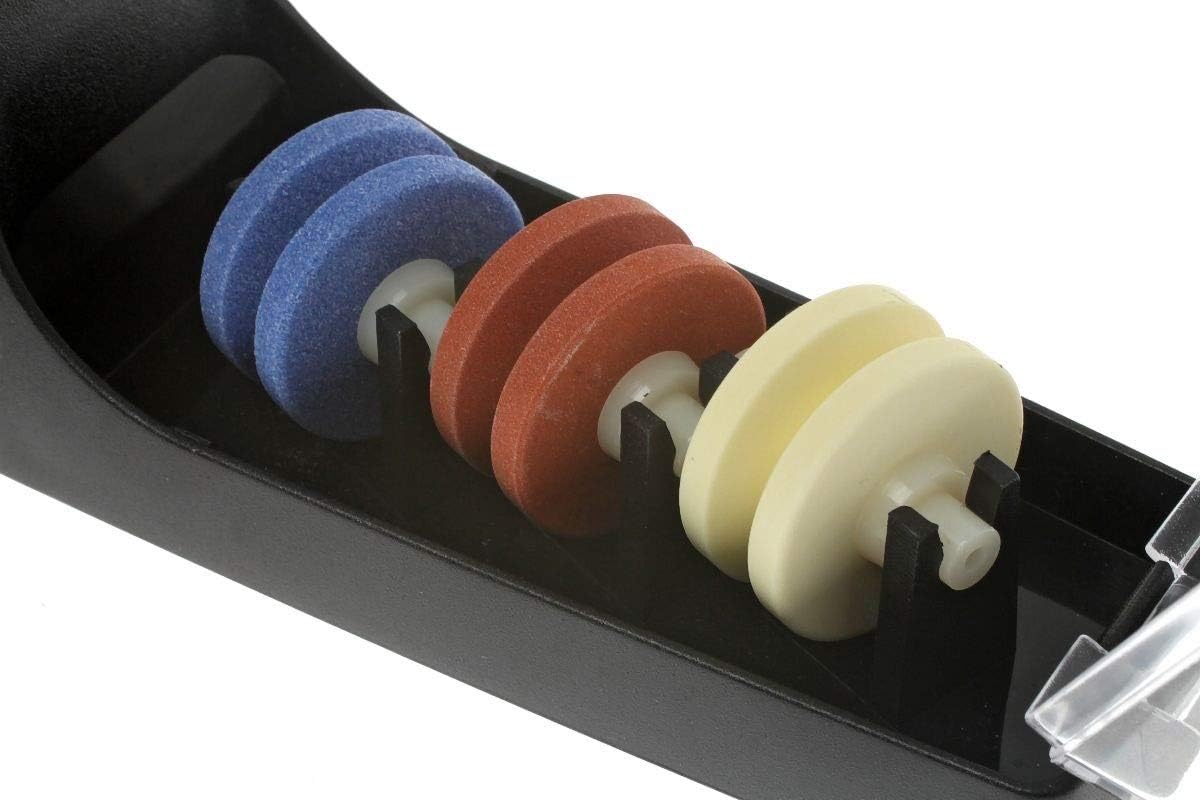
The MinoSharp 3, model 550/BR, adds a third wheel. Blue is coarse, brown is medium, yellow is the fine finishing stage. The first two wheels do the cutting while the yellow wheel polishes the edge, which is the step that turns a working edge into one that glides through a tomato skin. The angle is fixed at 15 degrees, the same as the Plus.
Yoshikin lists it as designed for GLOBAL knives but effective on most brands. European retailers that stock it describe it as suitable for both Asian plus Western kitchen knives, which makes it the model to choose if one sharpener has to serve a mixed drawer. It is a full-length tool at about 23 cm plus 215 grams, with a proper reservoir rather than a damp sponge.
It carries the largest review base of the three: 4.6 out of 5 across more than 640 Amazon.com ratings, with about 79 percent at five stars. On the Dutch retailer knivesandtools it holds 4.3 out of 5 across 109 reviews. Across those public reviews the praise clusters on how quickly a GLOBAL knife comes back to sharp, while the consistent reservation is that a pull-through can only ever take an edge so far.
The catch is availability. Several European retailers list the 550 as discontinued, plus Amazon.com showed a single unit left when we checked. If the listing is out of stock when you read this, the Plus does the same job minus the polishing wheel.
Shinkansen Water Sharpener (Around $31 on Amazon)
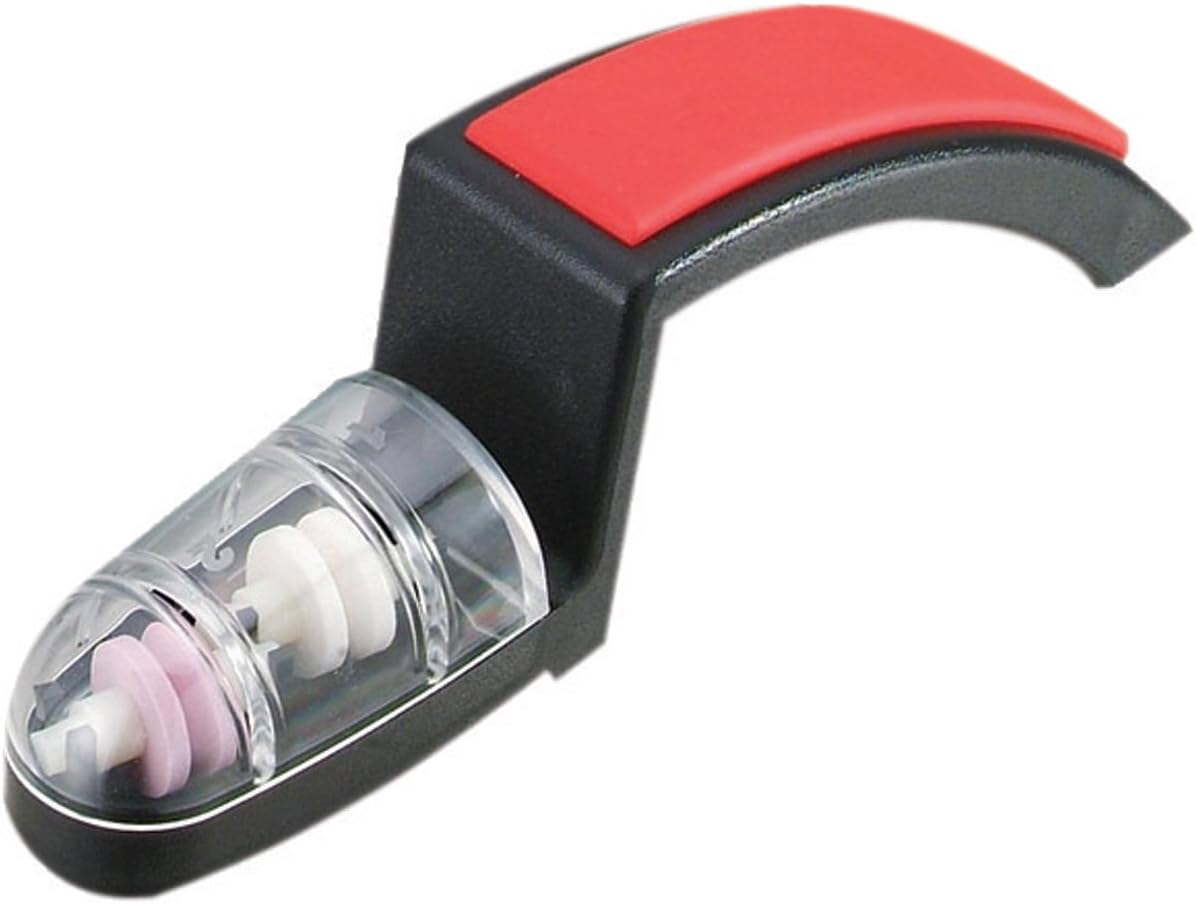
The Shinkansen is the small one. It measures about 20 by 4 by 6.5 cm, weighs 170 grams, with a curved handle that arches over two alumina-ceramic wheels, one rough plus one medium. The body is ABS plus AS resin. The listing describes it as a commercial restaurant product now sold in more than 65 countries, a claim we could not check beyond the listing itself.
The shape explains the name. The arched grip sits above the wheels like a bullet-train nose, so the knife is drawn through at counter height while your knuckles stay above the housing. It is the model that fits in a knife roll or a small drawer, which suits the restaurant use the listing describes.
Buyers rate it 4.6 out of 5 across more than 120 Amazon.com ratings, about 77 percent at five stars. With no fine polishing wheel the edge it leaves is a working edge, sharp enough for daily prep, a step short of what the MinoSharp 3’s yellow wheel produces. Amazon showed about five units in stock when we checked, so treat the price as indicative.
Compare the Three
| MinoSharp Plus | MinoSharp 3 | Shinkansen | |
|---|---|---|---|
| Approx. price | $44 | $45 | $31 |
| Wheels | 2, large (coarse white, fine pink) | 3 (coarse, medium, fine) | 2 (rough, medium) |
| Angle | 15°, fixed | 15°, fixed | 15°, fixed |
| Size / weight | Full length | 23 cm / 215 g | 20 cm / 170 g |
| Amazon rating | 4.6 (340+) | 4.6 (640+) | 4.6 (120+) |
| Stock when checked | About 16 | 1 | About 5 |
| Not for | Single-bevel, serrated | Single-bevel, serrated | Single-bevel, serrated |
For most readers the MinoSharp Plus is the one to buy. It has the largest wheels, the healthiest stock position plus the maker’s own endorsement as the simplest tool in the range. Its two stages cover what a home cook needs between proper stone sessions.
The MinoSharp 3 is the better tool on paper, because the third wheel adds a polish that the other two cannot. Buy it if you can find it in stock, or if your knife drawer mixes a GLOBAL with a German chef’s knife. The Shinkansen is for the cook who wants the lowest price, the smallest footprint, or a sharpener that lives in a knife roll.
Buyer’s Considerations
Check your knife’s edge before you buy any of these. A double-bevel gyuto, santoku, nakiri or petty from a brand such as GLOBAL, Tojiro or Shun will work. A single-bevel yanagiba, usuba or traditional deba will not; those blades can only be sharpened on whetstones, where our King vs Naniwa vs Shapton guide explains which to buy first.
Match the tool to the job. A MinoSharp handles the monthly refresh. A ceramic honing rod handles the weekly realignment between those refreshes. A whetstone handles the once-a-year rebuild, plus any chip repair. Owners who try to make the pull-through do all three jobs are the ones who end up disappointed by it.
Finally, budget for wheels. Ceramic is porous, so the wheels wear with use plus eventually need replacing. Yoshikin sells replacement wheel sets for the two-wheel models. Keep the unit rinsed after each session, because dried steel paste is what shortens wheel life. Our Japanese knife care guide covers the rest of the routine, from drying to storage.
Summary
A pull-through is safe for a Japanese knife when it is built for one, which means a 15-degree angle, ceramic wheels plus water. The MinoSharp line meets all three conditions because it comes from the company that makes GLOBAL knives. Buy the Plus for most kitchens, the MinoSharp 3 if you find it in stock, the Shinkansen if price or size matters most. Keep a whetstone for the jobs no pull-through can do.
FAQ
Is a MinoSharp safe for Japanese knives?
For double-bevel Japanese knives, yes. The wheels are ceramic rather than carbide, fixed at the 15-degree angle Japanese knives are ground to, with water to carry away swarf. It is not safe for single-bevel knives such as a yanagiba or deba, nor for serrated blades.
Can I use a MinoSharp on non-Japanese knives?
Yoshikin says the MinoSharp 3 works on most brands. Because the angle is fixed at 15 degrees, a German knife ground at 20 degrees will slowly take on a thinner edge over repeated sessions. Many owners consider that an improvement; a knife maker that specifies 20 degrees may not.
Does a MinoSharp replace a whetstone?
No. It keeps a sharp knife sharp between stone sessions. A truly dull or chipped edge needs a whetstone, which removes enough steel to rebuild the edge. The most common complaint in public reviews of the MinoSharp line is from buyers who expected it to do the whetstone’s job.
How much pressure should I use?
Almost none. Yoshikin warns that pressing down damages the ceramic wheels. Let the weight of the knife rest on the wheels, pull toward you at a steady pace, then repeat a handful of times. The water turning grey tells you the wheels are cutting.
What is MinoSharp called in Japan?
In Japan the same sharpeners are sold under the GLOBAL brand name by Yoshikin. The two-wheel ceramic water sharpener is the GLOBAL G-91. MinoSharp is the label Yoshikin uses for export markets, which is why Amazon.com lists the products under both Global plus Minosharp as the brand.