This article contains affiliate links (we may earn a commission).
Pilot vs Uni-ball — Quick Answer
In Japan, the Pilot vs Uni-ball question is almost a national pastime among writers. Our editorial pick for most people is the Uni-ball Signo 207 for its secure, water-resistant ink; the Pilot G2 wins on value and the Pilot Juice Up 0.4mm wins for fine detail. Check the Uni-ball Signo 207 on Amazon.
Top pick: Uni-ball Signo 207 (Mitsubishi Pencil’s fraud-resistant gel ink — the most versatile all-rounder). Best value: Pilot G2 (the international everyday gel pen from Tokyo’s 1918-founded Pilot). Best for detail work: Pilot Juice Up 0.4mm (Pilot’s precision pen for fine handwriting and detail).
Read on for the full editorial breakdown of which brand wins for everyday writing, document signing and detail work.
Both Pilot (パイロット) and Mitsubishi Pencil — the company behind the Uni and Uni-ball lines — are pillars of the Japanese stationery industry and both routinely sit at the top of bestseller shelves at Bic Camera, Yodobashi, Loft and Tokyu Hands. Yet they pursue very different design philosophies. This guide compares three of their most representative gel pens, explains the brand history that overseas buyers usually miss and lays out which model fits which kind of writer.
Quick Verdict
- Uni-ball Signo 207 — top pick. Best overall ink quality and security.
- Pilot G2 — best for everyday writing. Smooth, reliable, widely available.
- Pilot Juice Up 0.4mm — best for fine lines. Ultra-precise, vibrant ink.
Specs Comparison — 3 Japanese Pens Side by Side
| Spec | Pilot G2 | Uni-ball Signo 207 | Pilot Juice Up 0.4mm |
|---|---|---|---|
| Price | ~$1/pen | ~$2.50/pen | ~$5/pen |
| Tip Size | 0.7mm | 0.7mm | 0.4mm |
| Ink Type | Gel | Super Gel | LJP Gel |
| Refillable | Yes | Yes | Yes |
| Water Resistant | Partial | Yes | Yes |
| Amazon Rating | 4.8 / 5 | 4.7 / 5 | 4.6 / 5 |
Pilot vs Mitsubishi Pencil — Two Giants of Japanese Stationery
Before comparing individual pens, it helps to understand the two companies behind them, because their corporate histories explain why each brand writes the way it does. These are not generic OEM stationery makers — they are two of the oldest and most research-driven writing-instrument companies in the world and in Japan they carry the kind of trust that takes a century to build.
Pilot Corporation (パイロット) — founded 1918
Pilot was established in Tokyo in 1918 as the Namiki Manufacturing Company by Ryosuke Namiki, a professor at the Tokyo Higher Nautical School, together with his colleague Masao Wada. The nautical connection is the origin of the “Pilot” name — a pilot being the navigator who guides a ship safely into harbor. The company began with fountain pens and built its early reputation on durable, finely engineered nibs and the lacquered “maki-e” pens that are still collected internationally today.
Over the following century Pilot became one of the industry’s most prolific innovators, pioneering the erasable Frixion ink line, the capless retractable fountain pen and the gel formulations that power the G2 and Juice families. In Japan it is regarded as the dependable, mass-market standard-bearer: the brand you grow up writing with at school and keep using in the office, stocked in essentially every konbini, supermarket and 100-yen shop.
Mitsubishi Pencil Co. (三菱鉛筆) — founded 1887
Mitsubishi Pencil is even older, tracing its roots to 1887 when Niroku Masaki began producing pencils in Tokyo. Despite the shared three-diamond mark, the company has no corporate relationship with the Mitsubishi industrial conglomerate (the famous keiretsu) — both simply adopted the diamond emblem independently before modern trademark law. Mitsubishi Pencil registered its mark in 1903, predating the conglomerate’s wide use of it.
The company sells its non-pencil products under the “uni” brand, a name introduced in 1958 with the premium Uni pencil and later extended to the Uni-ball range of rollerball and gel pens. In Japan, “uni” carries a reputation for engineering precision and ink chemistry — Japanese consumers associate it with reliability for documents, exams and professional work. The Uni-ball Signo’s fraud-resistant Super Ink and the smooth Jetstream ballpoint are the brand’s flagship achievements and both are staples in Japanese offices and banks.
The practical takeaway: Pilot tends to optimize for an effortless, friendly writing feel at scale, while Mitsubishi Pencil’s uni line leans toward ink performance and security. That difference in priorities runs straight through the three pens compared below.
Pilot G2 Review — The Reliable Workhorse


The Pilot G2 is the pen most overseas buyers already recognize and for good reason: it is consistently among the best-selling gel pens in both Japan and the United States. The 0.7mm tip writes smoothly on most paper without bleeding and the contoured rubber grip stays comfortable across long writing sessions. The standout trait identified in our review process is consistency — units bought months and markets apart write the same way from the first stroke.
In Japan, the G2 is genuinely everywhere: convenience stores, 100-yen shops and office-supply chains all stock it. That ubiquity is part of its value proposition. When a pen runs dry, a replacement (or a refill) is rarely more than a few minutes’ walk away and the standardized refill system keeps the long-term cost low for heavy users.
The ink dries quickly enough to avoid smearing in normal left-to-right writing, although left-handed writers occasionally report smudging. For right-handed users this is essentially a non-issue.
The Brand in Japan
Among Japanese consumers the G2 (sold domestically within Pilot’s wider gel range alongside models such as the Juice and Acroball) represents the “safe default” — the pen a manager hands a new hire, the one bought by the dozen for a household. It is not seen as a status item, but as the writing instrument that simply never lets you down. That reputation for dependable, no-drama performance is exactly what makes Pilot’s mass-market line so dominant on Japanese shelves.
Real-World Usage
The G2 excels at meeting notes, to-do lists and general daily writing. In extended use the grip remains comfortable through multi-hour sessions and the pen rarely stops mid-stroke — a failure common to cheaper gel pens. It is the kind of pen that disappears into the task, which is the highest compliment an everyday tool can earn.
Pros
- Unbeatable value — Under $1 per pen in multi-packs; the most cost-effective quality gel pen
- Smooth, consistent ink — Pilot’s gel formula writes reliably on all standard paper
- Refillable — G2 refills are widely available, reducing long-term cost
Cons
- Tip can skip on glossy paper — Works best on standard notebook paper; struggles with coated stocks
- Clip can loosen — The pocket clip loosens with repeated use over months
Who Should Buy This
The Pilot G2 is ideal for students, office workers and anyone who writes daily and wants a reliable, affordable gel pen. If you go through a lot of pens, the multi-pack economics make this the clear choice.
Uni-ball Signo 207 Review — Premium Ink Quality

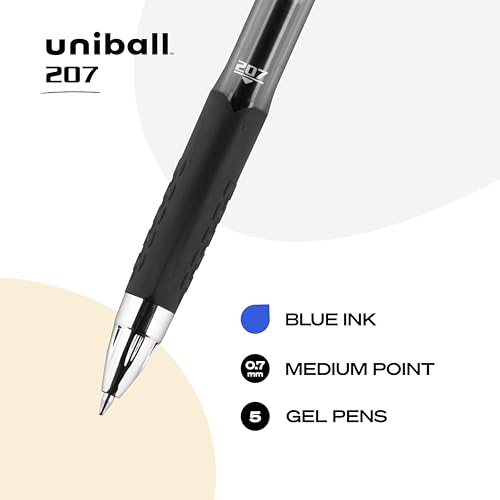

The Uni-ball Signo 207 is the pen to reach for when a document actually matters. Its Super Ink formula is genuinely fraud-resistant — pigment particles bond into the paper fibers in a way that makes the writing extremely difficult to alter or chemically wash out. For anyone signing checks, contracts, or legal forms, that is a real and practical advantage, not a marketing line.
In writing feel, the 207 is the smoother of the two, and its gel formulation is built to keep ink flowing consistently from the start of each stroke. How clean the first mark is after a pen has sat unused overnight is the trait that separates a good gel pen from a mediocre one.
Water resistance is the 207’s headline strength. Its pigment-based Super Ink is formulated to resist water and fading, which is exactly why standard dye-based gel ink is the wrong choice for anything that has to survive a spill. For archival notes and important records, that durability is the deciding factor.
The Brand in Japan
Mitsubishi Pencil’s uni line occupies a more “professional” position than Pilot’s mass-market range in the eyes of Japanese consumers. The Signo and its sibling Jetstream are the pens stocked at bank counters and used for exam answer sheets and official paperwork. Where Pilot signals friendly reliability, uni signals precision and trustworthiness — the brand you choose when the writing has to hold up. That perception, built over more than a century of ink-chemistry research, is why the Signo commands a price premium without losing shelf space.
Real-World Usage
The Signo 207 is best kept on hand specifically for forms, signatures and documents. The fraud-resistant ink provides peace of mind for anything official and the slightly heavier barrel gives it a more substantial, deliberate feel in the hand than the lighter G2. It is less an everyday scribbler than a tool reserved for writing that needs to last.
Pros
- Fraud-resistant Super Ink — Bonds to paper fibers, extremely difficult to alter or wash out
- Superior water resistance — Ink survives splashes and humidity without smearing
- Consistent first stroke — Writes perfectly from the first mark, even after sitting unused
Cons
- Higher cost — Roughly 2-3x the price per pen compared to G2
- Slightly shorter ink life — Heavy writers may find cartridges run out faster than the G2
Who Should Buy This
The Signo 207 is the best choice for anyone who signs documents, checks, or anything requiring tamper-resistant ink. It is also ideal for professionals who want their written work to look polished and last long-term.
Check the Uni-ball Signo 207 Gel Pens on Amazon
Pilot Juice Up 0.4mm Review — Precision for Detail Work

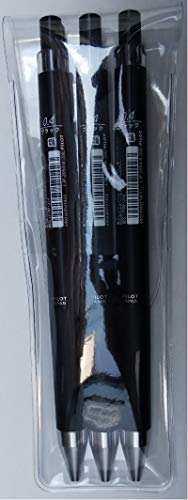
The Pilot Juice Up 0.4mm occupies a different category from the other two pens here. With its ultra-fine tip, it is built for detailed work: annotating printed documents, bullet journaling and writing in tight spaces. Covering the Japanese market, our editors note these are seen everywhere in stationery shops and rank as a clear favorite among students and designers.
The LJP (Low-Viscosity Pigment) ink is noticeably more vibrant than standard gel ink — colors read richer and more saturated and the black version has a deep, almost matte quality that photographs beautifully. That last trait is exactly why the Juice Up has become a staple among hand-lettering and journaling content creators.
Despite the fine point, the writing experience stays smooth rather than scratchy, which is the key engineering challenge with sub-0.5mm tips and something Pilot solves better than most rivals at this size.
The Brand in Japan
In Japan, fine-tip gel pens are a category unto themselves, driven by the dense, character-based writing system and the popularity of compact planners and study notes. The Juice Up sits in the sweet spot of that market: affordable enough for students, refined enough for designers and offered in an extensive color range that fuels the stationery-collecting culture (bungu) that is genuinely a hobby in Japan. Pilot’s dominance in this fine-tip niche is a major reason it co-leads the domestic market alongside Mitsubishi Pencil.
Real-World Usage
The Juice Up shines for annotation and planner work. The fine tip fits comfortably inside small calendar boxes without cramping and the pigment ink resists bleeding through standard 80gsm paper. For dense note-taking where space is tight, it does what a 0.7mm pen simply cannot.
Pros
- Ultra-fine 0.4mm tip — Perfect for small writing, dense notes and detail work
- Vibrant LJP ink — Deeper, more saturated color than standard gel pens
- Smooth despite fine tip — No scratching or catching; writes nearly as smoothly as a 0.7mm pen
Cons
- Premium price — Roughly 5x the cost of a G2; hard to justify for casual writing
- Narrower use case — The fine tip is great for detail but tiring for long-form writing sessions
Who Should Buy This
The Pilot Juice Up is for anyone who does detail-oriented writing — annotators, planners, bullet journalists, or anyone who regularly writes in small spaces. It is a specialty tool that excels at exactly what it sets out to do.
Check the Pilot Juice Up Gel Pen 0.4mm on Amazon
Head-to-Head Comparison — Category-by-Category Winner
Value: The G2 is untouchable here — multi-pack pricing brings it to roughly $1 per pen against $2.50 for the Signo and around $5 for the Juice Up. Ink quality: the Signo’s secure Super Ink and the Juice Up’s vibrant LJP pigment both edge ahead of the G2’s classic gel. Water resistance: the Signo’s fiber-bonding ink is the clear leader. Precision: nothing here matches the 0.4mm Juice Up. Availability: all three are easy to find, but the G2’s near-universal stocking gives it the edge.
Which Pen Should You Buy? A Use-Case Buying Guide
The right pick depends far less on which brand is “better” overall and far more on how you actually write. The guide below maps common writing situations to the model that fits.
- You write a lot, every day and hate fuss — Choose the Pilot G2. Buy the multi-pack, keep refills on hand and never think about it again.
- You sign documents, checks, or contracts — Choose the Uni-ball Signo 207. The fraud-resistant, water-resistant ink is built for writing that must survive and resist tampering.
- You keep a planner or bullet journal — Choose the Pilot Juice Up 0.4mm. The fine tip and saturated color are made for small boxes and decorative layouts.
- You want one pen to cover everything — Choose the Signo 207. It is the most versatile all-rounder: smooth enough for daily writing, secure enough for documents.
- You are buying on a tight budget for a classroom or office — Choose the G2 in bulk; the per-pen economics are unmatched.
The Refill and Ink Ecosystem — What to Know Before You Commit
One advantage often overlooked by first-time buyers of Japanese pens is the depth of the refill ecosystem. All three pens here are refillable, which changes the long-term math considerably and is a meaningful sustainability point as well.
- Pilot G2 refills are among the most widely stocked replacement cartridges anywhere, available in multiple tip sizes (0.38mm, 0.5mm, 0.7mm, 1.0mm) and a broad color range. Because the refill fits the standard G2 barrel, one good-quality body can outlast dozens of cartridges.
- Uni-ball Signo 207 refills carry the same fraud-resistant Super Ink as the pen itself, so the security benefit persists across the life of the barrel. Refill availability is slightly narrower than the G2 but still easy to source online.
- Pilot Juice Up refills come in the same vivid LJP color range as the pens, including metallic and pastel options that are popular in Japan’s bungu culture. Matching a refill color to your existing barrel is simple.
Tip sizes explained
Japanese gel pens are sold across a wider range of tip sizes than most Western brands and the numbers matter. A 0.7mm tip (G2, Signo 207) is the all-purpose default — smooth and legible for general writing. A 0.4mm tip (Juice Up) suits dense notes and small handwriting, while 0.38mm and 0.5mm options exist for those who want even finer control. If your handwriting is small or you write in cramped planner spaces, drop down a size; if you want bold, fast everyday writing, stay at 0.7mm.
Our Verdict — Overall Ranking
#1 – Uni-ball Signo 207 The fraud-resistant ink and superior water resistance make it the most versatile pen in this group — smooth enough for daily writing yet secure enough for documents. It is the one our editors would recommend to most people. Check price on Amazon →
#2 — Pilot G2 — Best value — unmatched affordability for the quality and stocked almost everywhere Check price on Amazon →
#3 — Pilot Juice Up 0.4mm — Best for precision work — unmatched fineness and ink vibrancy Check price on Amazon →
Summary
- Best value everyday pen: Pilot G2 — Under $1/pen, reliable gel ink, great for daily writing and note-taking
- Best overall quality: Uni-ball Signo 207 — Fraud-resistant ink, water resistant, ideal for documents and signatures
- Best for precision: Pilot Juice Up 0.4mm — Ultra-fine tip, vibrant LJP ink, perfect for planners and detail work
There is no real loser here. Both Pilot and Mitsubishi Pencil have earned their century-plus reputations through relentless refinement and any of these pens will outperform most mass-market alternatives. The choice comes down to how you write — and on that basis the Signo 207 earns the editor’s nod for the broadest set of users, with the G2 and Juice Up each owning their specialties.
Frequently Asked Questions
Which is smoother, Pilot G2 or Uni-ball Signo 207?
The Uni-ball Signo 207 is generally regarded as the smoother of the two, particularly at the start of strokes. However, both are smooth enough that most writers will not notice a difference in day-to-day use.
Are these pens available in Japan?
Yes. Both Pilot and Uni-ball (Mitsubishi Pencil) are Japanese brands and you can find them in virtually any convenience store, 100-yen shop, or stationery store across Japan, often at lower prices than overseas.
Is the Pilot G2 made in Japan?
The G2 is a Pilot brand pen, but manufacturing varies by market. Pens sold in Japan are typically made locally, while those sold in other markets may be manufactured elsewhere. The Japanese-market versions sometimes use slightly different ink formulations.
Is Uni-ball the same company as the Mitsubishi conglomerate?
No. Uni-ball is made by Mitsubishi Pencil Co., founded in 1887, which has no corporate relationship with the Mitsubishi industrial group. The two companies independently adopted the three-diamond emblem before modern trademark law and Mitsubishi Pencil actually registered its mark first.
Will these ship internationally from Amazon Japan?
Most of the Japanese-brand items featured here are also stocked on Amazon US and the links above point to that storefront so international readers can buy with familiar shipping options. For the Japanese-domestic SKU, Amazon Global Shipping or a forwarding service such as Tenso or Buyee can handle the import — just be aware of customs duties on larger orders.
Are these the actual pens Japanese consumers buy?
Yes. These three models are mainstays on the shelves at Bic Camera, Yodobashi, Don Quijote, Loft and ordinary convenience stores throughout Japan, not just titles that rank well on overseas marketplaces. Where a brand sells different model numbers in Japan versus other markets, that difference is noted explicitly.
Can the price information here be relied on?
Prices on Amazon move daily and exchange-rate shifts add another layer of variation. Treat the figures here as a snapshot at the time of writing — always click through to the current Amazon listing for the live price before buying.
You Might Also Like
Kokuyo Campus vs Maruman Mnemosyne vs Stalogy: Best Japanese Notebook for Professionals →
Best Japanese Notebooks 2025: Hobonichi vs Midori vs Kokuyo →
References
- Pilot Corporation – Corporate History – Pilot official, accessed May 2026
- Zebra Co., Ltd. – Corporate History – Zebra official, accessed May 2026
- Mitsubishi Pencil Co. – Corporate History – Mitsubishi Pencil (uni) official, accessed May 2026
- Kokuyo Co., Ltd. – Company History – Kokuyo official, accessed May 2026
- Hobonichi Techo – About Tomoe River S Paper – Hobonichi official, accessed May 2026
- Designphil – Midori Brand – Designphil official, accessed May 2026
- Stalogy Editor’s Series – Stalogy official, accessed May 2026
ピンバック: Best Japanese Gel Pens for Note-Taking in 2025 | VS-NAVI
ピンバック: Kokuyo Campus vs Maruman Mnemosyne vs Stalogy: Best Japanese Notebook for Professionals | VS-NAVI