vs-navi.online is a participant in the Amazon Services LLC Associates Program. Purchases made through links on this page may earn us a commission at no extra cost to you.
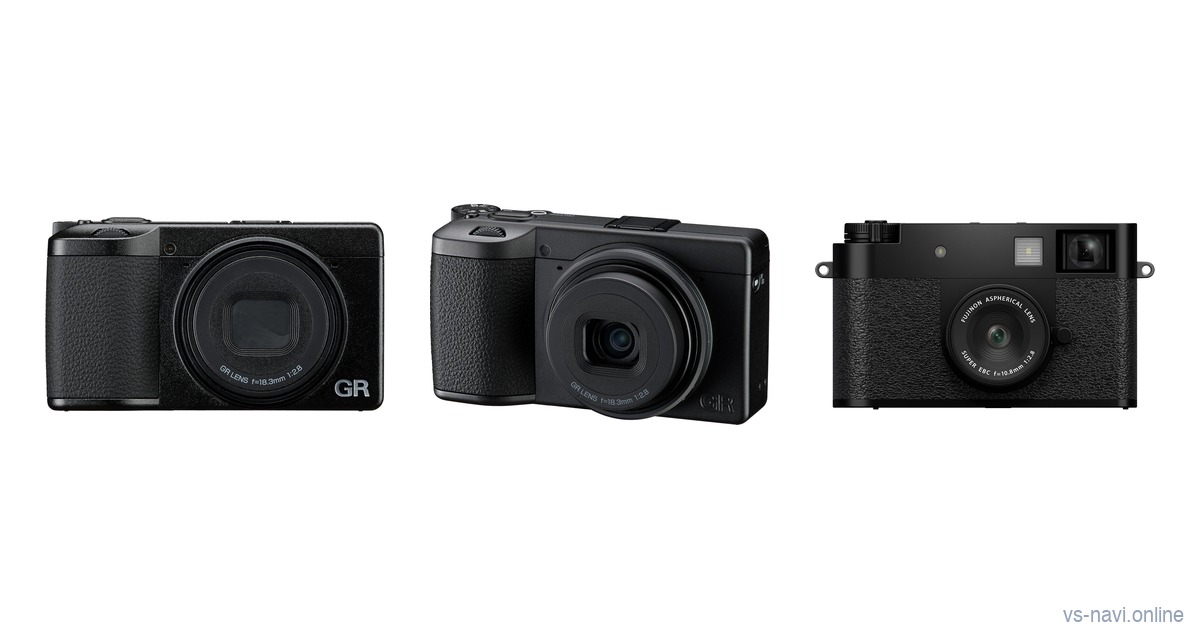
Picture a small black camera in your jacket pocket, a strap around your wrist, no phone screen in sight. That is the 2026 digicam mood.
The trend is real. In July 2026, YPulse reported that digicams are having a moment with teens and young adults again. It cited NPR figures showing Canon point-and-shoot sales jumped nearly sevenfold between 2022 and 2025. Young buyers say they want a slower, more offline way to keep memories.
Most cheap digicams cost under $200. But if you want a serious Japanese compact that still fits a pocket, three stand out on paper: the Ricoh GR IV HDF, the Ricoh GR IV Monochrome plus the Fujifilm X half. We compared them on published specs, maker information along with Amazon.com listings to help you pick.
Our Pick: Which Japanese Compact Fits You
- Ricoh GR IV HDF — around $1,696.99 on Amazon — best all-rounder, APS-C sensor with a built-in soft-glow filter for a film-like look.
- Ricoh GR IV Monochrome — list price $2,199.95 — black-and-white only, for street shooters who never want color.
- Fujifilm X half — launch list price $849 — the fun, affordable pick with vertical frames plus analog-style film looks.
Why Japanese Compacts Lead the Digicam Revival
Both brands come from Japan. Each has a long story with pocket cameras. Ricoh says its GR series turns 30 in 2026. The line goes back to the 1996 film camera called the RICOH GR1.
In Japan, the GR has a cult status with street photographers. Ricoh even runs GR SPACE showrooms where new models go on display. The GR IV also won Best APS-C Compact Camera at the 2026 TIPA Awards, according to Ricoh Imaging Americas.
Fujifilm was founded in 1934. It is famous for film stock plus its instant instax line. For instant prints on a smaller budget, see our instax mini 13 vs mini 12 vs mini 41 guide. The X half brings that film heritage into a digital body. In Japan it launched at ¥118,800 in 2025. It later won an Editor’s Choice award at the Camera Grand Prix 2026.
A quick note: there is also a standard Ricoh GR IV. It shares the same body as the HDF version, without the diffusion filter. We left it out of this comparison because we could not find a regular Amazon.com listing for it.
Ricoh GR IV HDF (Around $1,696.99 on Amazon)
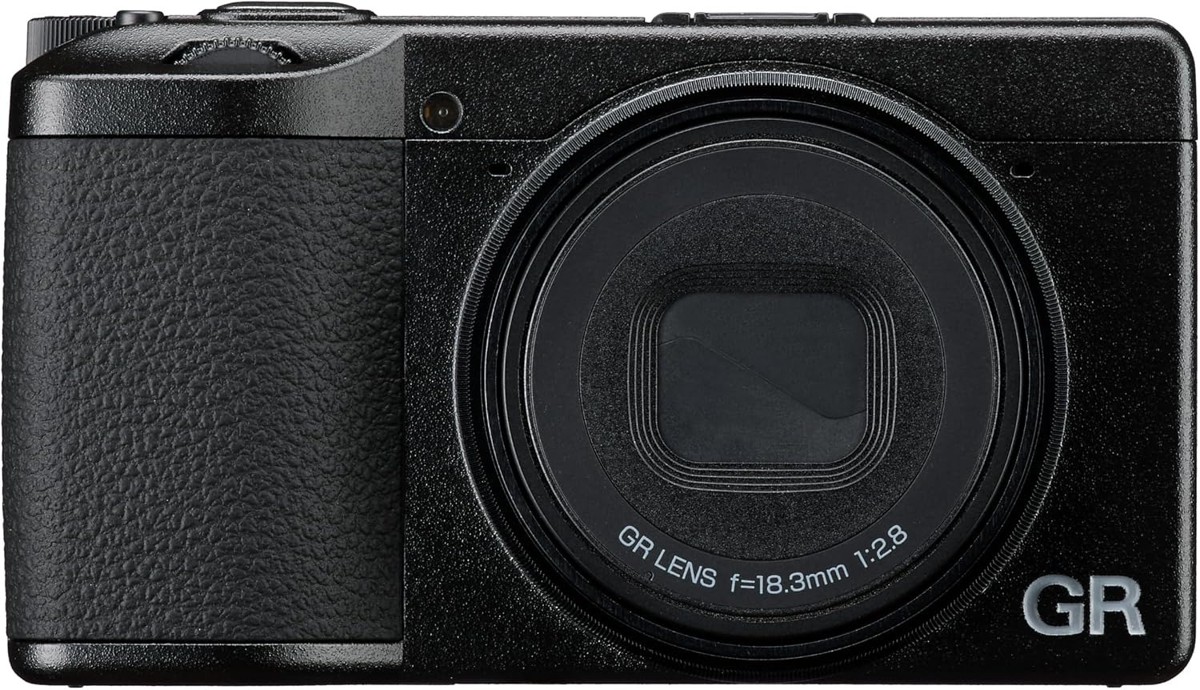
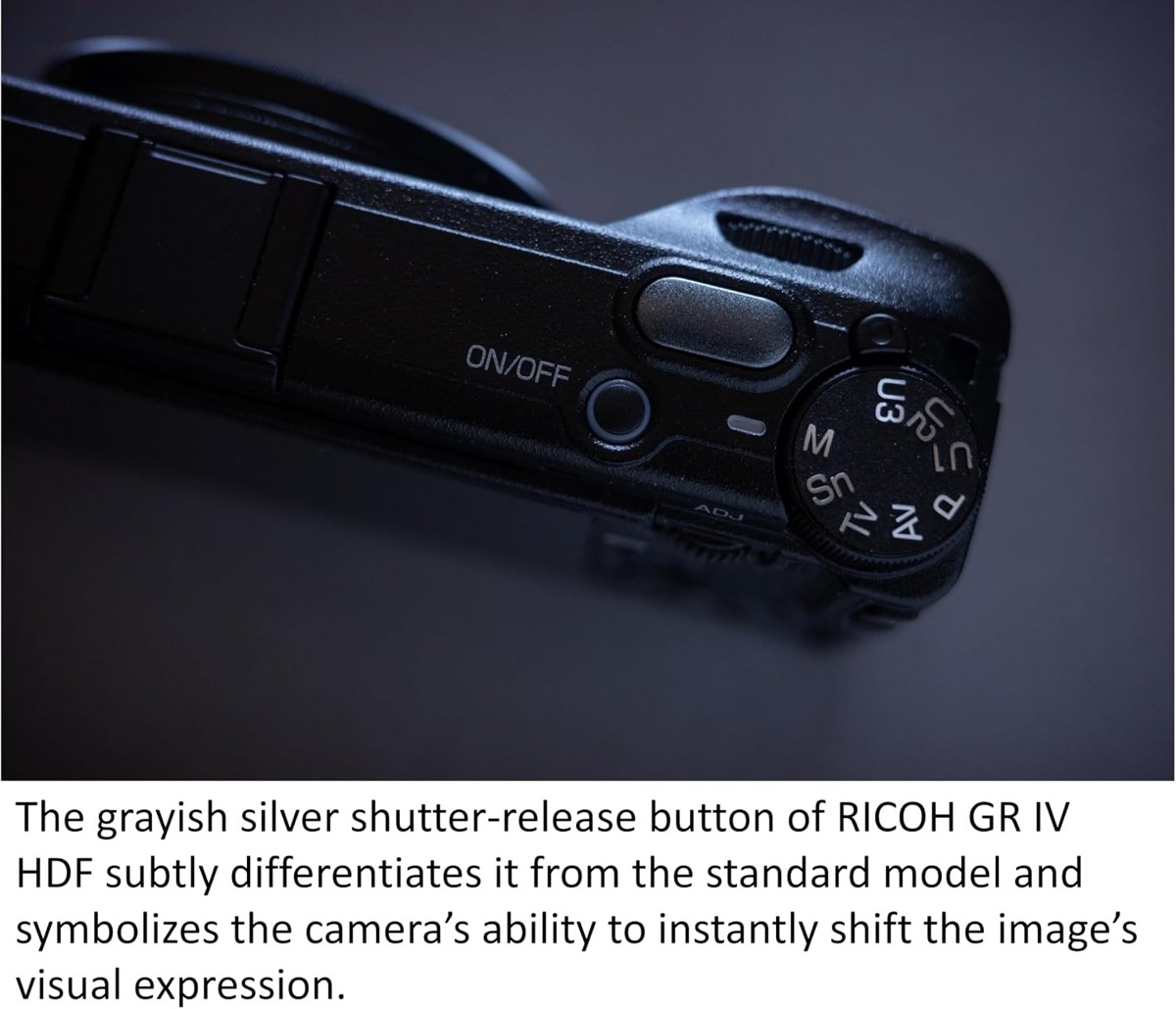
The GR IV HDF is the standard GR IV with one twist. It has a built-in Highlight Diffusion Filter. Ricoh says it softens highlights for a film-like glow. You turn it on or off with one press, since the Fn button controls it by default.
Picture a city street at dusk. Neon signs and car lights bloom softly instead of looking sharp and clinical. That is the look HDF is built for. Turn it off for crisp daytime shots.
Under the hood, you get a 25.74MP APS-C size sensor plus an 18.3mm F2.8 lens. That equals about 28mm on a full-frame camera, a classic wide view for streets or travel. ISO goes up to 204800. A 5-axis stabilizer helps in low light. The camera starts in about 0.6 seconds, per the Amazon listing.
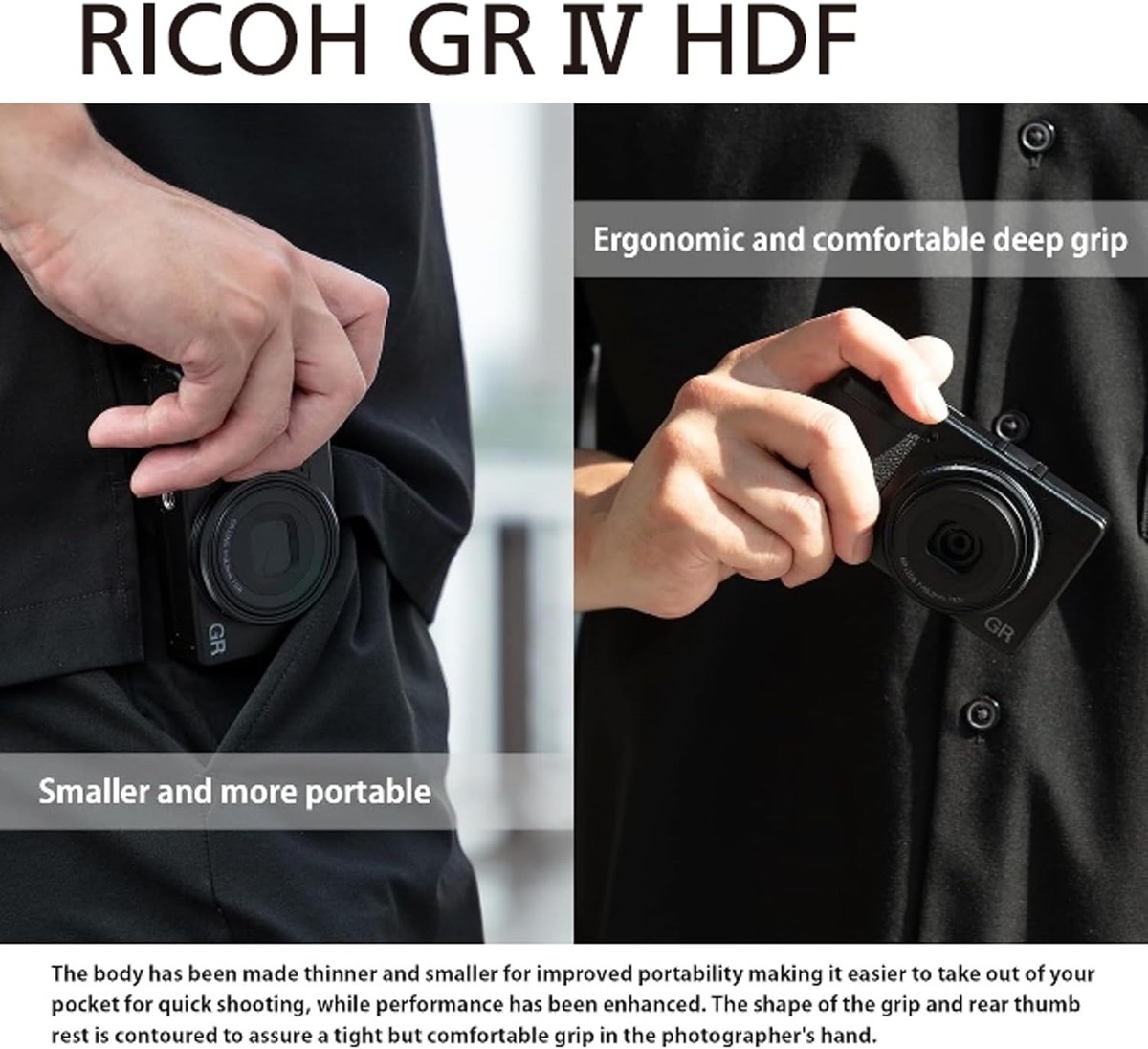
It is small for an APS-C camera. The body measures about 109.4 x 61.1 x 32.7 mm. It weighs about 262 g with battery plus card, so it sits in a coat pocket without pulling it down. There is 53GB of internal memory too, so a forgotten card does not end your day. On Amazon it holds 4.4 out of 5 stars from 17 ratings.
Downside: Ricoh notes the HDF version drops the built-in ND filter of the standard GR IV. On bright days at F2.8 you may need the electronic shutter. Battery life is also modest, about 250 shots per charge by CIPA standard. The Amazon price was also above Ricoh’s $1,599.95 MSRP when we checked.
Ricoh GR IV Monochrome (List Price $2,199.95)
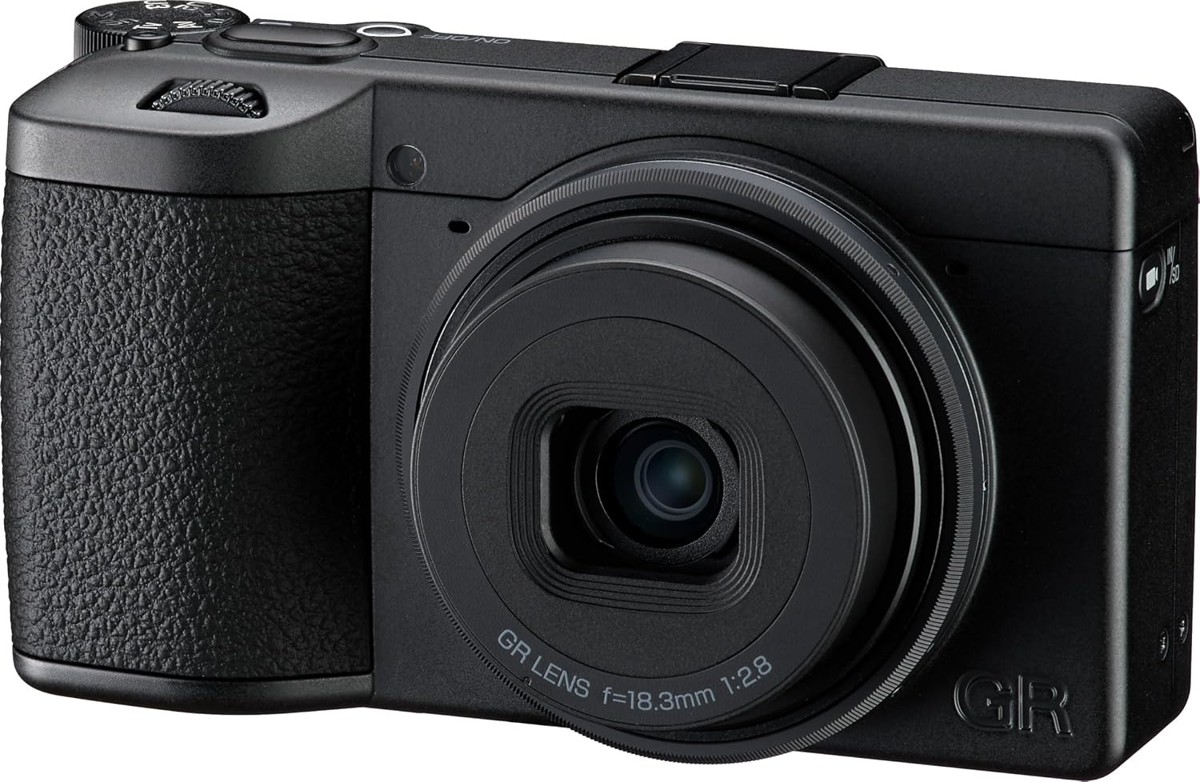
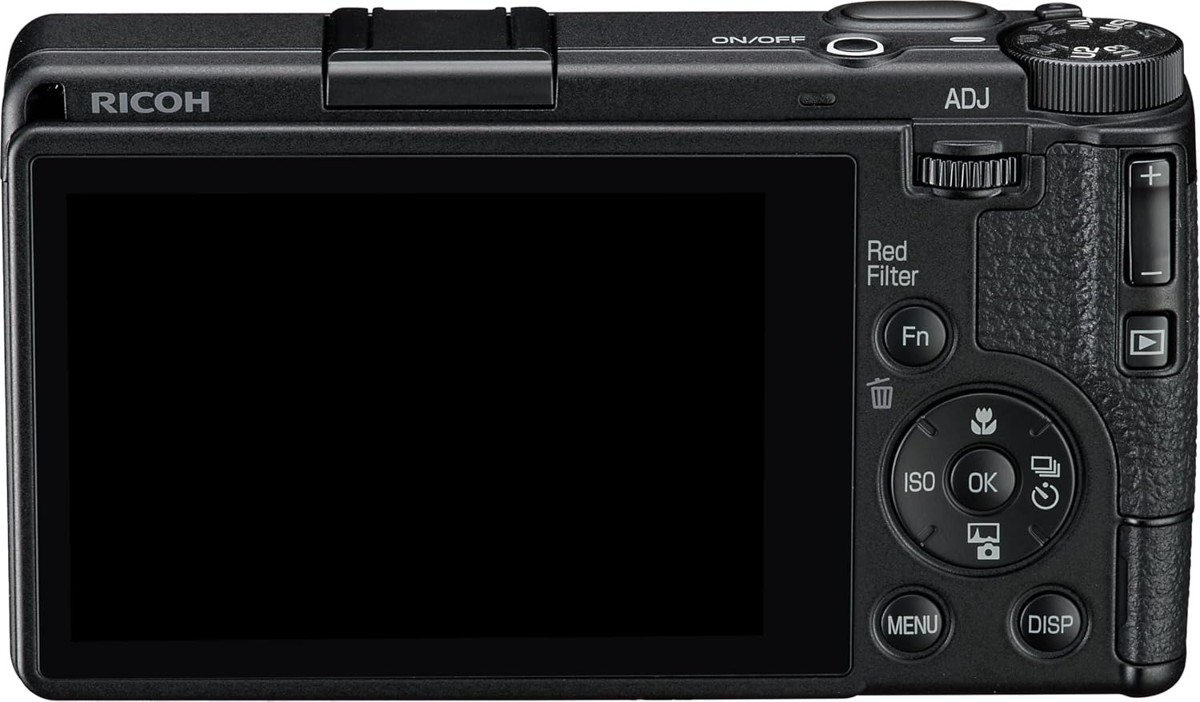
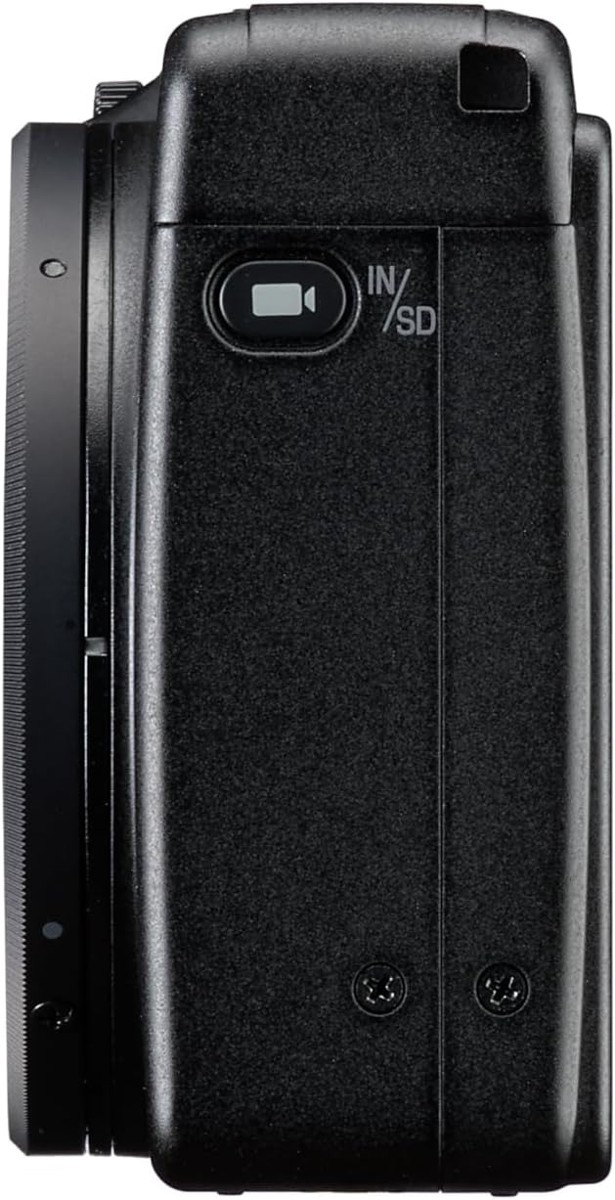
The GR IV Monochrome shoots only black and white. That is not a filter setting. Ricoh built it around a dedicated 25.74MP monochrome sensor with no color filters plus no AA filter. Every pixel records brightness only.
Why does that matter? Without a color filter on top, each pixel gets more light. Ricoh rates ISO up to 409600, double the color GR IV. Think of a rainy night alley or a dim jazz bar. This camera is made for exactly those grainy, moody scenes.
It also has a red filter built into the lens unit. Black-and-white film shooters used red filters to darken blue skies so clouds pop. Here you flip it on with one button. New Image Control modes called Solid plus Grainy add more classic mono looks.
The lens is the same 28mm-equivalent F2.8 GR lens. The body weighs about 262 g with battery plus card, the same as the HDF. The electronic shutter reaches 1/16000 sec, so you can shoot wide open in bright sun. On Amazon it shows 4.1 out of 5 stars from 18 ratings.
Downside: it is the most expensive camera here. You also give up color for good, so it cannot be your only camera for family trips. Our Amazon check could not see a price for this listing, so confirm stock before you plan around it.
Fujifilm X half (Launch List Price $849)
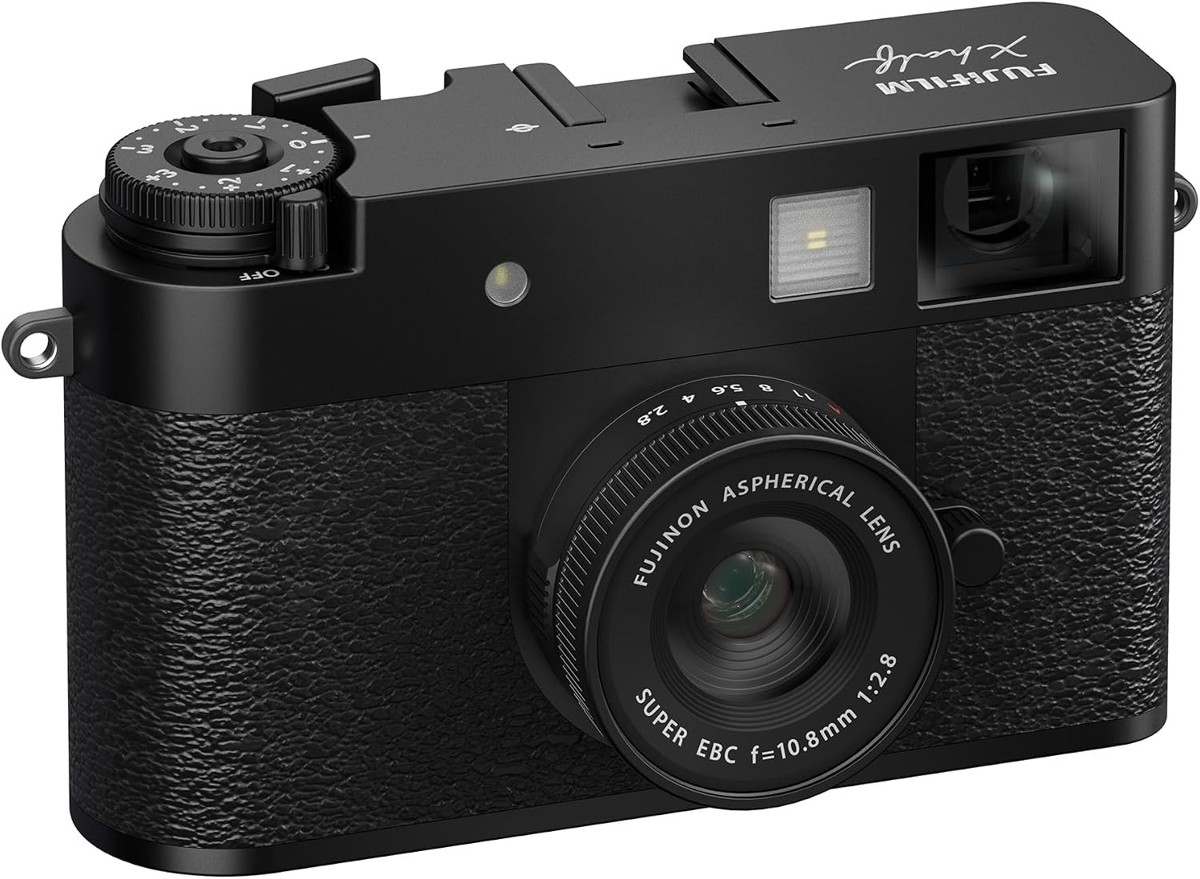
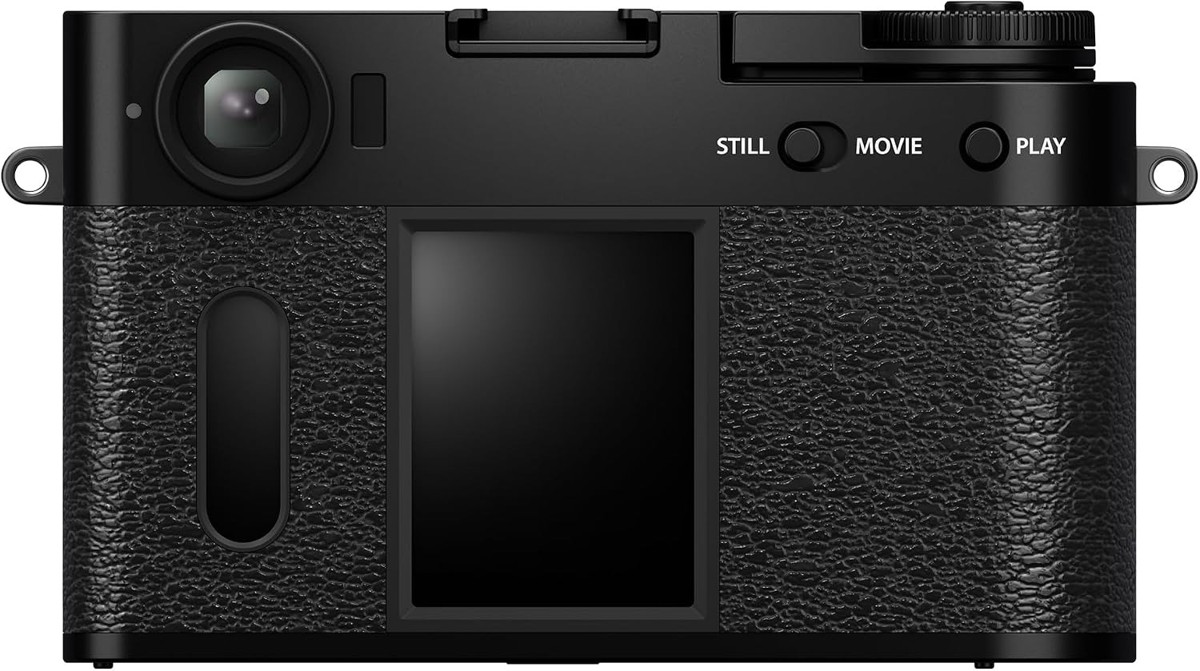
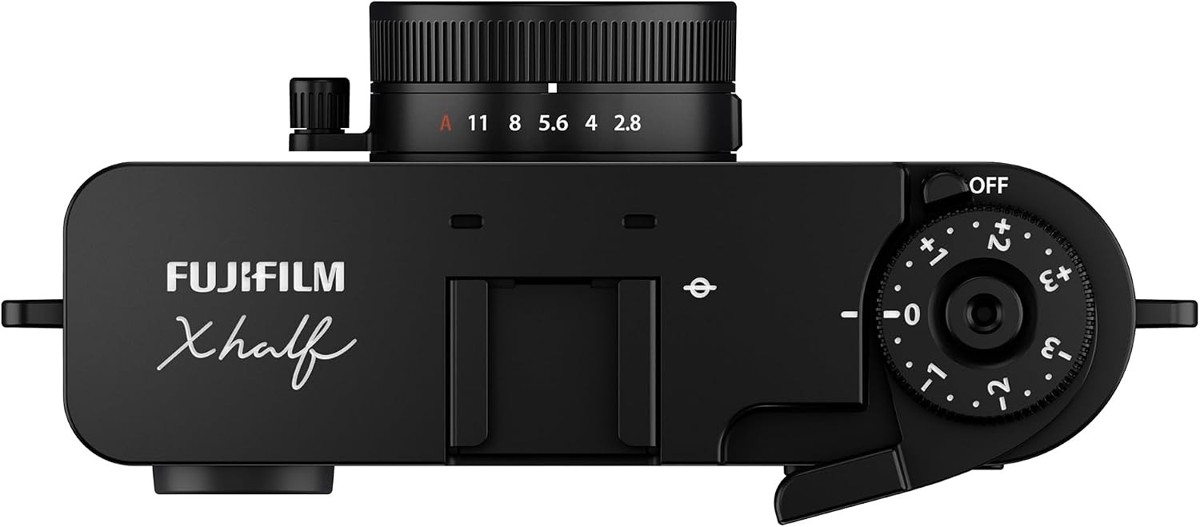
The X half is the playful one. It copies the idea of old half-frame film cameras. The 1-inch sensor is mounted on its side, so photos come out vertical by default. That suits phone screens plus social feeds without cropping.
It has a fixed 10.8mm F2.8 lens, about 32mm in full-frame terms. Resolution is about 18MP. You frame through a small optical viewfinder or a 2.4-inch touch screen. A lever that looks like a film winder lets you shoot as if you were advancing film.
Fujifilm leans hard into fun. The Amazon listing mentions 26 analog-inspired film plus filter options. A 2-in-1 mode combines stills or video into one creative frame. You can also print straight to a compatible instax printer. Imagine a birthday party where you snap, pair two shots, then hand out a print a minute later.
At about 240 g with battery plus card, it is the lightest camera here. It measures about 105.8 x 64.3 x 45.8 mm, a bit thicker than the GR. On Amazon it holds 3.9 out of 5 stars from 84 ratings, the most ratings of the three.
Downside: the 1-inch sensor is much smaller than the APS-C sensors in the Ricohs. Expect less detail plus more noise in dark rooms. ISO tops out at 12800 with a fastest shutter of 1/2000 sec. Our Amazon check could not see a current price either.
Compare the Three
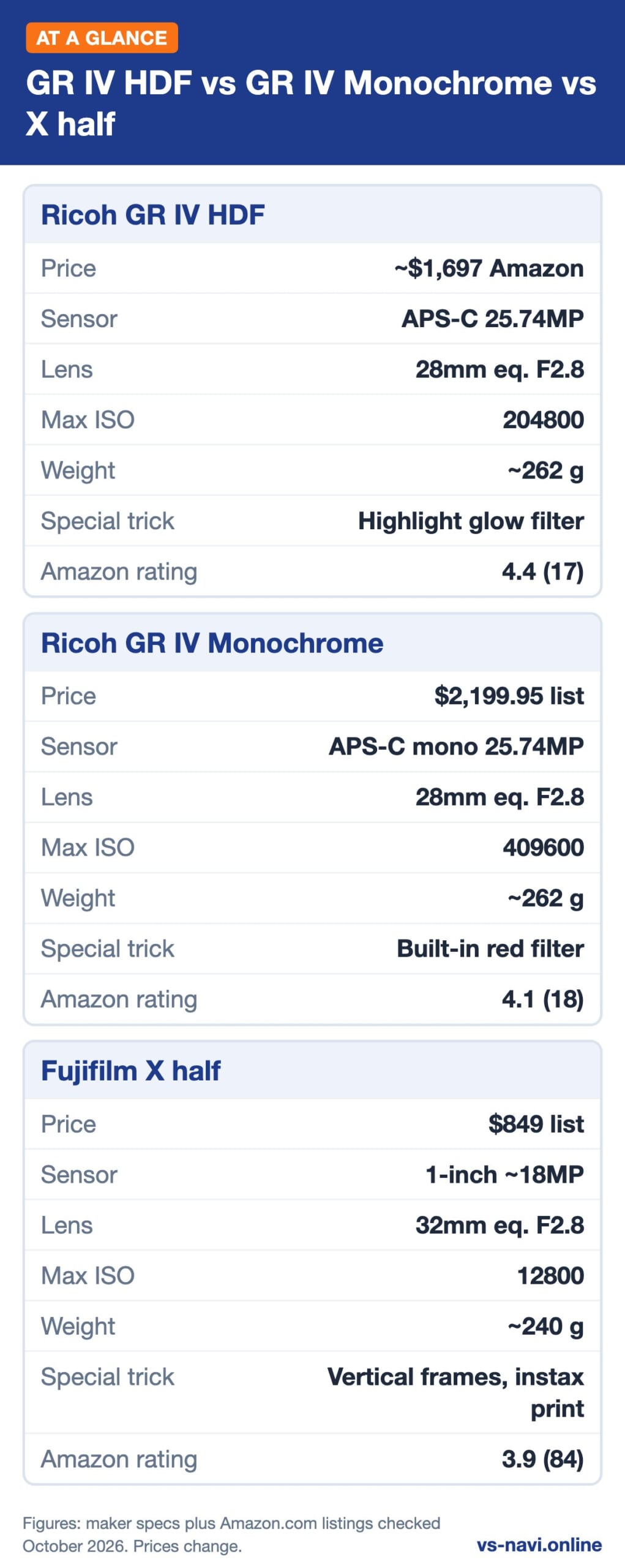
| Spec | GR IV HDF | GR IV Mono | X half |
|---|---|---|---|
| Price | ~$1,697 Amazon | $2,199.95 list | $849 list |
| Sensor | APS-C 25.74MP | APS-C mono 25.74MP | 1-inch ~18MP |
| Lens | 28mm eq. F2.8 | 28mm eq. F2.8 | 32mm eq. F2.8 |
| Max ISO | 204800 | 409600 | 12800 |
| Weight | ~262 g | ~262 g | ~240 g |
| Special trick | Highlight glow filter | Built-in red filter | Vertical frames, instax print |
| Amazon rating | 4.4 (17) | 4.1 (18) | 3.9 (84) |
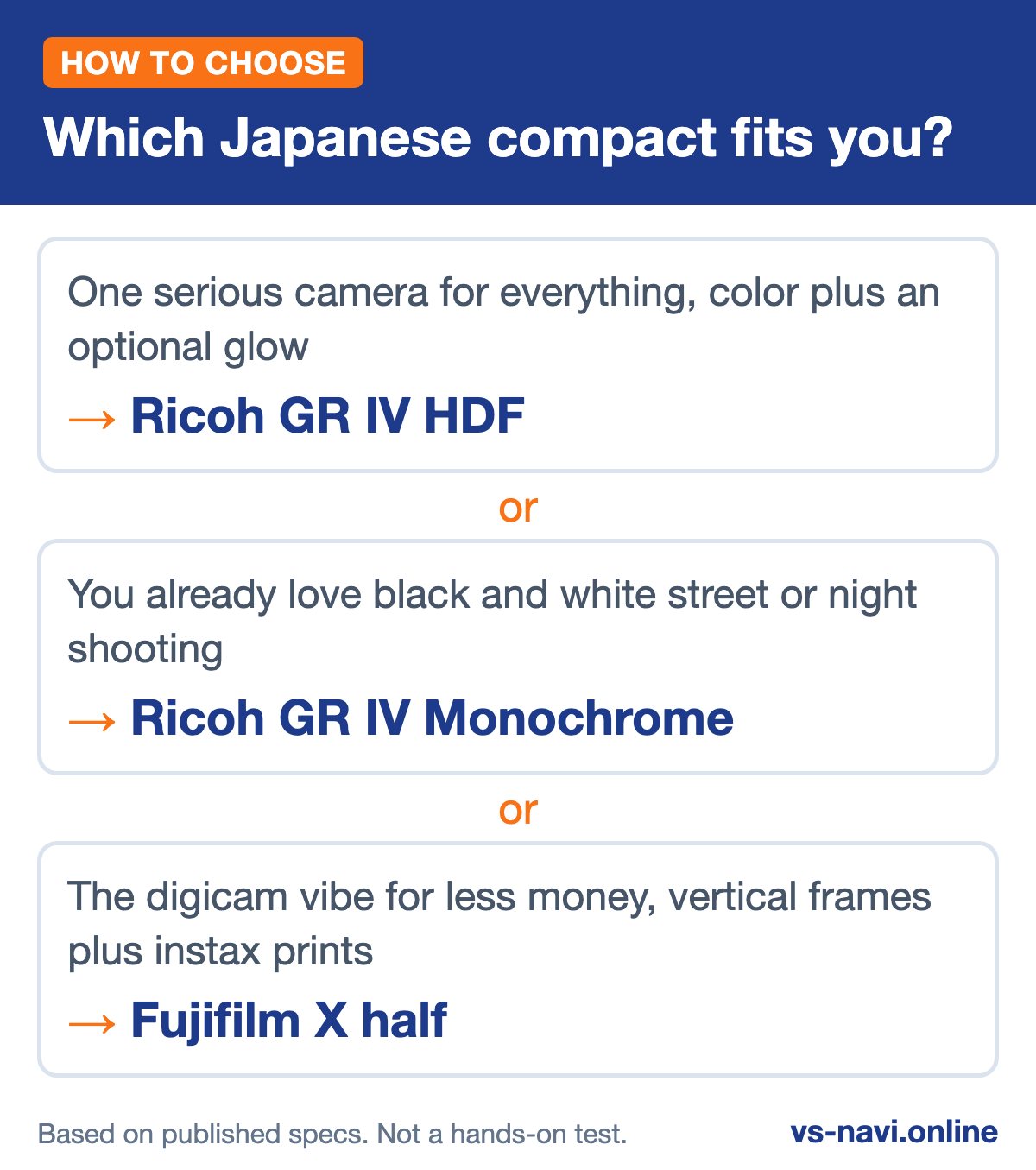
Choose the GR IV HDF if you want one serious camera for everything. You get a large sensor, color photos plus an optional dreamy glow. It is the safest buy for most people who can afford it.
Choose the GR IV Monochrome if you already know you love black and white. It is a specialist tool for street or night shooting. Pair it with your phone for color.
Choose the Fujifilm X half if you want the digicam vibe for less money. It is light, playful plus made for vertical sharing. Image quality is a step down, but the price is far lower too.
Summary
- Best overall: Ricoh GR IV HDF, an APS-C pocket camera with a one-touch film-like glow.
- Best for black and white: Ricoh GR IV Monochrome, with a dedicated mono sensor up to ISO 409600.
- Best value plus most fun: Fujifilm X half, vertical half-frame shots with instax printing.
Frequently Asked Questions
What does HDF mean on the Ricoh GR IV HDF?
HDF stands for Highlight Diffusion Filter. It is a filter built into the camera that softens bright highlights for a gentle, film-like glow. You can switch it on or off with the Fn button.
Can the GR IV Monochrome take color photos?
No. Its sensor has no color filters, so every image is black and white. That design lets each pixel collect more light, which is why Ricoh rates it up to ISO 409600.
Why does the Fujifilm X half shoot vertical photos?
The X half copies old half-frame film cameras. Its 1-inch sensor is mounted on its side, so photos come out in portrait orientation by default. That fits phone screens plus social feeds well.
Is there a regular Ricoh GR IV too?
Yes. The standard GR IV shares the HDF model’s body plus sensor but keeps a built-in ND filter instead of the diffusion filter. We did not find a regular Amazon.com listing for it, so it is not linked here.
Are these cameras good for beginners?
The X half is the easiest place to start, with dial controls plus ready-made film looks. The GR IV models are simple to carry but reward users who already enjoy photography.
Prices along with ratings were checked on Amazon.com in October 2026. Prices change often, so check the current price on Amazon before buying. GR IV Monochrome list price is Ricoh Imaging Americas MSRP; X half list price is its US launch MSRP as listed by DPReview.
Sources: Ricoh Imaging Americas (GR IV HDF launch, GR IV Monochrome launch, TIPA 2026 award news), Ricoh Imaging GR IV specifications, Fujifilm corporate profile, DPReview X half specifications, YPulse (July 23, 2026), Wikipedia entry for the Fujifilm X half.