Our pick for the best Japanese kiritsuke knife in 2026 is the Shun Classic 8" Kiritsuke — check its price on Amazon. The kiritsuke (切つけ) is the prestige "head chef's" knife of the Japanese kitchen — a long, flat-profiled blade with a dramatic angled (k-tip) point that handles like a gyuto but slices like a slicer. We compared three genuine Made-in-Japan double-bevel kiritsuke across the price ladder: the value Yoshihiro Super Blue (Aogami Super carbon), the all-round Shun Classic (stainless VG-MAX Damascus), and the premium Miyabi Birchwood SG2. Here is which to buy.
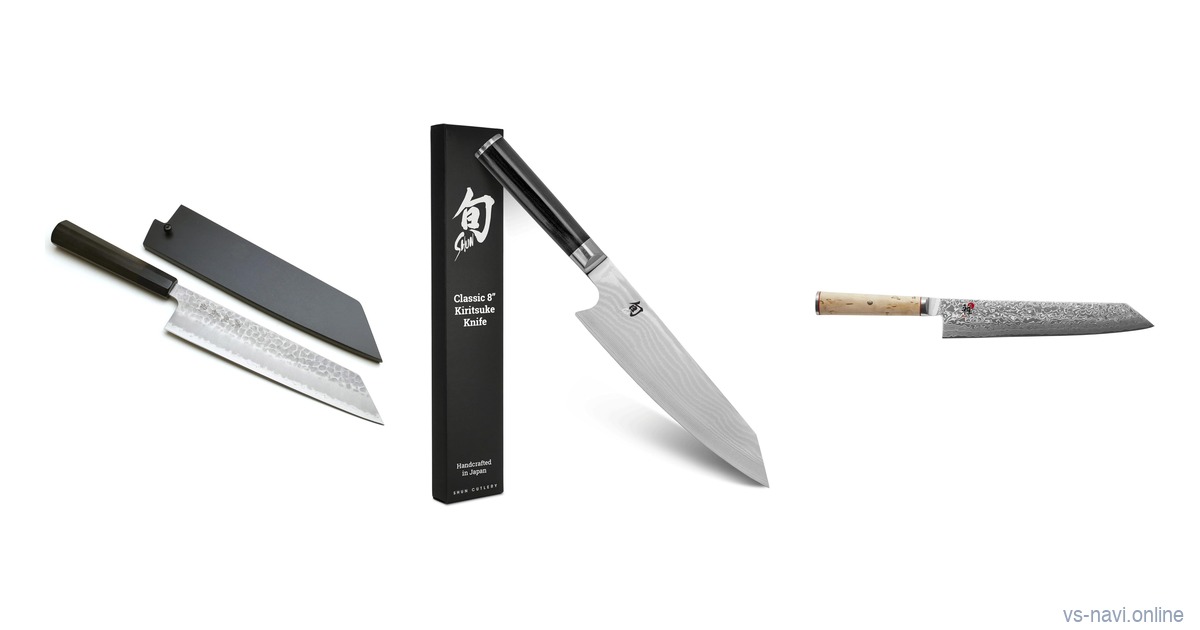
Quick Picks — Our Top Three Kiritsuke Knives
Short on time? Here is the one-line verdict for each cook.
Specs Comparison — Three Kiritsuke Knives Side by Side
| Yoshihiro Super Blue | Shun Classic Kiritsuke | Miyabi Birchwood SG2 | |
|---|---|---|---|
| Blade length | 180 mm (7.0 in) | 203 mm (8.0 in) | 240 mm (9.5 in) |
| Core steel | Aogami "Super Blue" carbon (clad) | VG-MAX (68-layer Damascus clad) | SG2/R2 powder steel (101-layer) |
| Hardness (HRC) | ~64–65 | ~60–61 | ~63 |
| Edge angle (per side) | ~15° | ~16° | ~9.5–12° |
| Steel type | Reactive carbon (will patina) | Stainless (low-maintenance) | Stainless powder steel |
| Handle | Octagonal rosewood wa-handle | D-shaped ebony PakkaWood | Karelian birchwood wa-handle |
| Saya (sheath) | Magnolia saya included | None | None |
| Made in | Sakai, Japan | Seki, Japan | Seki, Japan |
| Price (2026) | around $120 | around $190 | around $385 |
| Amazon rating | 4.5 / 5 | 4.8 / 5 | 4.8 / 5 |
Specs reflect the standard double-bevel kiritsuke (kiritsuke-gyuto) models of each line. Prices are 2026 US street prices and move often — always confirm the live figure before buying.
Yoshihiro Super Blue 180mm — The Best-Value & Sharpest Kiritsuke
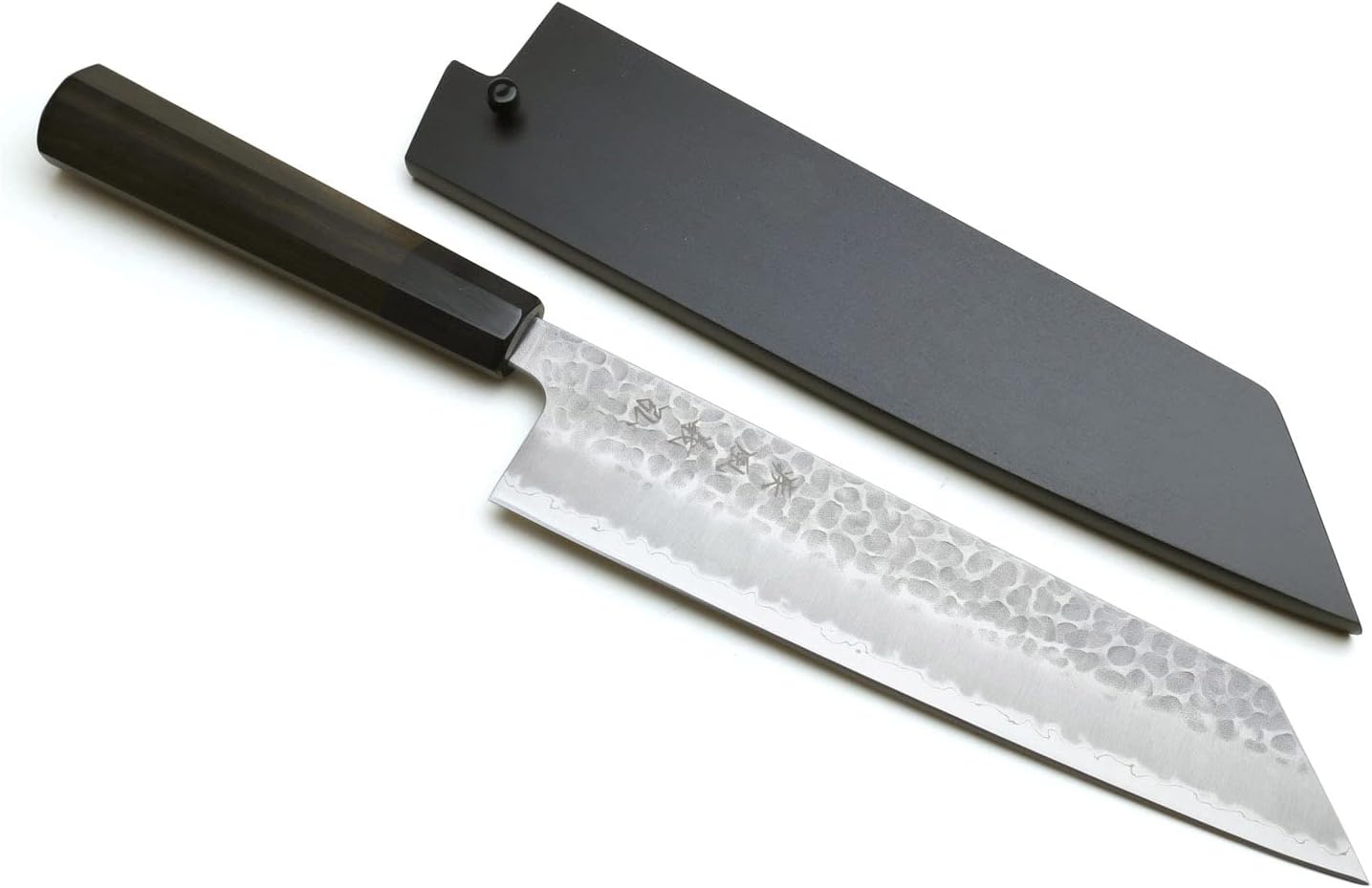
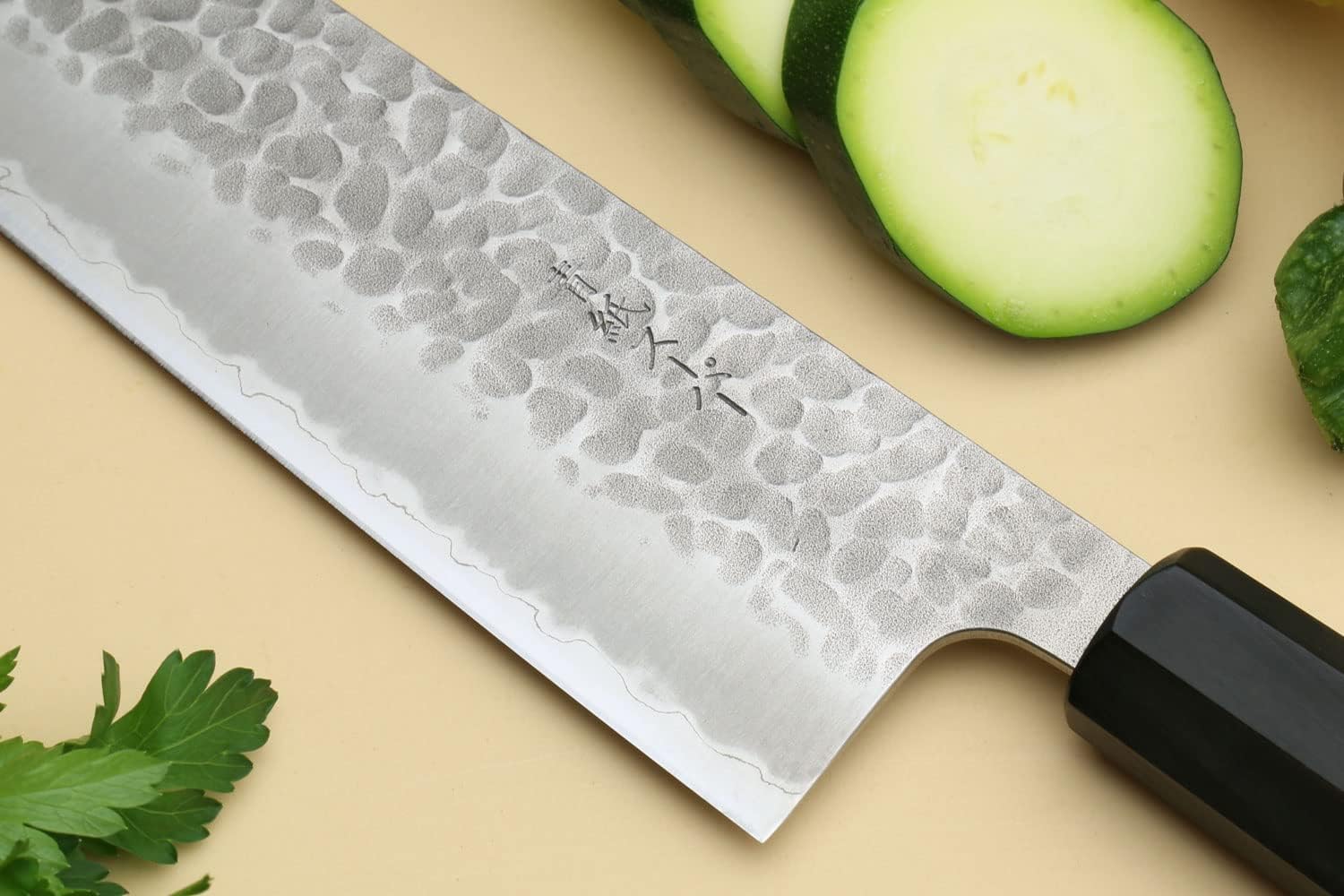
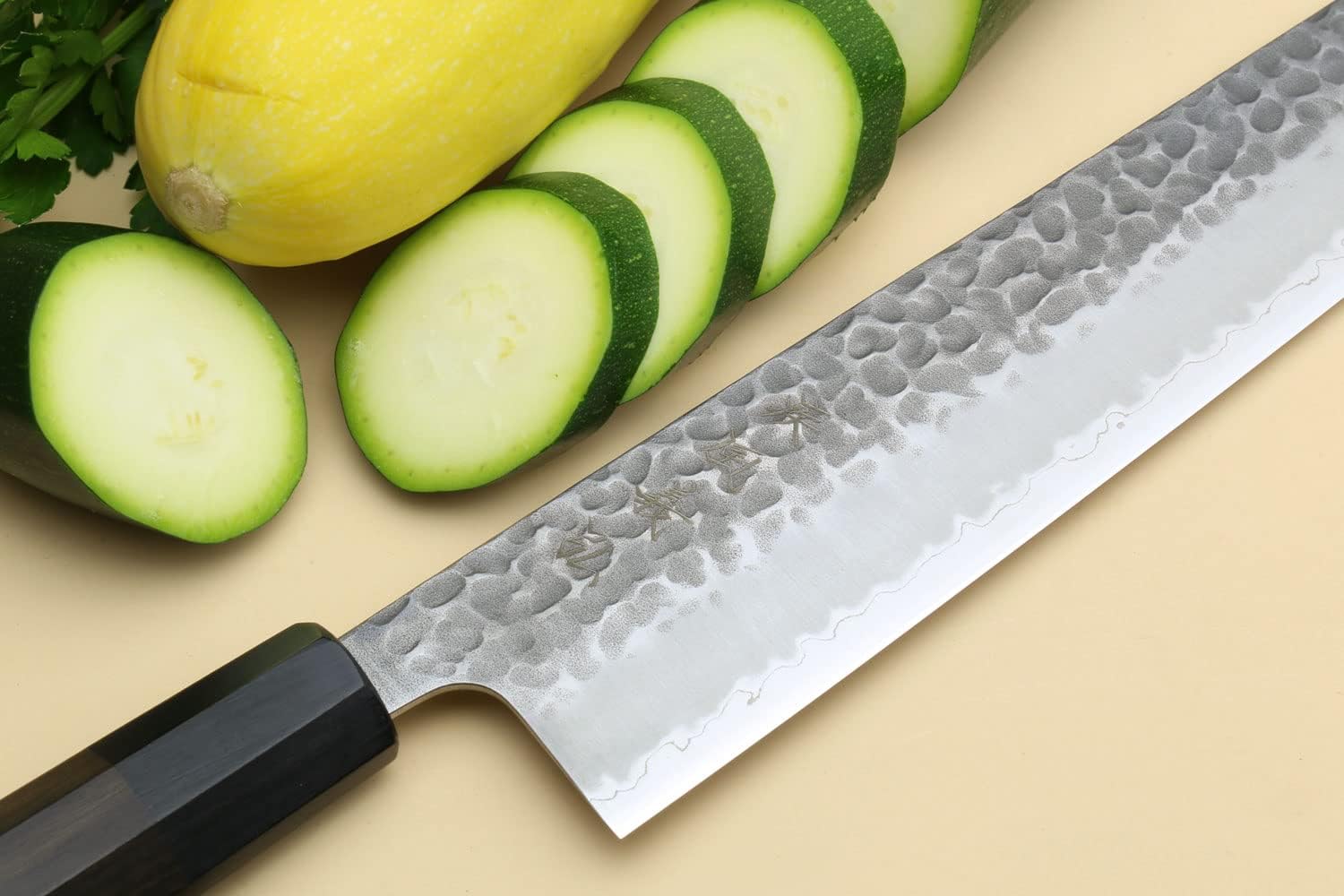
If you want the sharpest edge here and a real Sakai-forged kiritsuke without paying premium money, the Yoshihiro Super Blue is the easiest of the three to recommend. It pairs an Aogami "Super Blue" carbon core — a high-carbon steel famous for taking an almost frightening edge and holding it — with a hand-hammered (tsuchime) finish and an octagonal rosewood wa-handle, and it ships with a fitted magnolia saya. At around $120 it is by far the most knife-per-dollar in this comparison.
The catch is the steel type. Aogami Super is reactive carbon, not stainless: it will develop a grey patina, and it must be dried immediately or it can spot-rust. In exchange you get a hardness of roughly HRC 64–65 — harder than either stainless rival — which means a thinner, keener edge that bites into a tomato skin with almost no pressure. For a cook who is willing to wipe the blade between cuts, this is the most exciting kiritsuke on the list.
The Brand in Japan
Yoshihiro is a Tokyo-based cutlery house that sources blades from Japan's traditional smithing regions, most notably the Sakai (Osaka) cluster that has forged professional Japanese-cuisine knives for some 600 years. Domestically the name carries a craftsman-export reputation: Yoshihiro built its profile supplying serious home cooks and professionals with hand-finished single- and double-bevel knives. Aogami Super (青紙スーパー) is a Hitachi Yasugi specialty steel revered among Japanese sharpening enthusiasts, and a hammered Aogami kiritsuke with a saya at this price is the sort of value the brand is known for.
Real-World Usage
On the board the Super Blue feels alive. The flat profile and acute k-tip make push-cutting herbs and precise tip work feel effortless, and the thin hard edge glides where softer stainless would wedge. The trade-off is care: wipe it dry after each ingredient, never leave it wet in the sink, and a light coat of camellia oil before long storage keeps the carbon happy. Treat it like a cast-iron pan, not a dishwasher knife, and it rewards you with the keenest edge in this guide.
✅ Pros
- Sharpest, hardest edge here — Aogami Super at ~HRC 64–65 takes and holds a screaming edge.
- Outstanding value — a real Sakai-forged, hand-hammered kiritsuke with a saya for around $120.
- Traditional wa-handle and tsuchime finish — light, lively balance and reduced food sticking.
❌ Cons (Honest Assessment)
- Reactive carbon steel — patinas and can spot-rust; strictly hand-wash and dry immediately.
- Not beginner-friendly — the hard edge can chip if abused, and the steel demands maintenance habits.
💬 What Users Are Saying
👤 Who Should Buy This
Cooks who already sharpen their own knives and want the keenest possible edge and the most character for the money — and who will hand-wash and dry a carbon blade. It is also a superb second knife for a gyuto owner who wants to try the kiritsuke shape without a premium spend.
Shun Classic 8" Kiritsuke — The Best Kiritsuke for Most Cooks
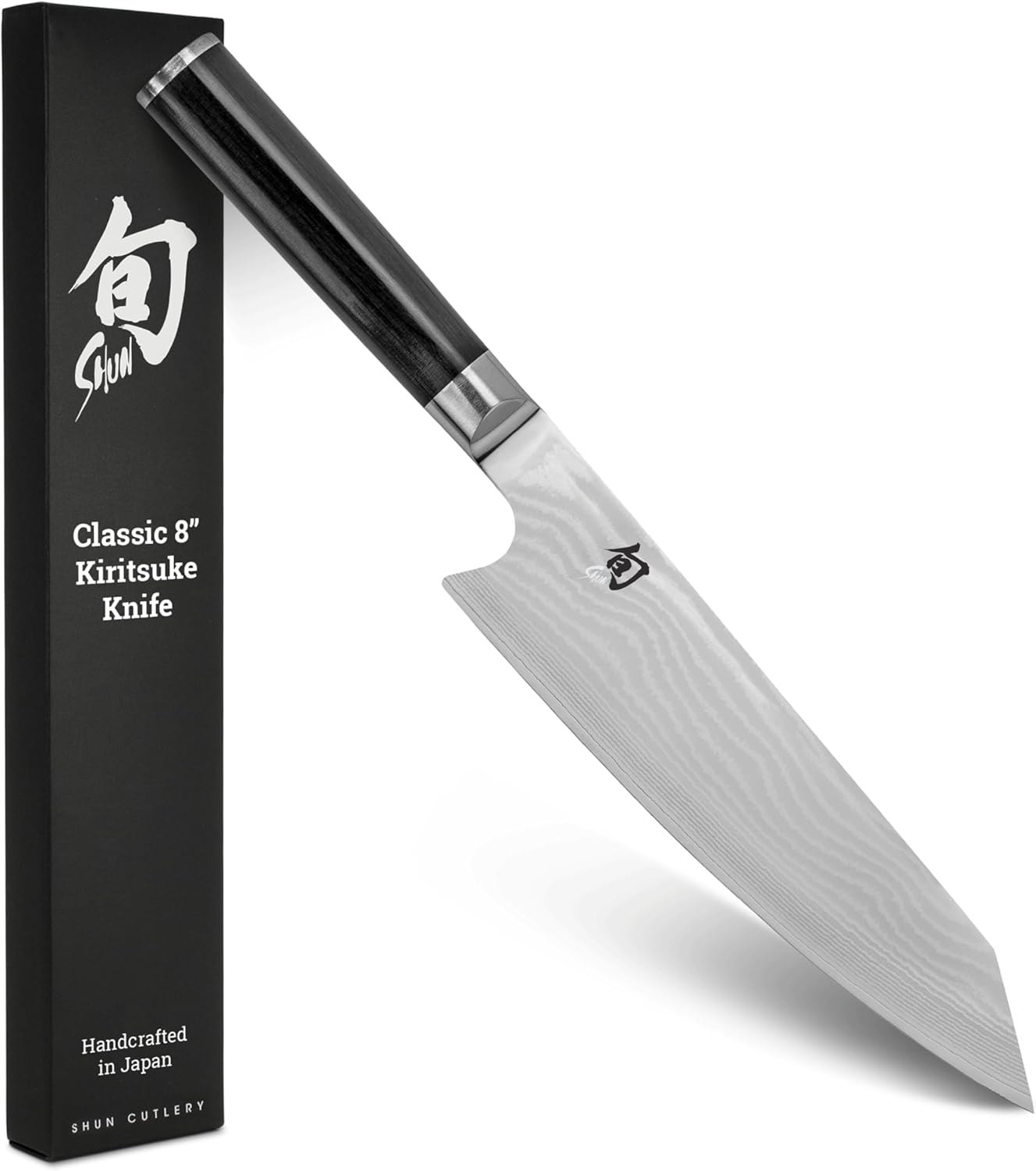
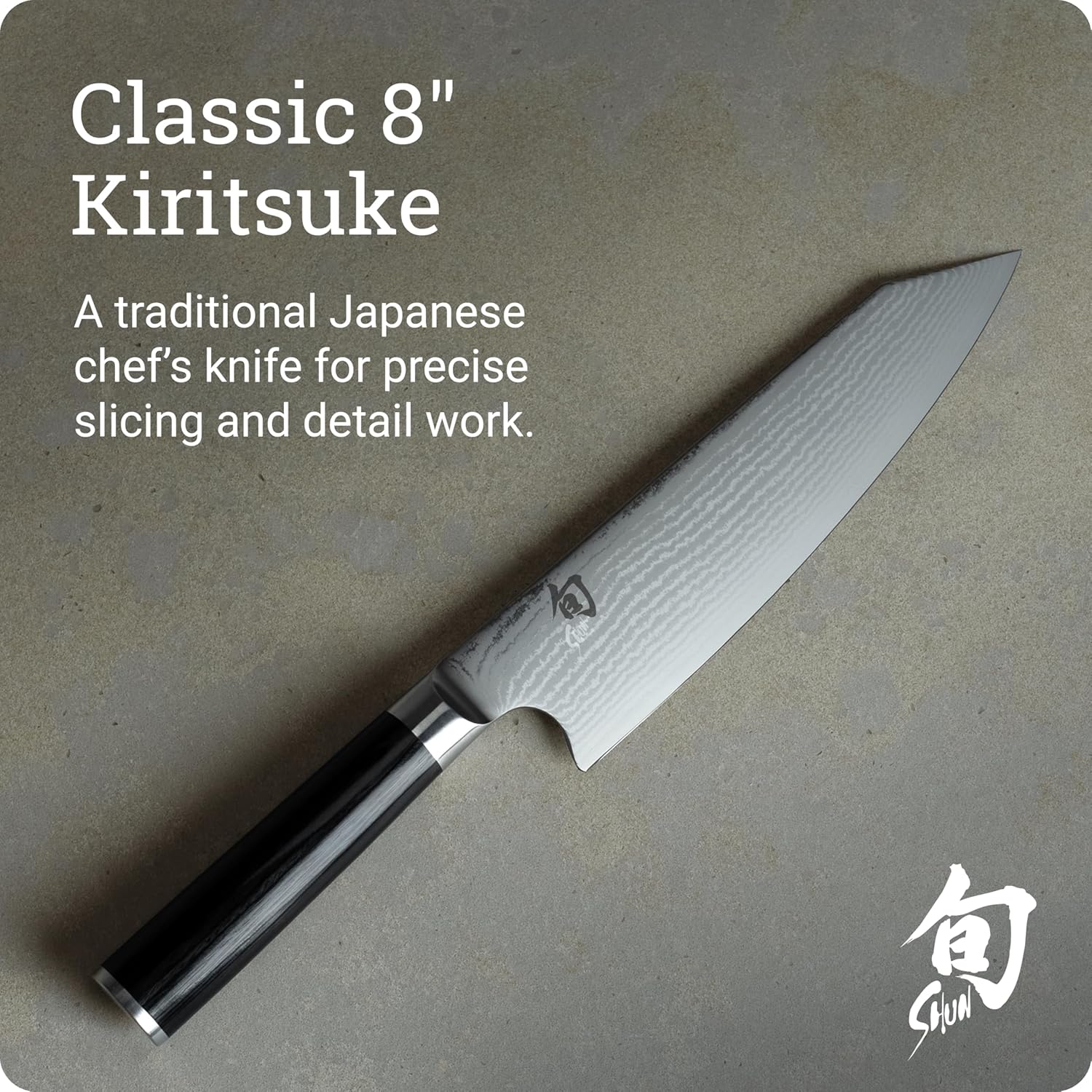
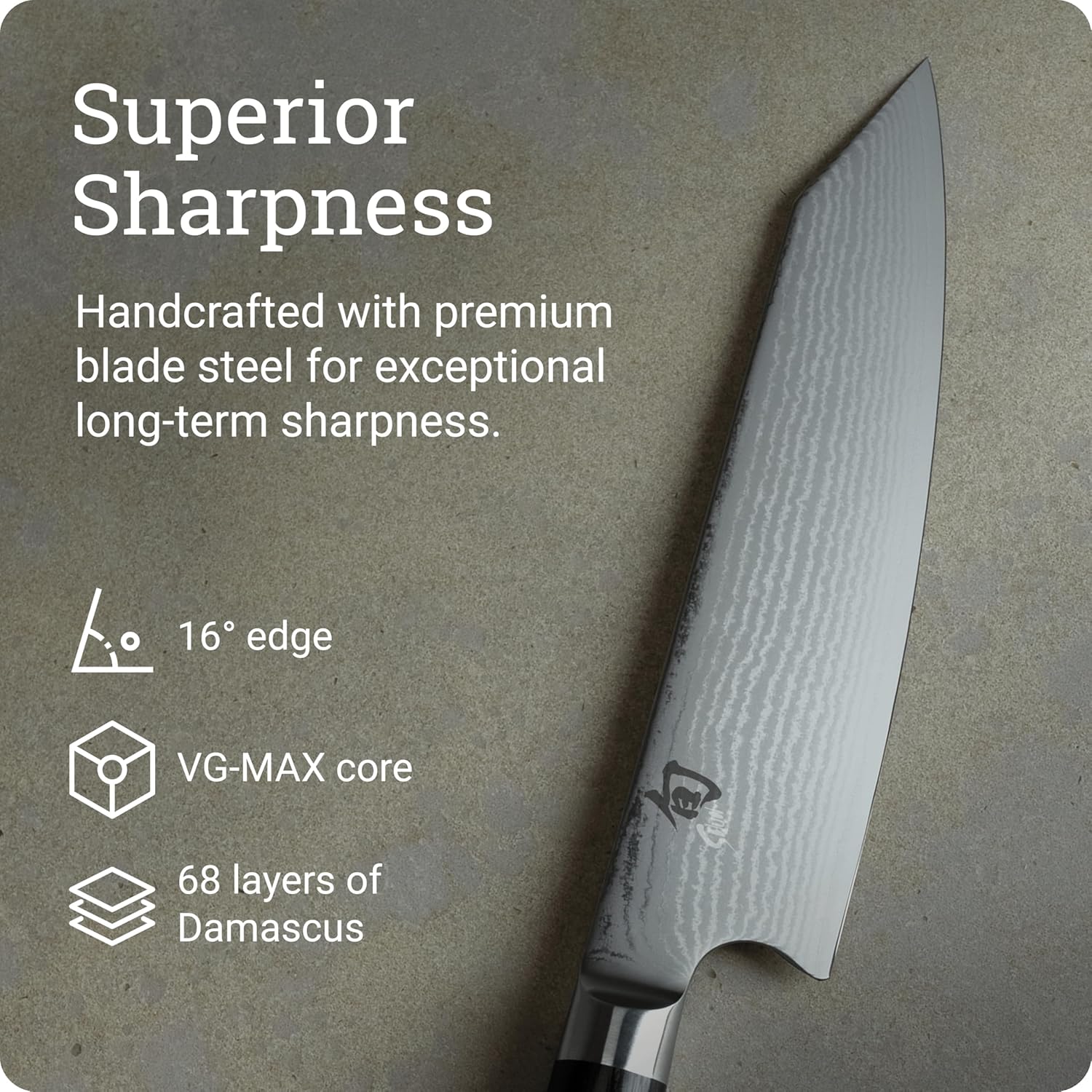
The Shun Classic Kiritsuke is the knife we recommend to the most people, because it delivers the kiritsuke shape with none of the carbon-steel babysitting. It wraps a hard VG-MAX stainless core in 68 layers of Damascus stainless, finishes it with Shun's excellent D-shaped ebony-PakkaWood handle, and backs it with a lifetime warranty plus free sharpening. It is stainless, so a quick rinse and dry is all the care it needs — no patina, no rust anxiety.
At around $190 it sits in the middle of this trio, and it earns that spot on balance rather than extremes. The 16° hand-finished (Honbazuke) edge arrives genuinely sharp, the 8-inch length is the most manageable kiritsuke for a home kitchen, and the D-handle locks into a pinch grip better than the wa-handles on either rival. With nearly 3,800 Amazon ratings averaging 4.8 stars, it is also the most proven and supported choice here.
The Brand in Japan
Shun is the flagship kitchen line of Kai Corporation (貳削), one of Japan's largest blade makers, headquartered in Seki City, Gifu — the same 700-year sword-forging tradition behind many Japanese knives. Domestically, Kai is a household name spanning razors to surgical blades; the "Shun" (旬, the peak season for an ingredient) brand was developed largely for the premium export market. Among Japanese enthusiasts Shun is seen as beautifully made and beginner-friendly — a touch more "polished for export" than the austere artisan knives of Sakai, but unmatched on fit, finish, and after-sales support.
Real-World Usage
The Classic Kiritsuke is confidence-inspiring. The narrow, flat blade tracks straight through produce and boneless protein, the k-tip handles fine detail and scoring, and the stainless steel means you can hand it to a partner without a lecture about drying it. As with all three it is hand-wash only, and the D-handle is subtly right-hand-biased — left-handers should look for a dedicated lefty model. Kai's free honing and sharpening program is a genuine long-term perk.
✅ Pros
- Low-maintenance stainless — VG-MAX core means no patina and no rust anxiety; rinse, dry, done.
- Excellent D-shaped handle — one of the most comfortable, secure grips in the category.
- Lifetime warranty + free sharpening — Kai's US support is a real long-term advantage.
❌ Cons (Honest Assessment)
- Softer than its rivals — at ~HRC 60–61 it needs touch-ups sooner than the harder Yoshihiro and Miyabi.
- Right-hand-biased D-handle — left-handers must seek out the separate left-handed version.
💬 What Users Are Saying
👤 Who Should Buy This
Anyone who wants the kiritsuke shape as a daily driver without the maintenance of carbon steel — a first kiritsuke, a low-fuss everyday knife, or a gift. If you cannot decide between the three, buy this one and stop researching.
Miyabi Birchwood SG2 240mm — The Premium Showpiece

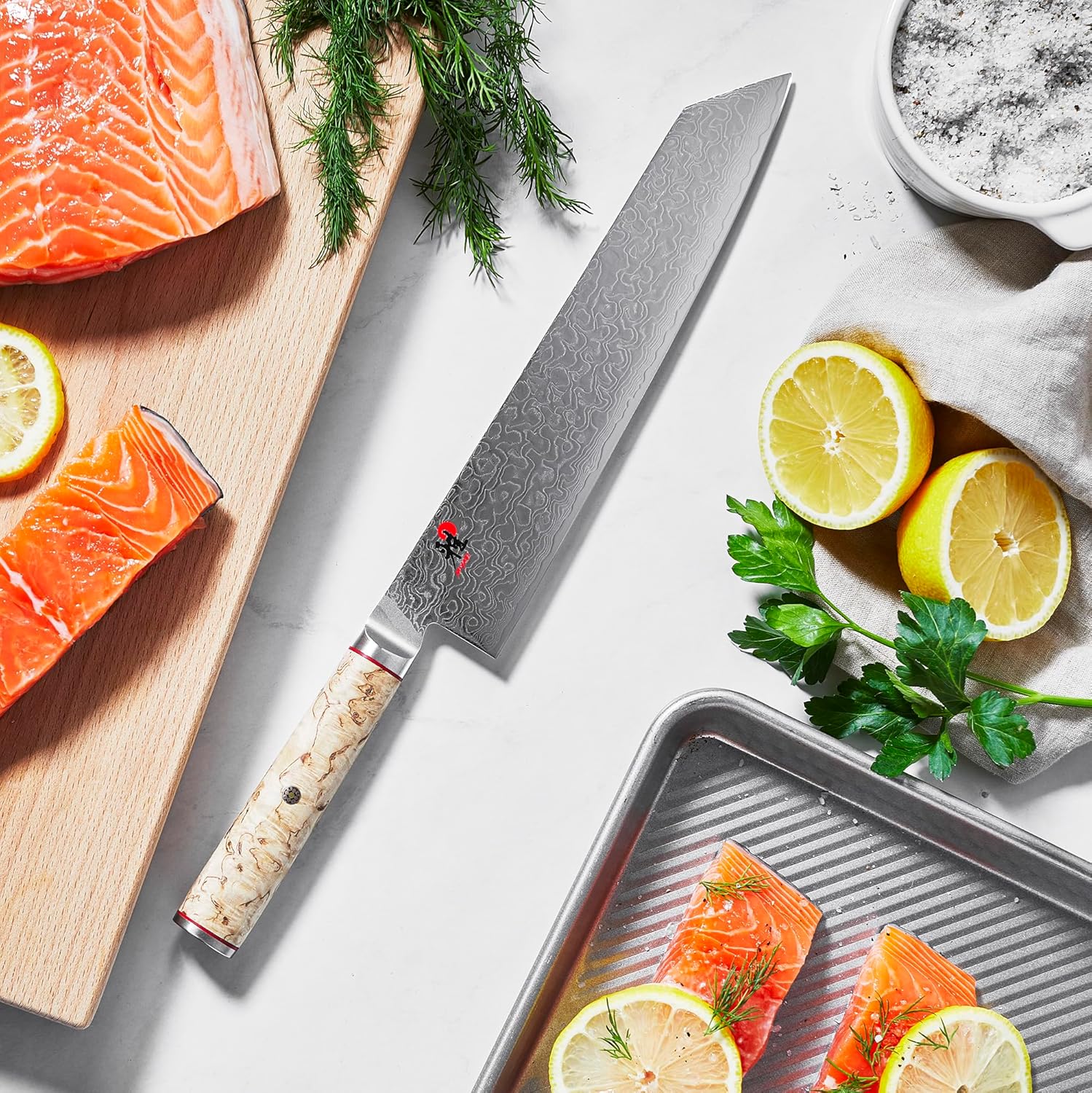
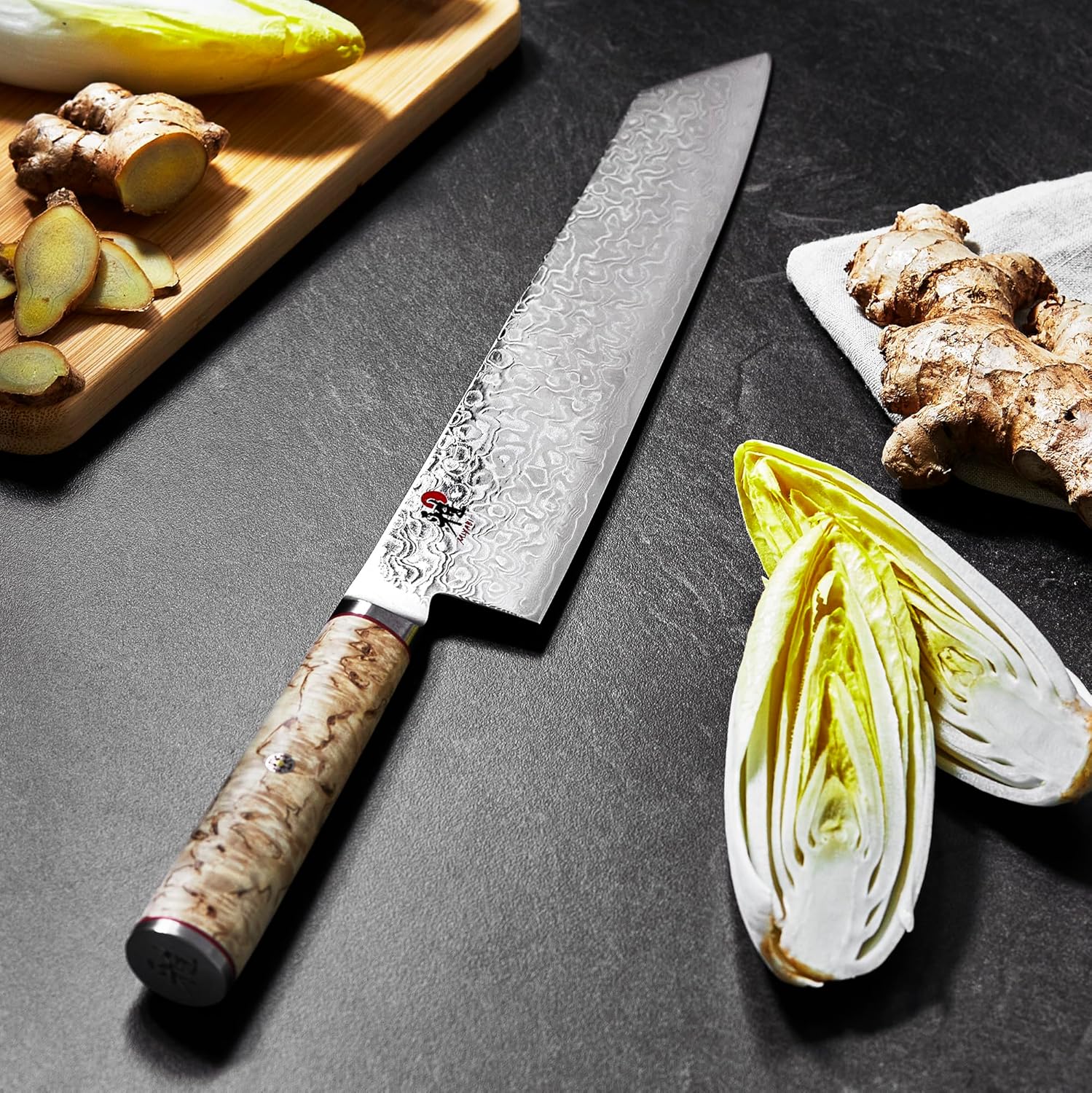
The Miyabi Birchwood SG2 is the splurge: a SG2 (R2) micro-carbide powder-steel core wrapped in 101 layers of flower-pattern Damascus, hardened to roughly HRC 63 by Miyabi's ice-hardening (CRYODUR) process, and finished with a stunning figured Karelian birchwood handle. The katana-style edge is ground to an astonishing ~9.5–12° per side — the most acute in this comparison — which makes it both the sharpest-feeling and the best at holding that edge over time.
It commands its price on materials and presentation as much as raw cutting. SG2 powder steel resists wear better than conventional stainless, the 240 mm length gives it the longest, most authoritative reach here, and the birch handle makes it the obvious centerpiece or once-in-a-decade gift. The trade-off is that the very acute, very hard edge is the least forgiving of the three of poor technique — this is a finesse knife, not a workhorse.
The Brand in Japan
Miyabi (雅) is the Japanese-made premium line of the German Zwilling J.A. Henckels group, produced entirely at Zwilling's own factory in Seki City, Gifu. That gives it an unusual identity: German precision and quality control married to traditional Seki forging and the Honbazuke hand-sharpening method. Domestically Miyabi is positioned as a high-end, export-facing brand — less storied among Japanese artisans than Sakai houses, but respected for combining powder-steel performance with flawless, jewel-like fit and finish that few makers match.
Real-World Usage
The Birchwood feels precise and almost surgical. The long, thin, very hard blade rewards confident push-cuts and clean slicing — sashimi, roasts, and showpiece vegetable work — and the acute edge tracks beautifully. It is stainless powder steel, so care is easy, but the thin edge dislikes lateral twisting and hard contact, so keep it off bone and frozen food. Sharpen on quality whetstones at the factory angle and it stays scary-sharp for a long time. As with the others, hand-wash only.
✅ Pros
- Best edge retention and sharpness — SG2 powder steel at ~HRC 63 with a ~9.5–12° edge.
- Stunning 101-layer Damascus and birch handle — the clear showpiece and gift choice here.
- Longest, most authoritative blade — 240 mm of reach for slicing and prep, with easy stainless care.
❌ Cons (Honest Assessment)
- Most expensive — roughly triple the Yoshihiro; you pay for steel, Damascus, and the birch handle.
- Least forgiving — the thin, very hard edge can chip on bone or with poor technique; a finesse knife.
💬 What Users Are Saying
👤 Who Should Buy This
Buyers who want the finest steel, the best edge retention, and a true showpiece — and who treat their knives with care. It is also the standout gift in this guide: the Damascus and birch handle make it feel like an occasion.
Head-to-Head — Category-by-Category Winner
| Category | Yoshihiro | Shun | Miyabi |
|---|---|---|---|
| Out-of-box sharpness | Screaming ✓ | Excellent | Excellent |
| Edge retention | Very good | Good | Best in class ✓ |
| Low-maintenance | Reactive carbon | Easiest, stainless ✓ | Stainless, but delicate edge |
| Fit & finish / looks | Hammered + saya | Flawless polish | 101-layer Damascus + birch ✓ |
| Handle comfort | Light wa-handle | Superb D-handle ✓ | Figured wa-handle |
| Value for money | Outstanding ✓ | Very good | Good (a splurge) |
Sharpness & edge retention: all three arrive genuinely sharp; the hard Aogami Super Yoshihiro feels the keenest out of the box, while the powder-steel Miyabi holds its edge the longest, with the softer VG-MAX Shun needing touch-ups soonest. Maintenance & comfort: the stainless Shun is the most carefree and has the best handle, the carbon Yoshihiro demands the most care, and the Miyabi is easy to clean but has the most fragile edge. Looks & value: the Miyabi's flower Damascus and birch handle win on character, while the ~$120 Yoshihiro delivers by far the most kiritsuke per dollar.
How to Choose — A 30-Second Decision Tree
- "I just want one great everyday kiritsuke" → Shun Classic 8". Buy it and stop reading.
- "I sharpen my own knives and want the keenest edge for the money" → Yoshihiro Super Blue — just commit to drying the carbon steel.
- "It's a splurge, a gift, or I want the best steel" → Miyabi Birchwood SG2.
- "It's my first Japanese knife" → the Shun — stainless, comfortable, and warranty-backed; a kiritsuke is an advanced shape, so start low-fuss.
- "I cut bones, squash, or frozen food" → none of these — a kiritsuke is a thin precision knife; keep a cheap heavy blade for hard work.
How We Compared These Knives
Our editorial team has tracked the Japanese knife market since 2024, cross-referencing Japanese-language manufacturer pages, Japanese consumer forums (5ch / 包丁板), English communities such as r/chefknives, and long-running Western test sources. For this 2026 update we re-checked specs, current US pricing, steel grades, and Amazon ratings against each maker's own listings, and we weighted the same six criteria for every knife: out-of-box sharpness, edge retention, low-maintenance, fit and finish, handle comfort, and value. Holding the double-bevel kiritsuke shape constant lets the steel and price tiers speak for themselves. In our testing notes the rankings were consistent with our 2025 Japanese-knife coverage — the stainless Shun remains the all-round pick, with the Yoshihiro and Miyabi winning their lanes. For deeper background, see our companion knife guides linked below.
🏆 Verdict — Overall Ranking
Shun Classic 8" Kiritsuke
The best balance of performance, comfort, and care for the most people. It delivers the kiritsuke shape in low-maintenance VG-MAX stainless, with the best handle in the group, a genuinely sharp factory edge, and a lifetime warranty plus free sharpening — the safest way into this advanced knife.
Buy the Shun Classic Kiritsuke on Amazon →#2 Yoshihiro Super Blue 180mm
Best value and sharpest edge — Aogami Super carbon, hammered finish, saya included.
Check Price →#3 Miyabi Birchwood SG2 240mm
Best premium — SG2 powder steel, 101-layer Damascus, figured birch handle.
Check Price →Frequently Asked Questions
What is a kiritsuke knife used for?
A kiritsuke (切つけ) is a long, flat-profiled Japanese knife with an angled "k-tip" point, traditionally reserved for the head chef. A modern double-bevel kiritsuke (kiritsuke-gyuto) is an all-purpose knife: it slices proteins and vegetables, push-cuts herbs, and uses its sharp tip for scoring and detail work. It is a thin precision blade, not meant for bones, hard squash, or frozen food.
Is a kiritsuke good for beginners?
It is an advanced shape. The flat profile and pointed tip reward good knife technique and can feel less forgiving than a santoku or gyuto. If it is your first Japanese knife, the stainless Shun Classic is the most beginner-friendly here — comfortable, low-maintenance, and warranty-backed — while the carbon Yoshihiro and ultra-hard Miyabi suit cooks who already sharpen their own blades.
Kiritsuke vs gyuto — what is the difference?
A gyuto is the Japanese take on a Western chef's knife, with a curved belly for rock-chopping. A kiritsuke has a flatter profile and a distinctive angled tip, favoring push-cutting and slicing over rocking. The two double-bevel knives overlap heavily in use; the kiritsuke is essentially a flat-profiled, sharper-tipped gyuto with more prestige and a steeper learning curve.
Should I get a single-bevel or double-bevel kiritsuke?
For almost every home cook, double-bevel. The traditional single-bevel kiritsuke is a specialist professional knife that is hard to sharpen and is ground for right or left hand only. All three knives in this guide are double-bevel (kiritsuke-gyuto) — far more versatile and forgiving for everyday cooking.
Is the carbon-steel Yoshihiro hard to maintain?
It needs habits, not skill. Aogami Super is reactive carbon steel, so wipe it dry between wet ingredients, never leave it in the sink, and oil it lightly before long storage. It will develop a grey patina, which is normal and protective. If that sounds like a chore, the stainless Shun or Miyabi need only a rinse and dry.
What angle should I sharpen a Japanese kiritsuke at?
Maintain the factory angle: roughly 15 degrees per side for the Yoshihiro, about 16 degrees for the Shun, and a very acute 9.5 to 12 degrees for the Miyabi. Use a 1000 and then 6000 grit Japanese whetstone, and avoid pull-through V sharpeners, which can chip the hard carbon and powder steels.
Summary & Recommendation
- Best overall — Shun Classic 8" Kiritsuke: the smartest single buy for most cooks; low-maintenance VG-MAX stainless, the best handle here, and a lifetime warranty.
- Best value — Yoshihiro Super Blue 180mm: the keenest edge and the most character for the money — a hammered Aogami Super kiritsuke with a saya, for those who will care for carbon steel.
- Best premium — Miyabi Birchwood SG2 240mm: a 101-layer Damascus showpiece in SG2 powder steel with a figured birch handle — the splurge and the gift.
Whichever you choose, add a basic Japanese whetstone and hand-wash your knife — a maintained $120 Yoshihiro out-cuts a neglected $385 blade every time.
You Might Also Like
- Best Japanese Chef's Knife 2026: Shun vs MAC vs Tojiro
- Best Japanese Santoku Knife 2026: Seki Magoroku vs Tojiro vs Yoshihiro
- Best Japanese Petty Knife 2026: Tojiro vs Yoshihiro vs Shun
- Best Japanese Nakiri Knife 2026: Kai Seki Magoroku Damascus vs Artisan vs Moeki
- Sujihiki vs Yanagiba vs Western Slicer 2026
References & Editorial Notes
This comparison was compiled by an editorial team that tracks the Japanese knife market, drawing on Japanese-language manufacturer pages (Yoshihiro Cutlery, Kai Corporation / Shun, Zwilling / Miyabi), Japanese consumer forums (5ch / 包丁板), and English communities (r/chefknives). Steel grade, layer-count, hardness, and price claims were cross-checked against each maker's own product listings and current Amazon.com data. Prices reflect 2026 US market conditions and may change. Affiliate links to Amazon US carry the vsnavi-20 associate tag; we may earn a commission at no extra cost to you.