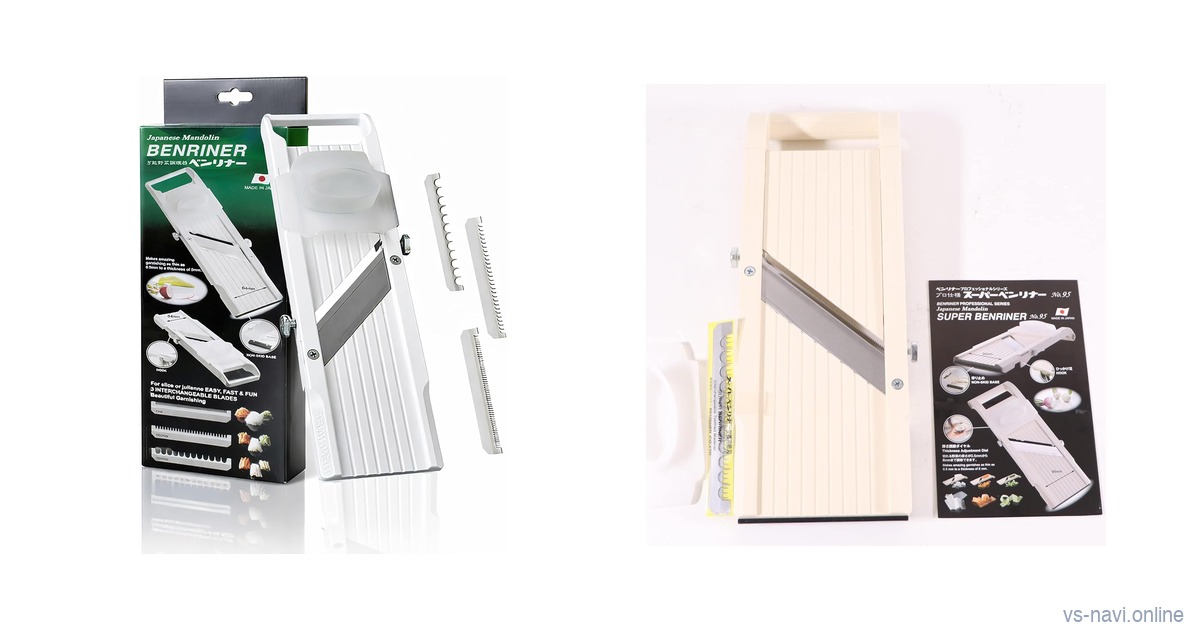
On Amazon, the Benriner has quietly become one of the best-selling mandolines you can buy. It is a $40 plastic slicer, nothing more. Watch a Japanese chef plate sashimi and you will often spot a thin, ribbon-cut curl of daikon underneath the fish; that garnish almost always comes off this exact tool. It weighs less than a paperback, has outsold flashier rivals through 2025.
The appeal is simple. A single razor-sharp Japanese blade set into a slim frame turns a cucumber into paper in seconds. There are no motors to break. There is nothing to store but a flat rectangle. In our testing it did what a $120 stainless mandoline does, at a third of the price.
The quick take: which Benriner to pick
For almost every home cook, the standard white Benriner Mandoline is the one to buy. Its 64 mm cutting bed handles carrots, cucumbers, potatoes, radishes plus most everyday vegetables. It is also the model professional test kitchens reach for by default.
Step up to the wider Super Benriner No.95 only if you regularly slice big items: whole cabbage, large potatoes for gratin, or wide sweet potatoes. Its 95 mm bed removes the “does this fit” hesitation. Both share the same blade system, so this is a decision about width, not quality.
Benriner Standard Mandoline (around $40)
Around $40 on Amazon · price varies
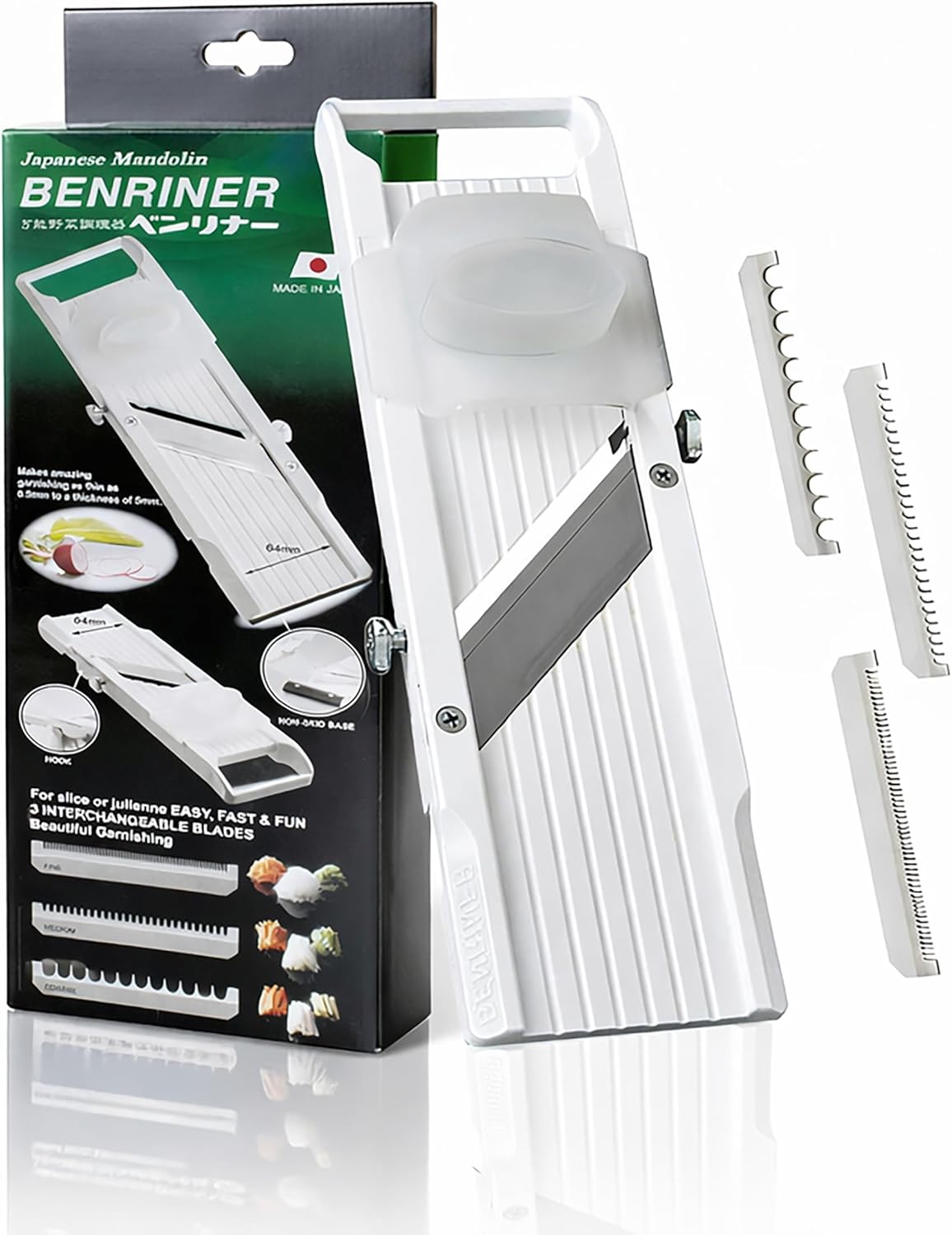
Benriner Co., Ltd. has made these slicers in Yamaguchi Prefecture for decades. In Japan the brand name is used almost generically for “mandoline” the way people say Hoover for a vacuum. Walk into an izakaya kitchen or a Japanese home kitchen and this exact white tool is likely in a drawer.
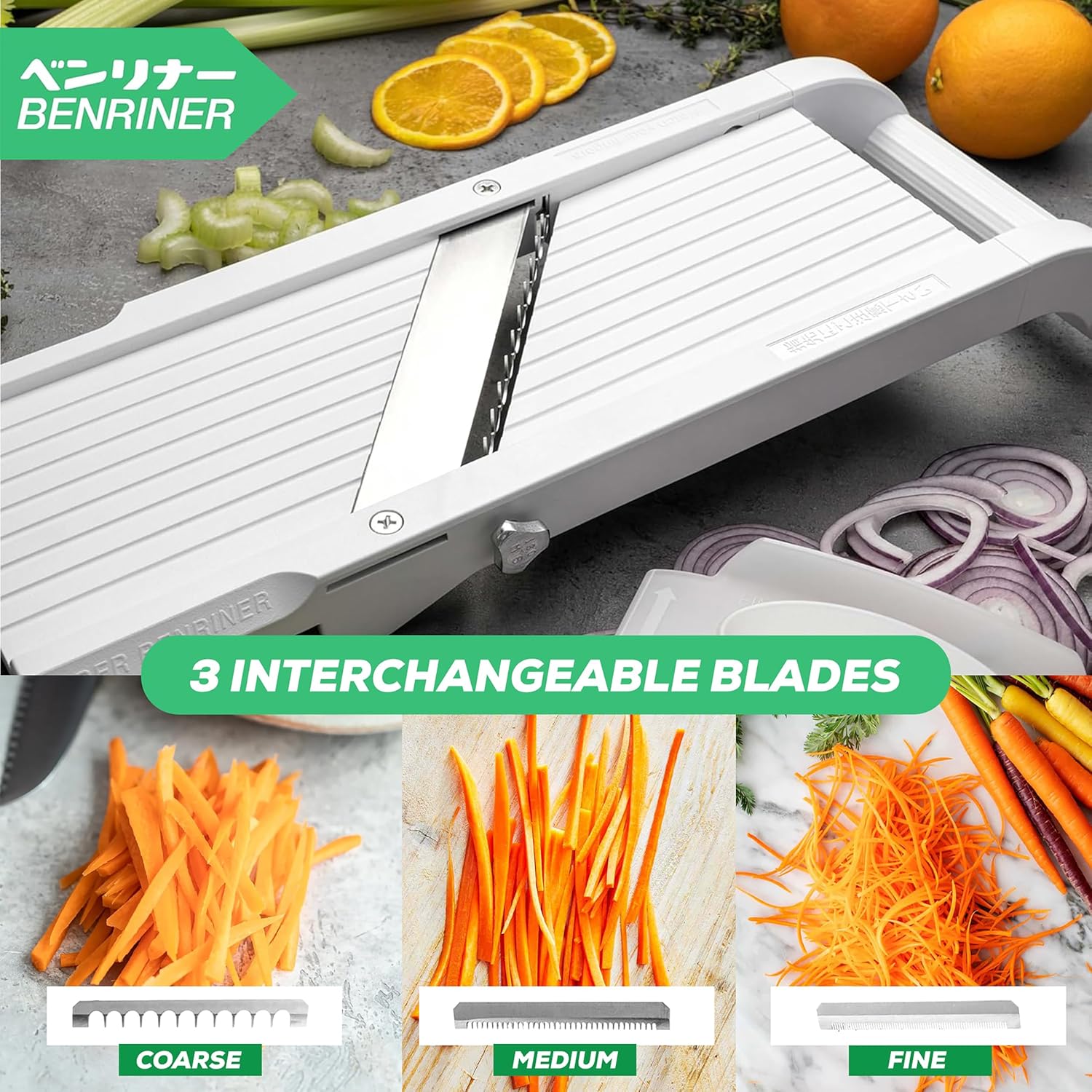
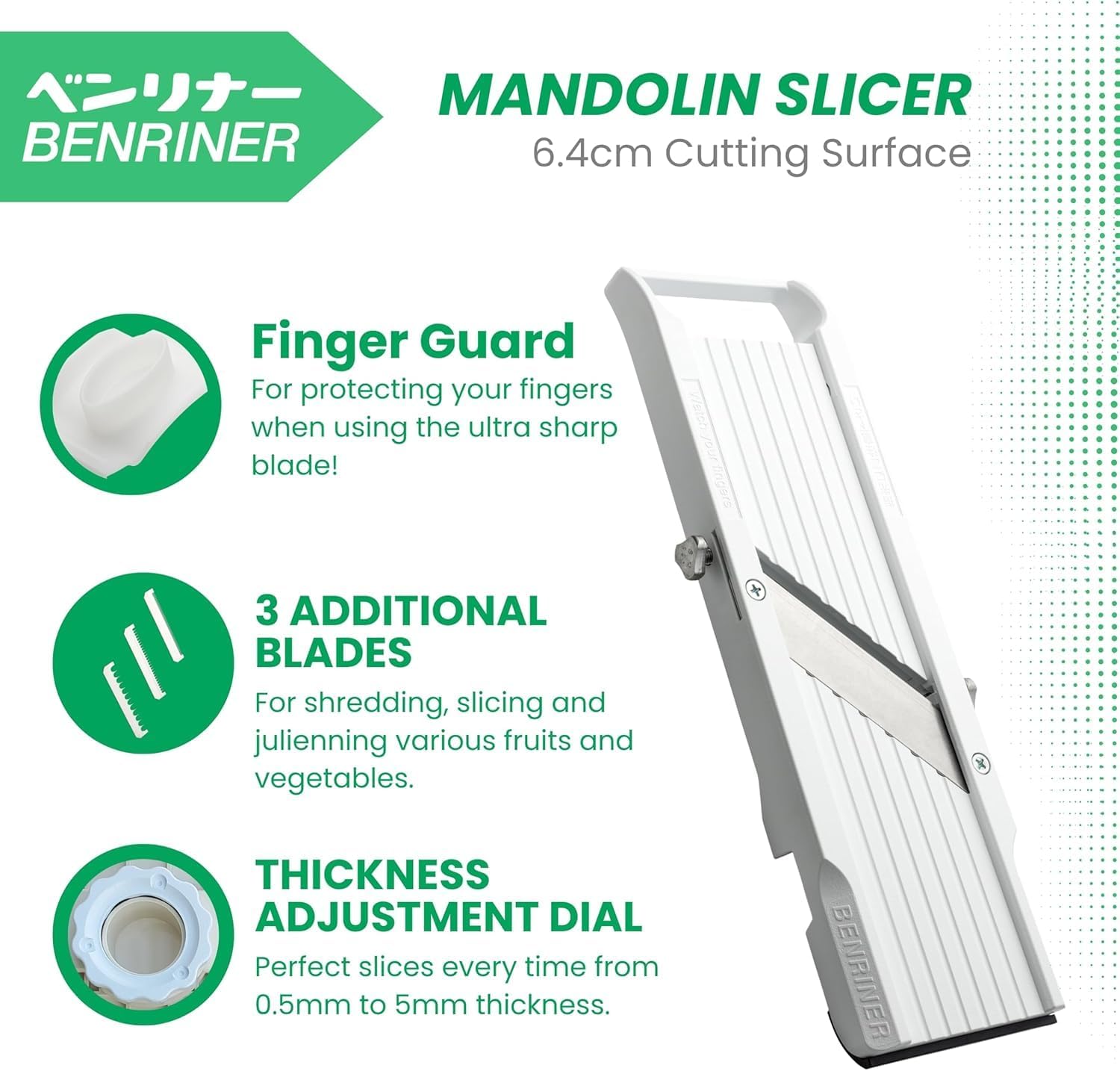
The magic is the blade. Japanese stainless steel, honed to a fineness most Western mandolines do not attempt, glides through a tomato without crushing it. A dial underneath adjusts thickness from a translucent 0.5 mm up to a chip-worthy 5 mm. Three snap-in blades add fine, medium plus coarse julienne.
It is not perfect. The included finger guard is functional rather than great, so many cooks buy a separate cut-resistant glove. And because the blade is genuinely dangerous, this is a tool you respect, not one you hand to a child. Those caveats aside, nothing at this price cuts as cleanly.
Who it suits: anyone who wants restaurant-thin slices for salads, gratins, pickles or garnishes without buying a bulky gadget. In our review process it was the fastest path from whole vegetable to uniform slice.
Super Benriner No.95 (around $40)
Around $40 on Amazon · price varies
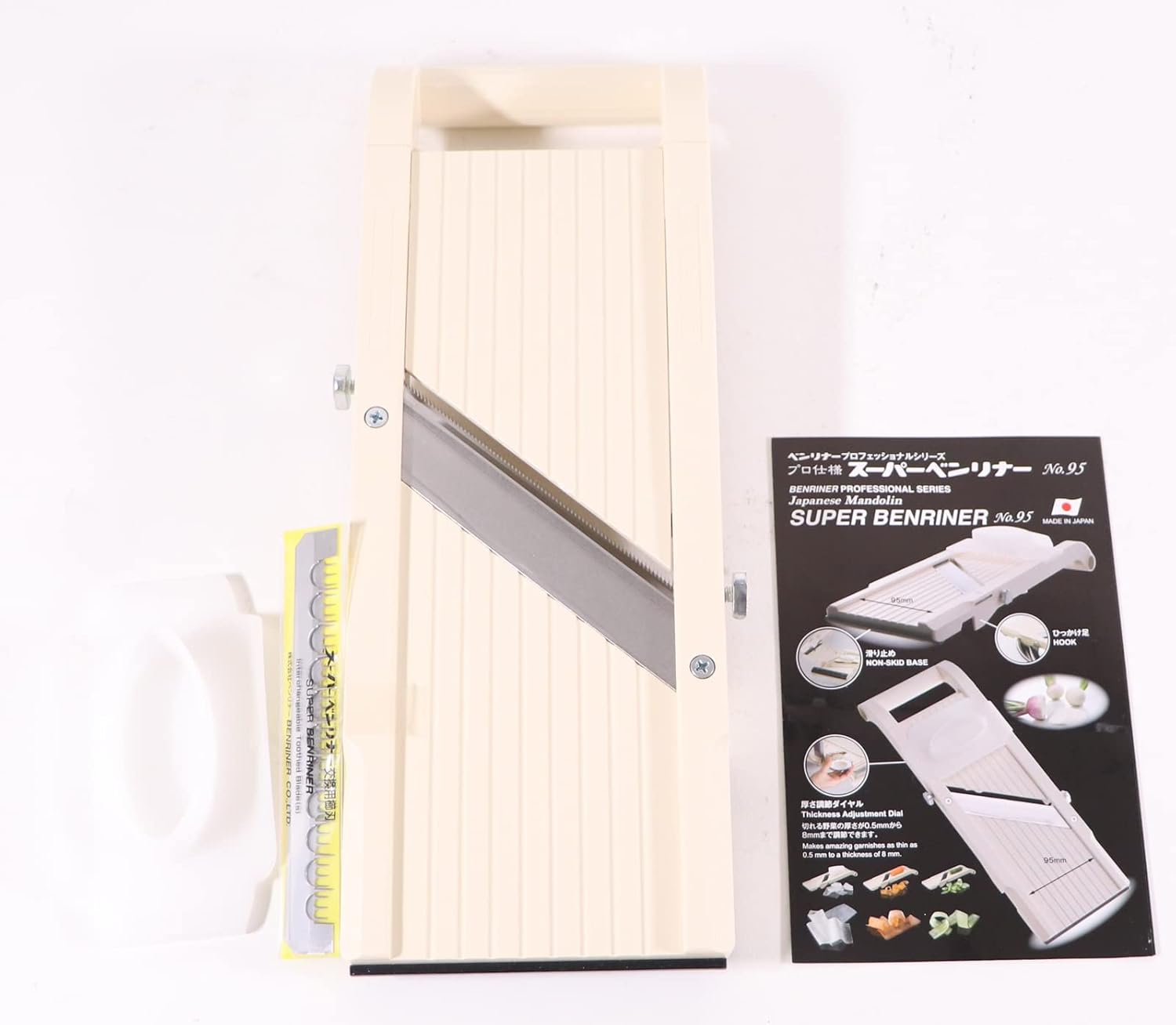
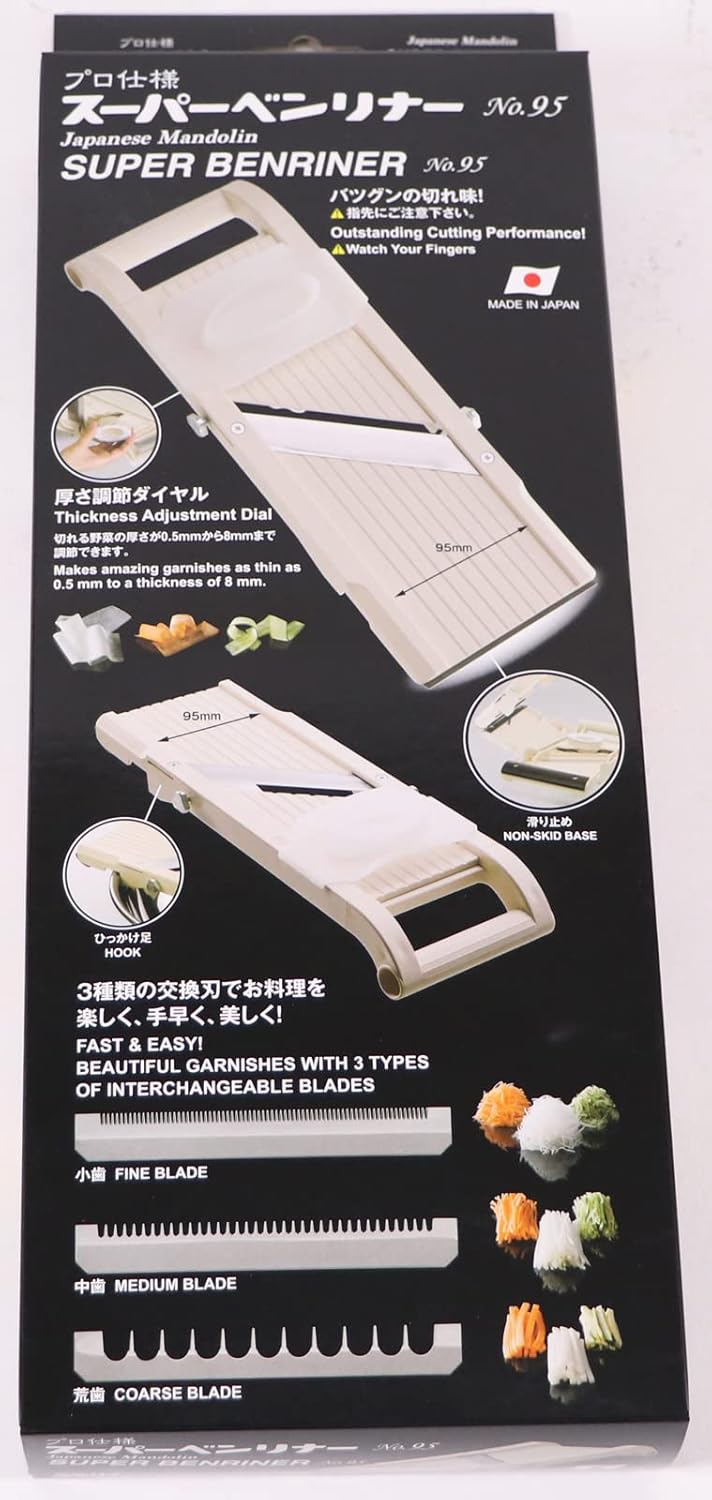
The Super Benriner is the same idea with a wider body. Its cutting bed measures 95 mm instead of 64 mm, which sounds minor until you try to slice a fat potato or a wedge of cabbage on the smaller model and it hangs off the sides.
Marketed as the professional series, it carries the same 0.5 mm to 8 mm thickness range plus the identical three-blade julienne system. A hook foot lets it perch over a bowl; the rubberized base keeps it planted while you push. The beige plastic looks less clinical than the white standard but is otherwise built the same way.
The trade-off is footprint. It takes more drawer space, so if you mostly slice carrots plus cucumbers you will never use the extra width. The wider bed also means a longer stroke, which some cooks find slightly less controlled on small items.
Who it suits: batch cooks, gratin lovers plus anyone who slices large or wide produce often enough to notice. For a household that makes big trays of scalloped potatoes, the width pays for itself.
Standard vs Super: side by side
| Benriner Standard | Super Benriner No.95 | |
|---|---|---|
| Cutting width | 64 mm | 95 mm |
| Thickness range | 0.5–5 mm | 0.5–8 mm |
| Blades included | Straight + 3 julienne | Straight + 3 julienne |
| Body colour | White | Beige |
| Best for | Everyday veg, most kitchens | Large or wide produce, batch cooking |
| Made in | Japan | Japan |
Pick the Standard if you want one slicer for general use; it is smaller to store and covers the vast majority of home tasks. Pick the Super if wide vegetables are a weekly event and you would rather never fight the edges of a narrow bed.
Because both use the same blade steel plus the same dial mechanism, neither is sharper or more precise than the other. You are choosing surface area, not performance.
Why professional kitchens rely on it
The Benriner is not a home gadget that leaked into restaurants; it went the other way. Japanese chefs have used it for years to produce the uniform, translucent cuts that classical presentation demands, from katsura-muki style ribbons of daikon to the wafer-thin cucumber that fans out under a piece of sashimi.
Consistency is the reason. A knife in a skilled hand is faster, but even a trained cook drifts a fraction of a millimetre over a hundred slices. The Benriner does not. Every pass off the same dial setting is identical, which matters when a dish is judged on how even the garnish looks or how uniformly a gratin cooks.
It is also cheap enough to treat as a workhorse. Restaurants buy several, keep spares of the julienne blades, plus replace the whole unit for around $40 when a blade finally dulls after heavy service. That disposability is part of why the tool never tries to be fancy.
How it compares to Western mandolines
Western mandolines from brands like OXO or Swissmar tend to be taller, heavier stainless-and-plastic machines with folding legs, dial-in settings plus a large hand guard. They feel more substantial on the counter. They also cost two to four times as much plus take up far more storage.
The Benriner trades that heft for a single sharp idea: a flat blade, a thickness dial, nothing else. In our testing the cut quality matched or beat pricier Western units, especially on delicate produce where a heavier machine can bruise the vegetable. The gap shows up in the guard, where Western designs are usually more idiot-proof.
If you want a safety-first tool for occasional use, a Western mandoline with a big guard makes sense. If you want the cut a professional gets plus you are willing to respect a sharp blade, the Benriner is the better tool for less money.
Using a Benriner without cutting yourself
This is the part every honest review has to stress. The Benriner blade is sharper than most kitchen knives; the flat, fast motion makes it easy to forget where your fingertips are. Real Amazon reviews are full of praise for the cut quality next to warnings about a nicked knuckle.
Three habits keep it safe. Use the finger guard once the vegetable gets small, or wear a cut-resistant glove for the whole job. Always push away from your body on the non-skid base. And when you rinse it, treat the exposed blade like a knife rather than reaching blindly into soapy water.
Follow those rules plus the Benriner is no more dangerous than a chef’s knife, with far more consistent results.
The bottom line
The Benriner earns its reputation. For roughly $40 you get the exact tool professional Japanese kitchens rely on, in a form that stores flat plus lasts for years. Buy the Standard unless you have a specific reason to go wide, respect the blade, then it will out-slice gadgets many times its price.
Frequently asked questions
Is the Benriner mandoline worth it?
For most home cooks, yes. At around $40 it delivers the paper-thin, uniform slices professional Japanese kitchens depend on, with no motor to fail plus a flat shape that stores easily. It consistently ranks among Amazon’s best-selling mandolines because it does one job extremely well for a low price.
What is the difference between the Benriner and the Super Benriner?
Width. The standard Benriner has a 64 mm cutting bed; the Super Benriner No.95 widens that to 95 mm for large vegetables like cabbage or big potatoes. Both use the same Japanese stainless blade, the same thickness dial plus the same three julienne blades, so the choice is about surface area rather than cut quality.
How thin can a Benriner slice?
The thickness dial adjusts from about 0.5 mm, thin enough to see light through a cucumber slice, up to roughly 5 mm on the standard model or 8 mm on the Super. That range covers everything from translucent garnishes to sturdy chips for baking.
Is the Benriner dishwasher safe?
The body is dishwasher safe, but Benriner recommends keeping it off the high-heat drying cycle, which can warp the plastic over time. Because the blade is extremely sharp, most cooks hand-wash it anyway to avoid reaching into a dishwasher basket near an exposed edge.
Do I need the finger guard?
Strongly recommended. The blade is sharper than a typical kitchen knife plus the fast sliding motion makes accidents easy once the vegetable gets small. Use the included guard for the last portion, or wear a cut-resistant glove for the whole task. Never freehand the final few slices.
Ready to pick one? The standard model suits almost every kitchen; go wide only if you slice big produce often.