vs-navi.online is a participant in the Amazon Services LLC Associates Program. Purchases made through links on this page may earn us a commission at no extra cost to you.
A spoon stirs matcha. A chasen turns it into foam. That is the whole reason the tool exists.
The chasen (茶筅) is a single piece of bamboo split into dozens of hair-thin tines that curl inward at the tip. Drawn quickly through a bowl, those tines break up the powder, pull air into the water, then leave a layer of fine jade-green froth on top. Lumps at the bottom of the cup are almost always a whisk problem rather than a matcha problem.
We compared four whisks that are in stock on Amazon.com right now, chosen so that each one suits a different kind of buyer. It is a desk comparison: we worked from the published listings, the makers’ care instructions and Amazon’s own customer review summaries. Nothing here was sent to us by a brand.
Quick Picks
Short version, before the detail:
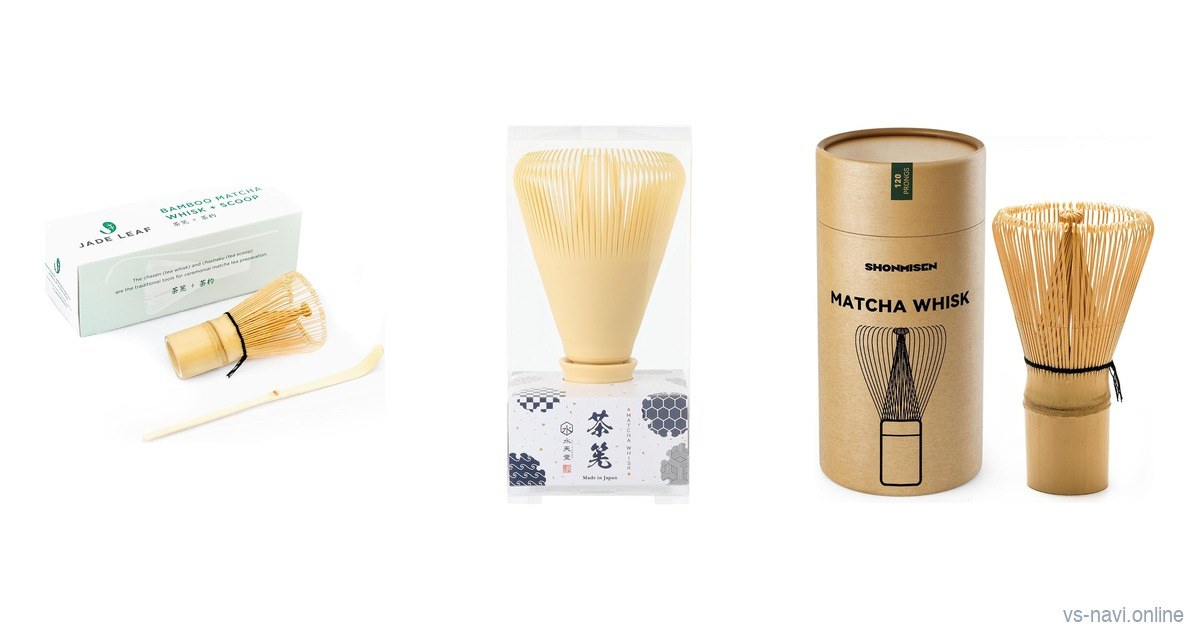
- Jade Leaf Whisk and Scoop Set — the safe default at around $13. A plain bamboo whisk with a bamboo scoop from a matcha brand with more than 11,000 Amazon ratings. See the Jade Leaf set on Amazon →
- YIBO Matcha Whisk Kit — the best first purchase at around $9 to $10. You get a 76-prong whisk and the two accessories beginners skip: a ceramic whisk holder with a sifter. See the YIBO kit on Amazon →
- SUITENDO Resin Whisk — the only Made-in-Japan whisk in this comparison, at around $20. A 100-prong polypropylene chasen that comes apart for washing. For people who make a latte every morning. See the SUITENDO whisk on Amazon →
- SHONMISEN 120-Prong Whisk — the cheapest way to try a high prong count, at around $7. The finest tines here for the softest foam. Also the one most likely to need replacing early. See the SHONMISEN whisk on Amazon →
What the Prong Count Actually Changes
Chasen are sold by the number of tines. The common counts for everyday thin tea (usucha) run from roughly 70 up to 120. In Japan the 80-tine whisk is called hachijuppon-date, the 100-tine hyappon-date.
More tines means each one is cut thinner. Thin tines move more water per stroke, so foam comes up faster with a finer bubble. They also bend sooner. Fewer tines means thicker, stiffer bamboo that forgives a heavy hand but gives a slightly coarser froth.
One correction to a common claim: a high prong count is not the whisk for thick tea (koicha). Koicha is kneaded rather than whipped, which is why tea schools use whisks with far fewer, sturdier tines for it. Every whisk on this page is an usucha whisk, which is also what a latte needs.
For most people the honest answer is that anything between 76 and 100 tines works. Technique matters more: sift the powder, use water well below boiling (around 175°F), then whisk in a fast M or W stroke with the wrist rather than stirring in circles.
Jade Leaf Matcha Whisk and Scoop Set (around $13 on Amazon)
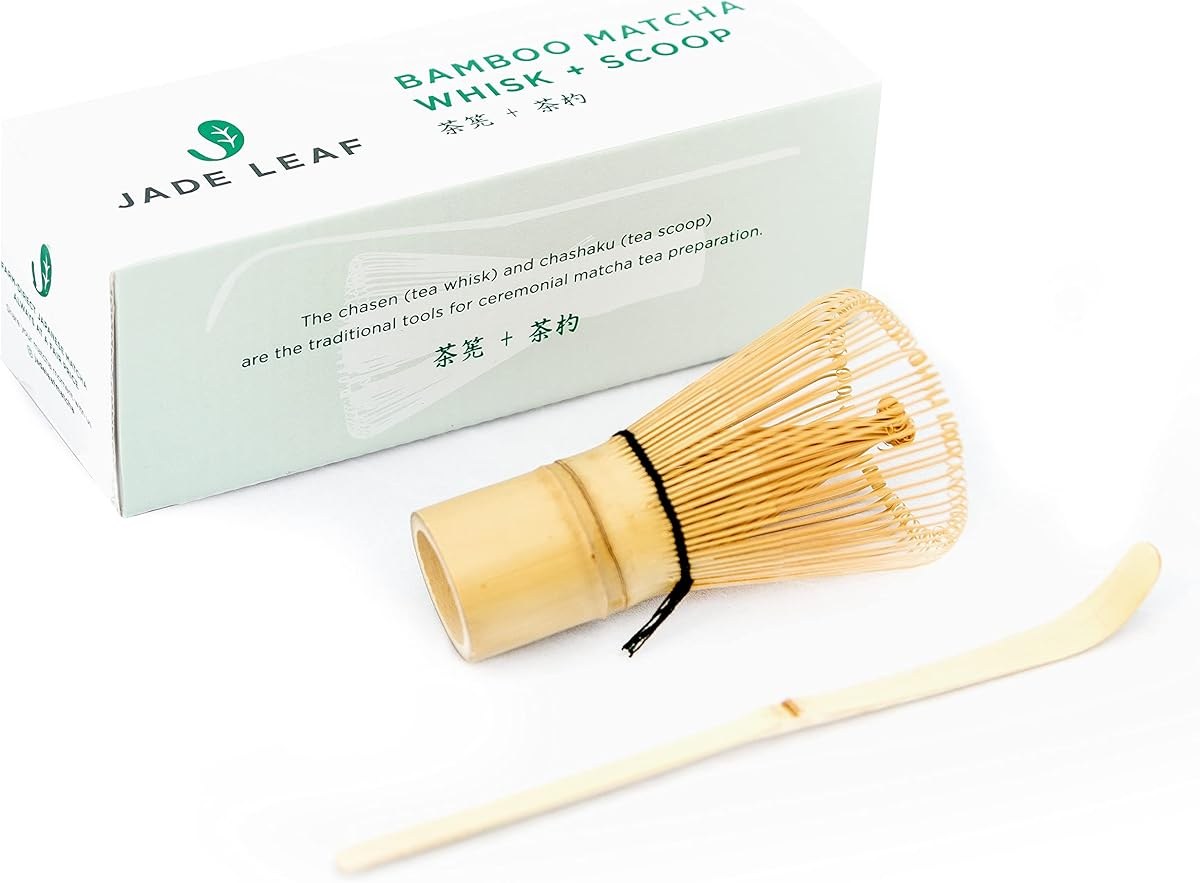
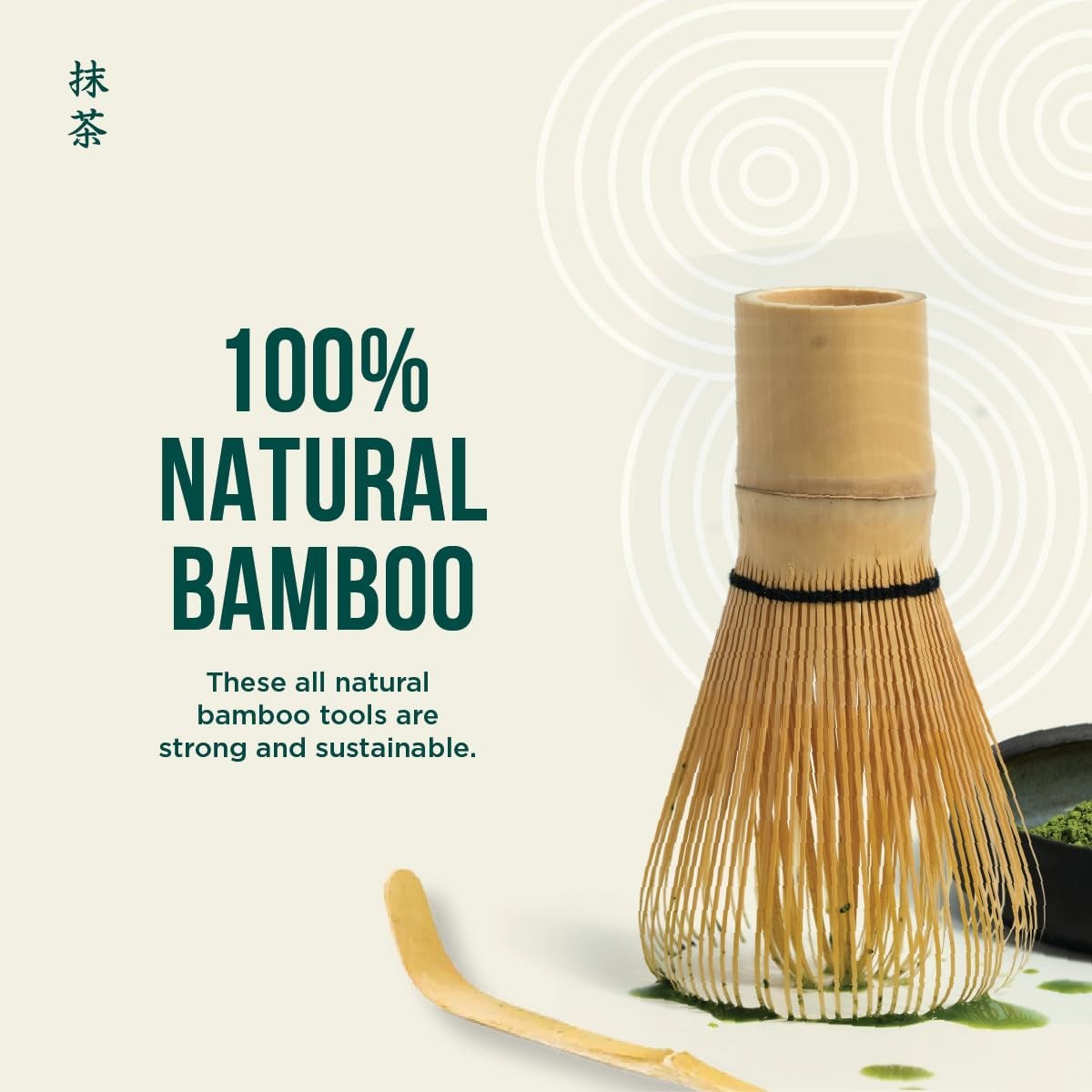
Jade Leaf is an American matcha brand, not a whisk maker. Its Amazon listing says the company buys its tea from family-owned partner farms in Uji (Kyoto) and Kagoshima, the two regions most Japanese shoppers would also name first for matcha. The whisk set exists so that people who buy the tea have something to make it with.
That is the reason to pick it. The set is a plain natural-bamboo chasen with a chashaku, the curved bamboo scoop that measures roughly one gram of powder per scoop. It is sold by Jade Leaf itself, it carries a 4.5-star average across more than 11,000 Amazon ratings. There is also a real company to write to if the whisk arrives cracked.
The listing is refreshingly direct about lifespan. It describes the set as replacement-ready with a recommended change every 3 to 6 months. That matches how chasen are treated in Japan: a bamboo whisk is a consumable, closer to a toothbrush than to a kitchen knife.
The honest downside is what the listing leaves out. It does not state a prong count or a country of manufacture, so you are buying on the brand’s reputation rather than on a spec. Amazon’s summary of customer reviews praises how easily it mixes while flagging mixed feedback on durability, with some buyers reporting tines that came apart.
Buy it if you already own a bowl and a small sieve, or if you want the lowest-risk whisk from a seller you can identify. No whisk holder is included, so budget a few dollars for one.
Check price of the Jade Leaf set on Amazon →
YIBO Matcha Whisk Kit with Holder and Sifter (around $9 to $10 on Amazon)
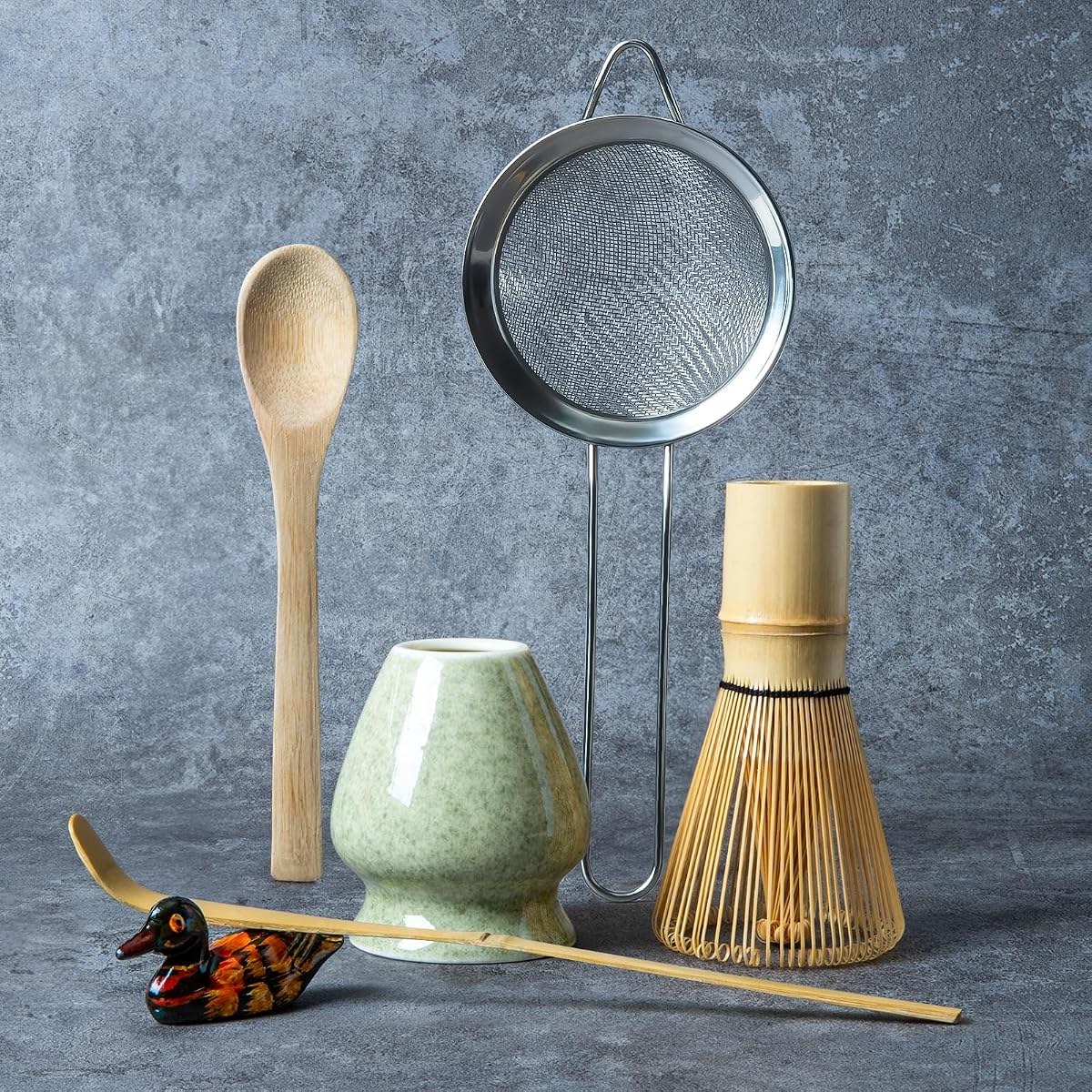
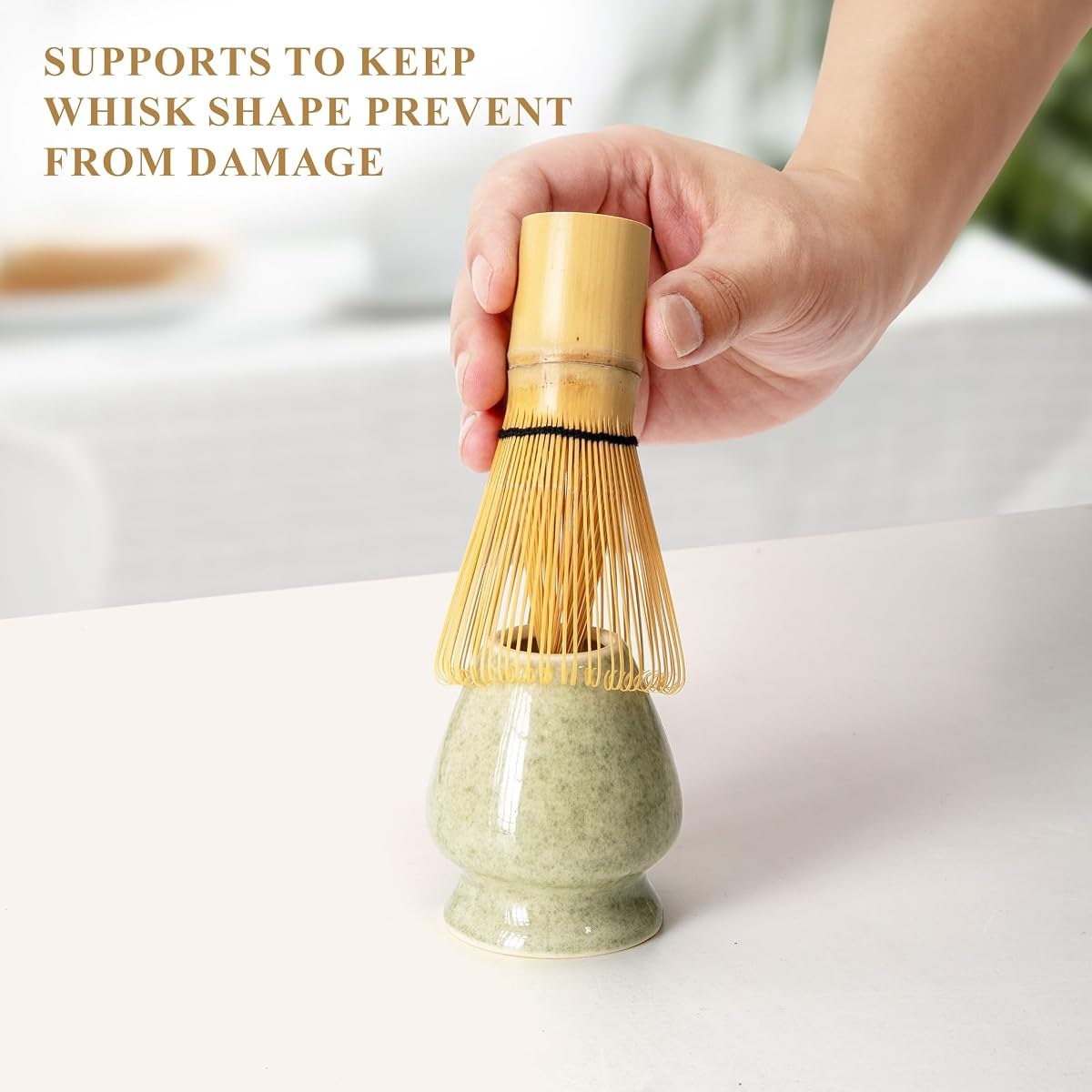
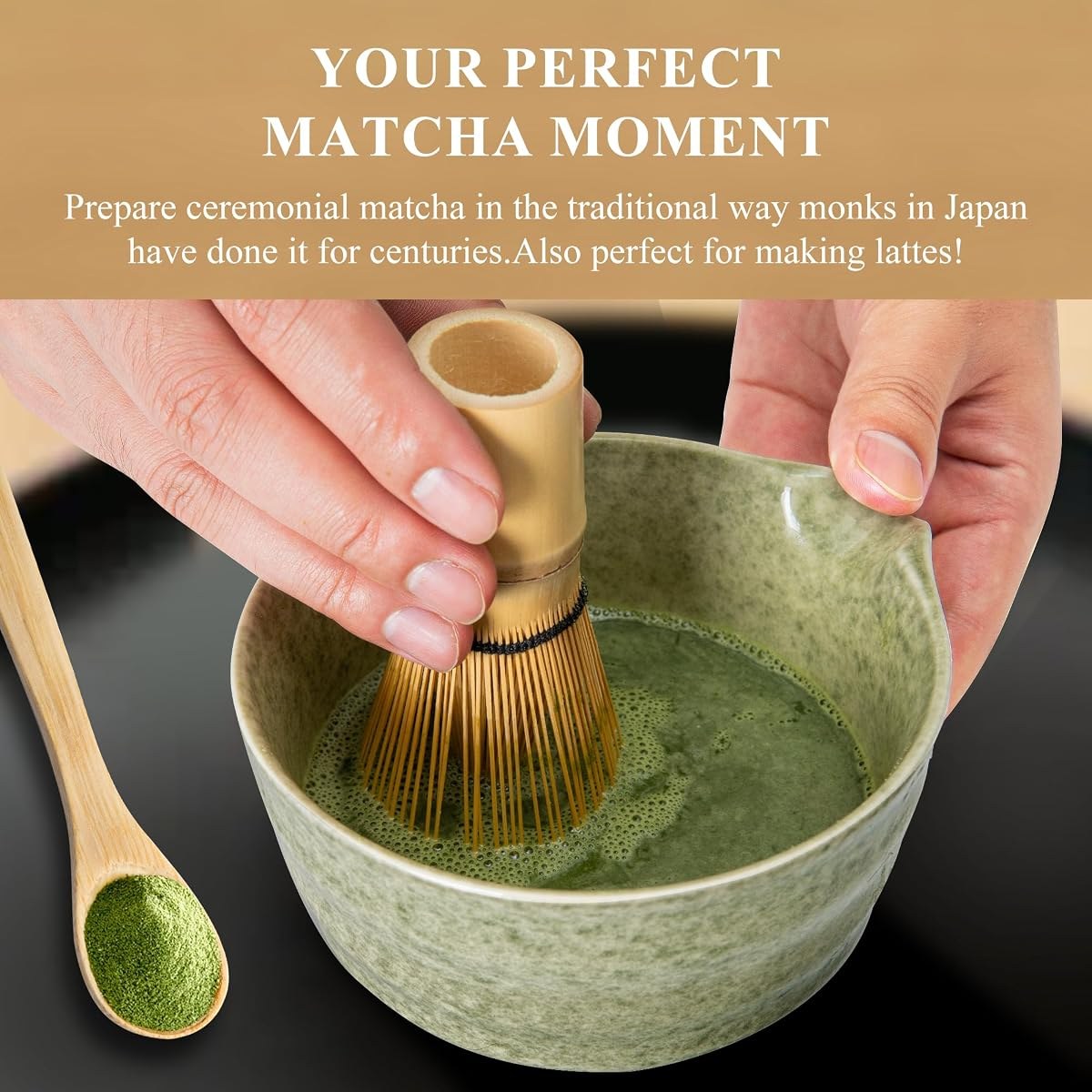
Most first-time buyers order a whisk alone, then discover two problems within a week. The powder clumps because it was never sifted. The tines close up like a wet paintbrush because the whisk dried lying on its side. This kit solves both for about the price of a whisk.
The listing specifies a 76-prong bamboo whisk about 4.1 inches tall, a ceramic holder about 2.5 inches tall, a stainless fine-mesh sifter roughly 8 inches long, a bamboo scoop, a wooden spoon and a small scoop rest. The holder comes in five glaze colours; the mottled green is the cheapest of them at the time of writing.
In Japan the holder has its own name, kusenaoshi, which means roughly “shape corrector”. A damp chasen pressed over its tulip-shaped dome dries with the outer tines spread and the inner knot centred. It is the cheapest way to make any bamboo whisk last longer, which is why a kit that includes one is better value than the price suggests.
Seventy-six tines is on the sturdy side. Expect froth with a slightly larger bubble than a 100-prong whisk gives, with tines that tolerate a beginner’s heavy hand. The honest downside is durability again: Amazon’s review summary (4.5 stars from more than 1,100 ratings) praises value and ease of use, yet notes several buyers whose whisk shed tines within a month.
Buy it if this is your first chasen or a gift for someone curious about matcha. You will only need to add a bowl.
Check price of the YIBO kit on Amazon →
SUITENDO Resin Matcha Whisk, Made in Japan (around $20 on Amazon)
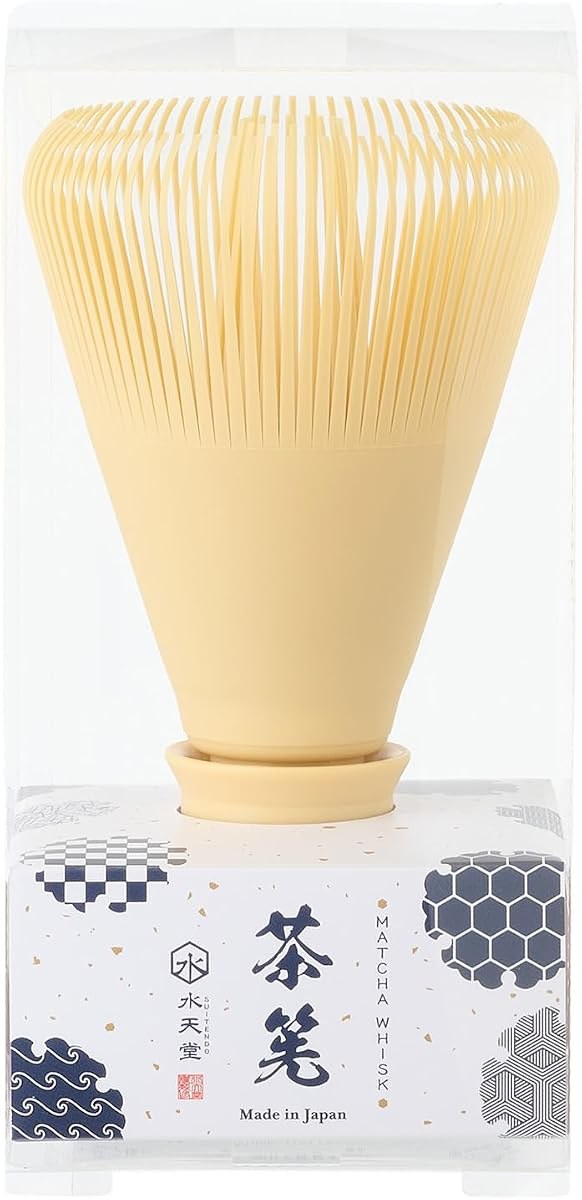
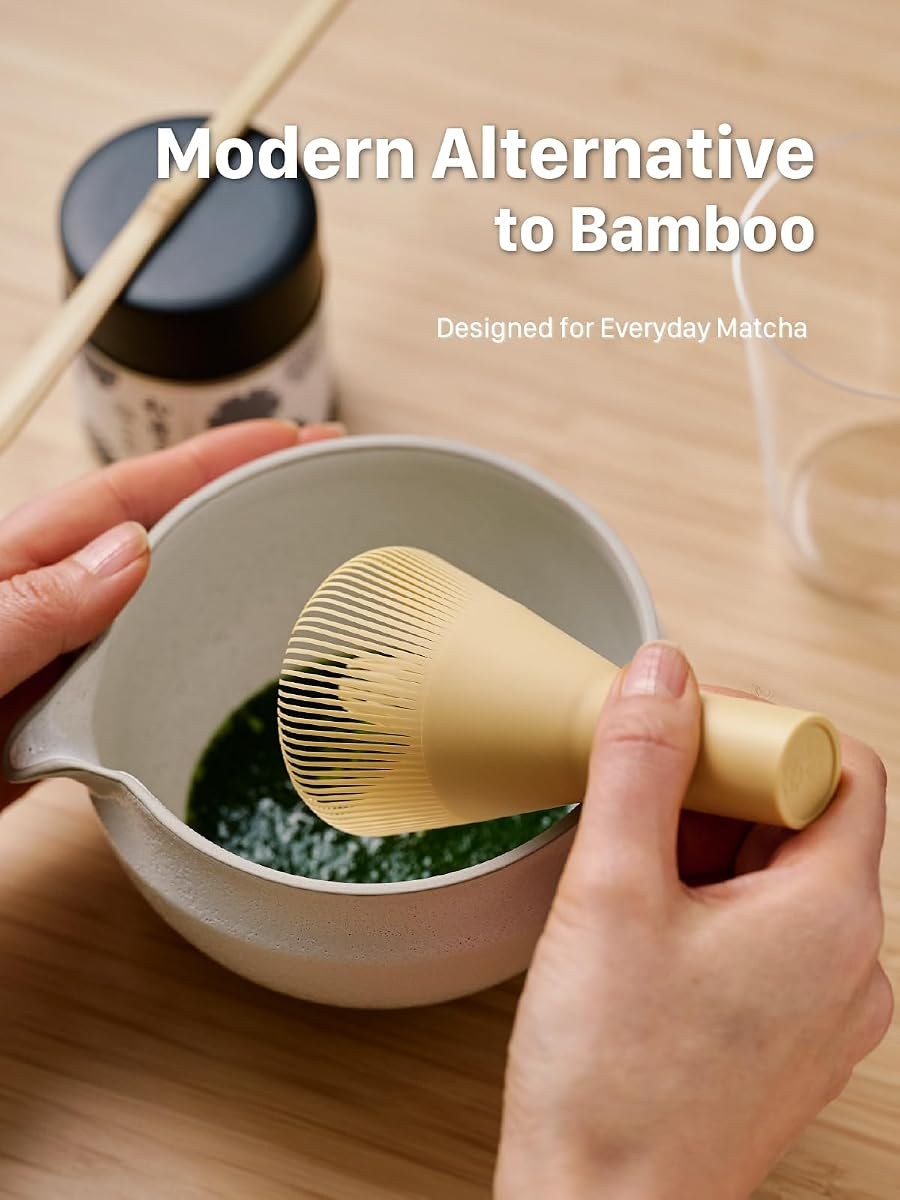
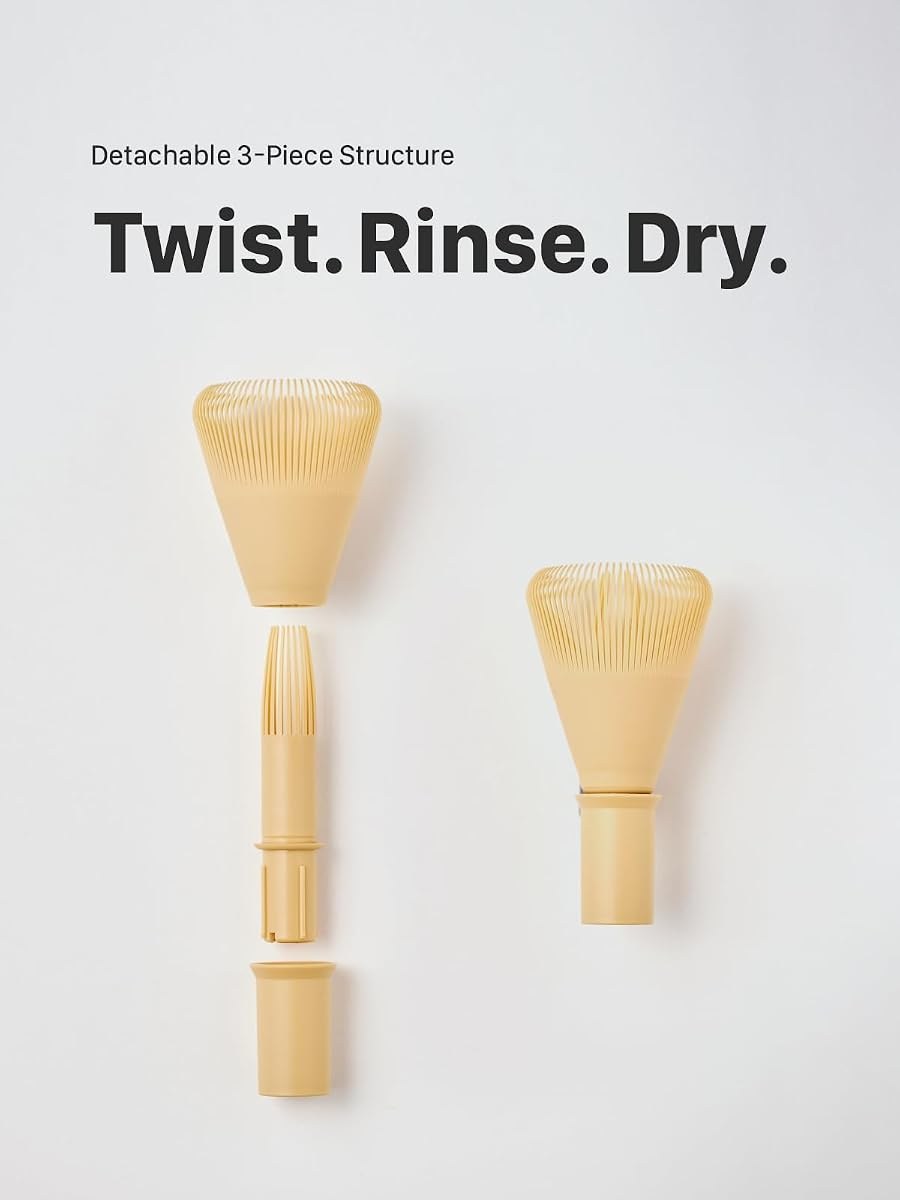
This is the whisk for people who love matcha but have no patience for bamboo. It is moulded from food-grade polypropylene in the shape of a traditional 100-prong chasen. Both the listing and the printed retail box state that it is made in Japan; the listing adds that Japanese materials and a Japanese factory are used.
Resin chasen are sold in Japan too, as a practical alternative rather than a novelty. A bamboo whisk dislikes everything about a busy kitchen: it wants soaking before use, it must never see detergent, it grows mould if it dries badly. A resin whisk asks for none of that, which is the whole argument for it in a home where matcha is a weekday drink rather than a ceremony.
The published specs are 4.3 inches (11 cm) tall, 2.5 inches (6.4 cm) across at the tines, just 22 grams. The body separates into three pieces for washing. The handle has an anti-drip lip so it can be set down on the counter. The listing’s images add BPA-free resin rated to 100°C with a silver-based antimicrobial treatment.
The honest downside comes in two parts. It is hand-wash only, so the maker explicitly rules out the dishwasher. It also lacks the natural give of bamboo tines, which traditionalists value. Amazon’s review summary (4.4 stars from a little over 100 ratings) highlights easy cleaning and lump-free mixing, with several buyers saying they prefer it to bamboo.
Buy it if you drink matcha daily, mostly as lattes, or if you have already thrown away two mouldy bamboo whisks. At around $20 it costs about as much as two bamboo whisks, so it pays for itself once it outlasts them.
Check price of the SUITENDO whisk on Amazon →
SHONMISEN 120-Prong Bamboo Whisk (around $7 on Amazon)
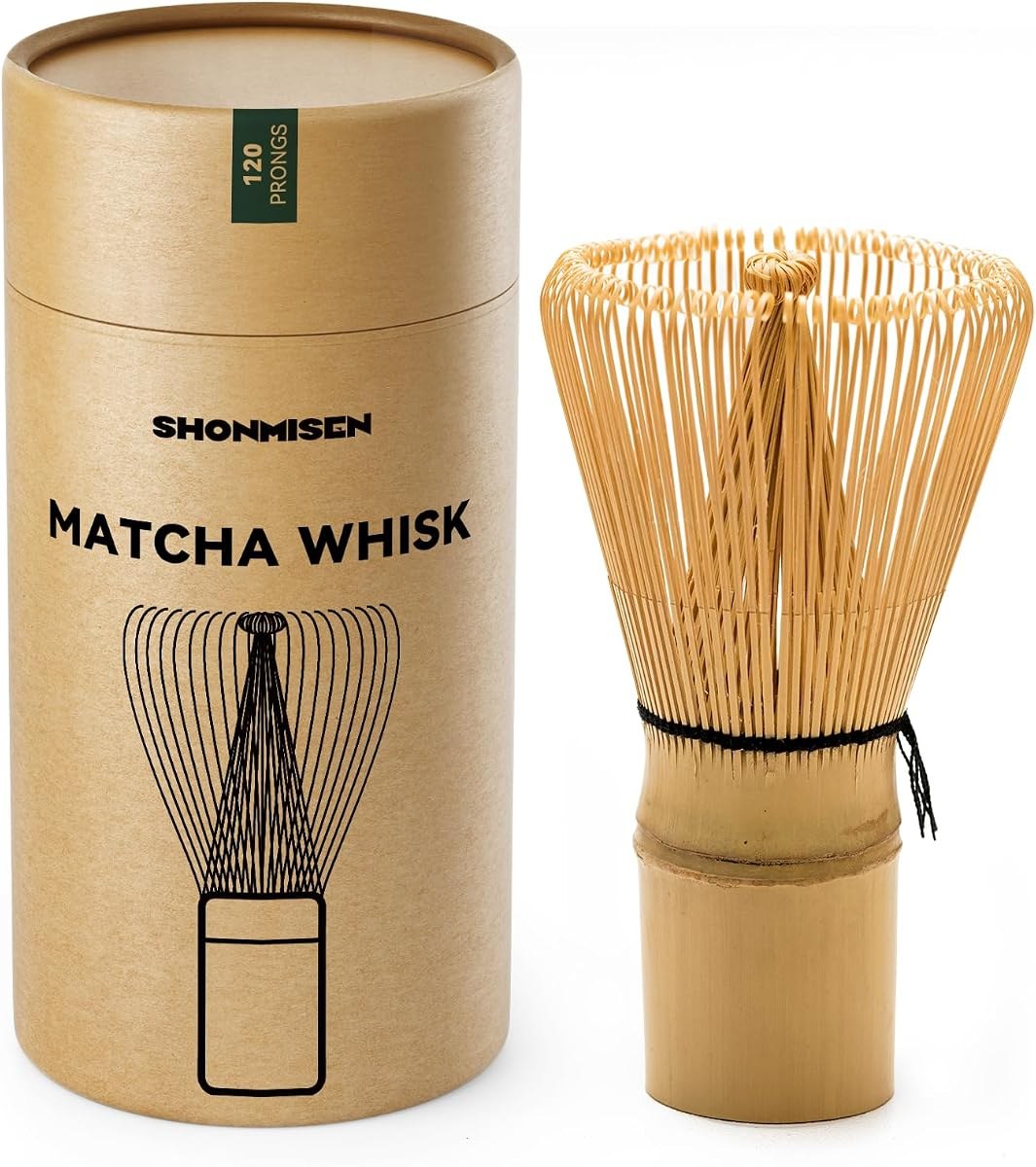
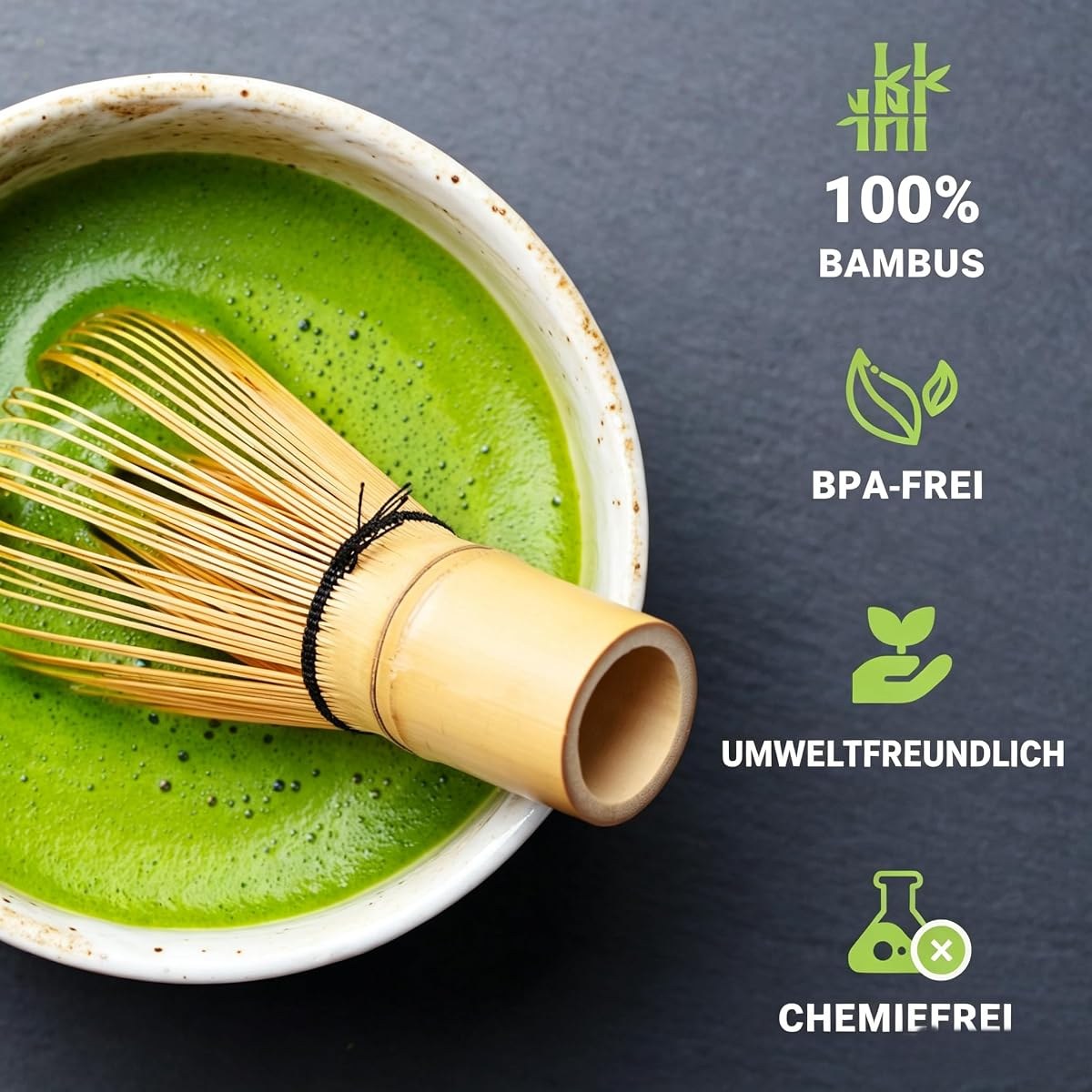
If the question you arrived with was “80, 100 or 120 prongs?”, this is the inexpensive way to answer it for yourself. SHONMISEN sells the same golden-bamboo whisk in more than one prong count from a single Amazon listing. When we checked, the 120-prong and the 100-prong versions were both in stock at almost the same price; the 80-prong named in the listing title was not offered.
The listing gives the size as about 3.9 inches (10 cm) tall by 2.4 inches (6 cm) wide, slightly more compact than the others here. It arrives in a stiff cardboard tube. Keep the tube for travel only: a whisk stored damp inside a closed tube is how mould starts.
In Japan, high-count whisks of 100 to 120 tines are sold to usucha drinkers who want the finest possible foam. With that many tines the foam comes up quickly with a very small bubble, the look that tea drinkers describe as creamy. The cost is fragility, because every tine has been shaved thinner to fit.
The honest downside is exactly that. Amazon’s review summary (4.3 stars from about 800 ratings, the lowest average in this comparison) praises how smoothly it mixes but reports whisks splitting early, with mixed comments about mould. The listing does not state where the whisk is made. Treat it as a consumable that lets you test a high prong count for the price of a coffee.
Buy it if you already have a holder and good habits, or as a spare. Soak the tines in warm water for a minute before every use; thin bamboo that goes into the bowl dry is bamboo that snaps.
Check price of the SHONMISEN whisk on Amazon →
Compare the Four
| Jade Leaf set | YIBO kit | SUITENDO resin | SHONMISEN 120 | |
|---|---|---|---|---|
| Approx. price | $13 | $9 to $10 | $20 | $7 |
| Whisk material | Bamboo | Bamboo | Polypropylene resin | Bamboo |
| Prong count | Not stated | 76 | 100 | 120 (100 also sold) |
| In the box | Whisk, scoop | Whisk, ceramic holder, sifter, scoop, spoon, scoop rest | Whisk only | Whisk, storage tube |
| Origin stated on listing | Not stated | Not stated | Made in Japan | Not stated |
| Care | Soak, rinse, air-dry | Soak, rinse, dry on holder | Takes apart; hand wash | Soak, rinse, air-dry |
| Amazon rating when checked | 4.5 (11,000+) | 4.5 (1,100+) | 4.4 (110+) | 4.3 (800+) |
| Best for | A known seller | First-time buyers | Daily latte drinkers | Trying fine foam cheaply |
Pick the YIBO kit if you own nothing yet. The holder and the sifter fix the two mistakes that make beginners give up, for about the price of a whisk alone.
Pick the Jade Leaf set if you would rather buy from a named matcha company with a very long review history, or if you already have a holder. Pick the SHONMISEN if you are curious what 120 tines do to the foam but do not want to pay much to find out.
Pick the SUITENDO if matcha is a daily habit rather than an occasion. It is the only whisk here with a stated Japanese origin, the only one that does not depend on careful drying to stay free of mould. It is also the one most likely to still be in your drawer next year.
A Note on Hand-Carved Takayama Chasen
The whisk a tea teacher in Japan would hand you is a different object. Traditional chasen come from Takayama, a district of Ikoma in Nara Prefecture where the craft goes back roughly five centuries. Takayama chasen hold Japan’s national Traditional Craft designation. Each one is split, shaved then curled by hand from a single piece of bamboo.
We searched Amazon.com in September 2026 for bamboo whisks whose listings document a Takayama or other Japanese origin. We did not find one that was in stock with that origin stated, so none is recommended here. The bamboo whisks above are inexpensive production whisks whose listings do not say where they are made. We would rather tell you that than imply a heritage we cannot verify.
If you want a Takayama whisk, specialist Japanese tea retailers that ship internationally are the realistic route. Expect to pay several times the prices on this page. The care routine below applies to those whisks just as much as to a $7 one.
How to Make a Bamboo Whisk Last
- Soak before use. Stand the tines in warm water for a minute or two. Wet bamboo flexes; dry bamboo snaps.
- Rinse with water only. Swish the whisk in a bowl of clean warm water right after use. No detergent, no dishwasher.
- Dry it open. Shake off the water then set the whisk on a holder, or stand it on its handle with the tines up. Never put it away damp in a closed tube.
- Expect the centre knot to open. The tight curl at the tips relaxes after the first soak. That is normal, not damage.
- Replace it when tines break. A few months of daily use is a fair life for an inexpensive bamboo whisk.
Summary
Buy the YIBO kit to start, the Jade Leaf set for a seller you can name, the SHONMISEN to experiment with 120 prongs, or the Made-in-Japan SUITENDO resin whisk if you want to stop replacing bamboo.
Whichever you choose, the matcha matters as much as the whisk. Our guide to the best Japanese matcha for beginners covers which tins are worth whisking. If you brew loose-leaf tea as well, see the Ito En versus Yamamotoyama green tea comparison. For the rest of the kitchen, there is our guide to Japanese kitchen tools.
FAQ
Do I really need a bamboo whisk for matcha?
For traditional whisked matcha, yes. A spoon or fork cannot suspend the powder or build foam. A handheld electric frother is an acceptable shortcut for lattes, although it gives a bigger, less stable bubble than a chasen.
What is the difference between 80, 100 and 120 prongs?
More prongs means thinner tines, finer foam and a more fragile whisk. Around 80 is sturdy but forgiving, 100 is the everyday middle, 120 gives the softest froth. All three are for thin tea (usucha). Thick tea (koicha) is kneaded with a whisk that has far fewer, stiffer tines.
Do I need to soak a chasen before using it?
Yes for bamboo. A minute or two in warm water softens the tines so they bend instead of breaking. A resin whisk such as the SUITENDO does not need soaking.
Can I wash a matcha whisk with soap or in the dishwasher?
No. Bamboo absorbs detergent. Dishwasher heat cracks it. Rinse in warm water only. The SUITENDO resin whisk is also listed as hand wash only by its maker.
How long does a bamboo chasen last?
It depends on use and care. Jade Leaf’s own listing recommends replacing its whisk every 3 to 6 months. Drying the whisk on a holder is the single habit that extends its life the most.
Is a whisk holder worth buying?
Yes. The holder (kusenaoshi) keeps the tines spread while they dry so the whisk holds its shape, with air able to reach the centre. The YIBO kit includes one; with the other bamboo whisks here it is a few dollars extra.
Are these whisks made in Japan?
Only the SUITENDO resin whisk states a Japanese origin on its listing and its packaging. The three bamboo whisks do not state a country of manufacture. Hand-carved Takayama chasen from Nara are a separate, much more expensive category that we did not find in stock on Amazon.com.
Prices are approximate US figures taken from Amazon listings checked in September 2026. Ratings, stock and prices on Amazon move frequently, so check the current listing before you buy. Compiled by the Vs-Navi.Online Editorial Team from published listings; no products were supplied by brands.