This article contains affiliate links (we may earn a commission).
Top Pick: Casio G-Shock GA-2100-1A1 (the ‘CasiOak’ – 200m water resistance, sub-$100, and a Tokyo cultural icon). Best for Mechanical Choice: Seiko 5 Sports SRPD55 (Japan’s bestselling automatic, the ‘Mini-Turtle’ diver). Best for Solar Reliability: Citizen Eco-Drive AW0050-82E (light-powered with zero battery changes for life).
Japan makes some of the most respected watches in the world — Seiko invented the quartz revolution, Citizen perfected solar power, and Casio built the indestructible G-Shock. But which Japanese watch is right for YOU? This guide compares three of the best-selling Japanese timepieces on Amazon to show which delivers the best value, precision, and durability under $500.
Looking for something far cheaper? Casio still sells its 1980s and 1990s digital classics new for under $35. Our Casio F-91W vs A168WA vs CA-53W comparison explains which retro Casio fits which wrist.
Quick Answer — Our Recommendations
- Best for Watch Enthusiasts / Automatic Lovers — Seiko 5 Sports SRPD55 (mechanical soul at $180)
- Best for Low Maintenance / Precision Seekers — Citizen Eco-Drive AW0050-82E (solar-powered forever)
- Best Value / Outdoor Adventure — Casio G-Shock GA-2100-1A1 (editor’s pick)
>
Specs Comparison — 3 Products Side by Side
| Seiko 5 Sports SRPD55 | Citizen Eco-Drive AW0050-82E | Casio G-Shock GA-2100-1A1 | |
|---|---|---|---|
| Price | $179.99 | $189.99 | $99.00 |
| Movement | Automatic (21 jewels, no battery needed) | Eco-Drive Solar Quartz (light-powered) | Quartz (battery, ~3 year life) |
| Water Resistance | 100m | 100m | 200m |
| Case Size | 42.5mm | 43mm | 45.4mm (slimmer profile at 11.8mm thick) |
| Crystal | Hardlex | Mineral | Mineral |
| Power Reserve | ~41 hours | 6 months in darkness after full charge | — |
| Amazon Rating | 4.4 / 5 | 4.5 / 5 | 4.7 / 5 |
Best for Watch Enthusiasts / Automatic Lovers
Seiko 5 Sports SRPD55
Mechanical soul at $180
Best for Low Maintenance / Precision Seekers
Citizen Eco-Drive AW0050-82E
Solar-powered forever
Brand in Japan: Seiko (founded Tokyo 1881 by Kintaro Hattori) is the most internationally famous Japanese watchmaker, and the SRPD55 “Mini-Turtle” is one of the bestselling automatics on Amazon Japan. Citizen (founded 1918) pioneered Eco-Drive light-powered movements in 1976 and is positioned in Japan as the practical professional’s watch. Casio G-Shock – launched 1983 in Tokyo – is the cultural icon: Japanese construction workers, JSDF military, and Tokyo streetwear designers all wear them, and the brand has its own boutique stores in Shinjuku and Harajuku. All three are mainstream Japanese consumer brands, not luxury – typical retail 10,000-50,000 yen.
#2 Seiko 5 Sports SRPD55 Review — The Definitive Japanese Automatic Under $200

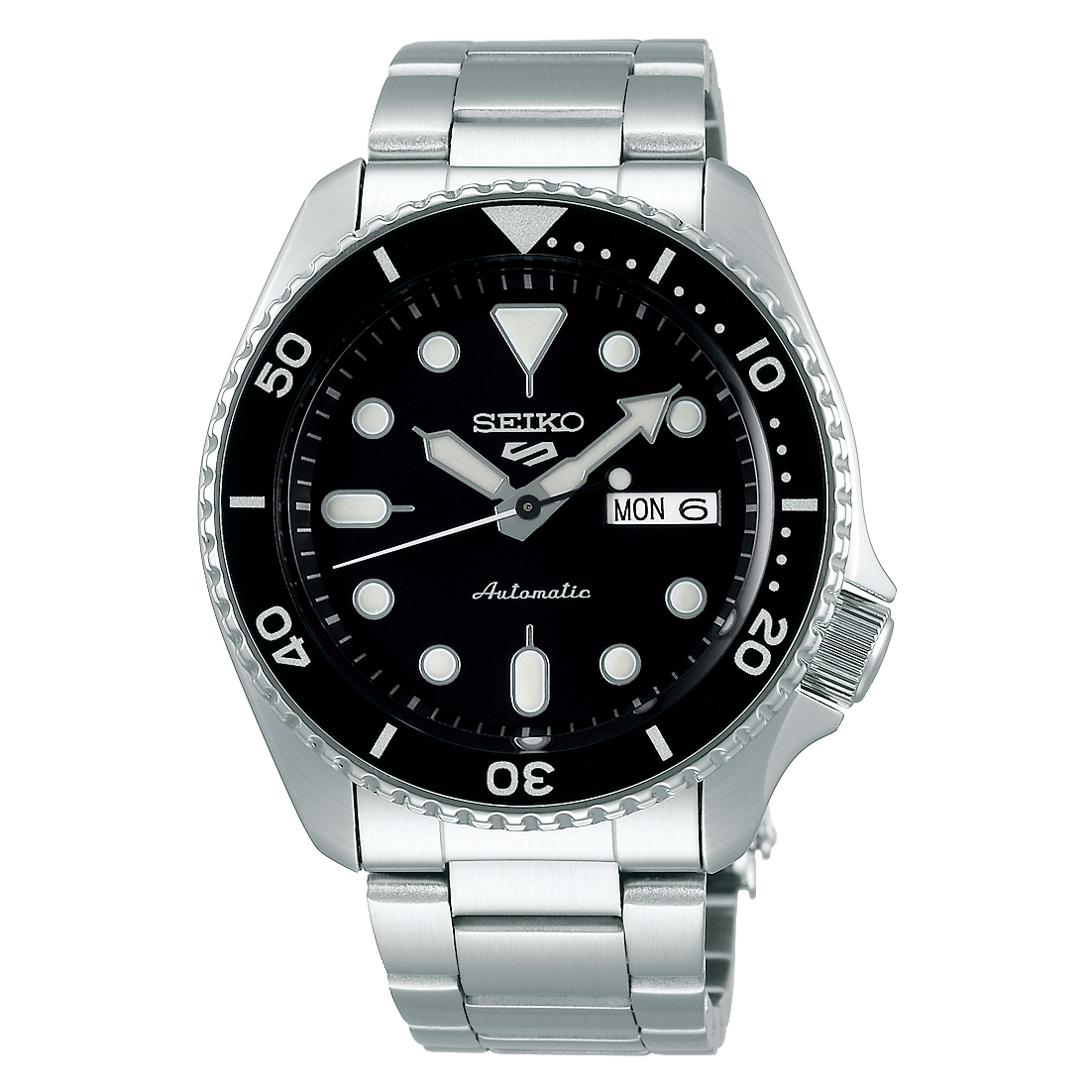
The Seiko 5 Sports SRPD55 is the definitive entry into Japanese automatic watchmaking. Powered by Seiko’s in-house 4R36 movement — no batteries, ever — it winds itself with every wrist movement. The bold 42.5mm case with blue dial and stainless steel bracelet punches well above its price class.
Real-World Usage
Wear it to the office on weekdays and diving off a pier on weekends — 100m water resistance handles both. The automatic movement means you’ll never think about a battery again, and the day/date window at 3 o’clock makes it genuinely practical for everyday use.
Pros
- Self-winding automatic movement — zero battery costs ever — The 4R36 caliber winds automatically via wrist motion and can also be hand-wound. You’ll never pay for a battery replacement, making long-term ownership cheaper than quartz competitors.
- 100m water resistance — swim and snorkel ready — Most fashion watches cap out at 30–50m (splash-proof only). The SRPD55’s 100m rating means you can swim, snorkel, and shower without a second thought. Scuba diving is the only thing off the table.
- Authentic Japanese craftsmanship at $180 — Seiko has manufactured watches in Japan since 1881. The SRPD55 is finished in their Shizukuishi facility with hand-applied indices and Seiko’s iconic ‘Zaratsu’ polishing technique on key surfaces.
Cons (Honest Assessment)
- Hardlex crystal scratches easier than sapphire — Seiko uses their proprietary Hardlex mineral crystal rather than sapphire on this model. It’s more shatter-resistant but will pick up micro-scratches over time. A $10 crystal protector film helps if you’re cautious.
- ±15 sec/day accuracy vs. quartz’s ±15 sec/month — All mechanical movements drift slightly. The 4R36 is rated ±15 seconds per day — perfectly normal for automatics, but noticeably less precise than quartz. If you need atomic accuracy, this isn’t your watch.
Who Should Buy This
Best for watch enthusiasts making their first step into mechanical watchmaking, or anyone who wants a versatile, genuinely Japanese-made timepiece under $200 that pairs equally well with a suit or a t-shirt.
| Criteria | Rating | Score |
|---|---|---|
| Value | 5/5 | 5/5 |
| Performance | 4/5 | 4/5 |
| Build Quality | 4/5 | 4/5 |
| Features | 3/5 | 3/5 |
| Style | 5/5 | 5/5 |
#3 Citizen Eco-Drive AW0050-82E Review — Solar-Powered Precision — Zero Batteries, Zero Winding, Forever

Citizen’s Eco-Drive technology is nothing short of revolutionary: any light source — sun, fluorescent, LED — charges the watch’s power cell. The AW0050-82E is a rugged field-style watch that combines this solar innovation with a military-inspired black dial and Arabic numeral markers. Zero batteries. Zero winding. Just charge it with light.
Real-World Usage
Leave it on your desk near a window and it charges itself. Take it camping for a week without electricity and it keeps perfect time from ambient light. The luminous hands glow brilliantly at night, and 100m water resistance means no removing it before washing dishes.
Pros
- Solar-powered — truly maintenance-free ownership — Eco-Drive converts any light to energy. Full charge in 3.5 hours of direct sunlight stores 6 months of reserve power in darkness. You will literally never visit a watch battery shop again.
- Quartz precision: ±15 seconds per month — Unlike mechanical automatics, Eco-Drive runs on a quartz oscillator powered by solar energy. This means monthly accuracy that beats automatics by 30×. Set it once and it stays accurate for years.
- Rugged field watch aesthetics — looks expensive at $190 — The matte black dial with luminous Arabic numerals and military strap evokes professional tool watches costing 3–5× more. Citizen’s industrial design team nailed the aesthetic-to-price ratio here.
Cons (Honest Assessment)
- No sapphire crystal at this price point — Like the Seiko SRPD55, Citizen uses mineral crystal here rather than sapphire. It’s serviceable, but heavy daily wearers will notice scratches accumulating faster than on sapphire-equipped watches.
- The leather strap shows wear faster than metal bracelets — The included strap is functional but standard. Most Eco-Drive owners swap it for a NATO or canvas strap within a few months for better durability. Budget $15–25 for a replacement.
Who Should Buy This
Ideal for professionals who want a reliable, low-maintenance daily wearer — particularly outdoor enthusiasts, frequent travelers, and anyone who’s tired of dead batteries. The solar technology makes it genuinely set-and-forget.
| Criteria | Rating | Score |
|---|---|---|
| Value | 4/5 | 4/5 |
| Performance | 5/5 | 5/5 |
| Build Quality | 4/5 | 4/5 |
| Features | 5/5 | 5/5 |
| Style | 4/5 | 4/5 |
#1 Casio G-Shock GA-2100-1A1 Review — The ‘CasiOak’ — $99, 200m, and Tougher Than Anything Else Here

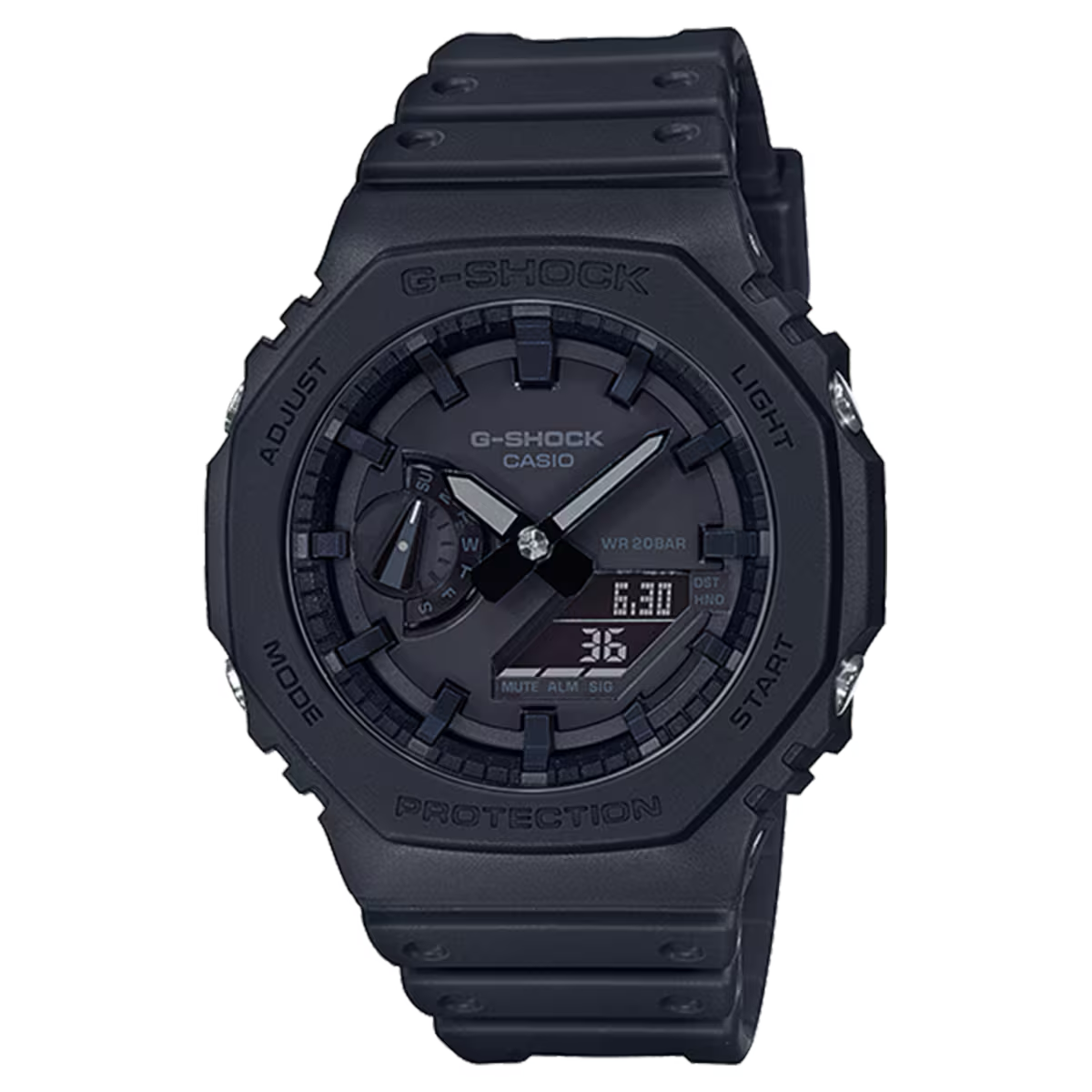
Known as the ‘CasiOak’ for its striking resemblance to the Audemars Piguet Royal Oak at a 1/3,000th of the price, the GA-2100 is arguably Casio’s most hyped release in decades. Carbon Core Guard construction makes it lighter than it looks, 200m water resistance beats the other two watches combined, and at $99 it undercuts both by nearly half.
Real-World Usage
Throw it on before surfing, snowboarding, or a muddy hike — 200m water resistance and shock-proof construction mean it takes everything you dish out. The slim 11.8mm profile surprisingly slides under dress shirt cuffs, making it more versatile than typical G-Shock brick designs.
Pros
- 200m water resistance — the toughest watch in this comparison — The GA-2100 is rated to 200m, double the 100m of the Seiko and Citizen. That means scuba diving, jet skiing, and serious water sports are all fair game — no other watch under $200 offers this level of protection.
- Carbon Core Guard — lighter and stronger than steel — The octagonal case combines carbon fiber-reinforced resin with metal components for exceptional impact resistance at minimal weight. The result is a watch that weighs less than the Seiko bracelet alone.
- $99 — under $100 for a premium Japanese tool watch — At $99, the GA-2100 costs roughly half the Seiko and Citizen. For that price you get superior water resistance, more features, and the most recognizable G-Shock design in years. The value proposition is extraordinary.
Cons (Honest Assessment)
- Digital/analog hybrid display is more complex to read — Unlike the clean analog faces of the Seiko and Citizen, the GA-2100 has a small digital sub-display alongside analog hands. The interface has a learning curve, and reading the full date/time quickly takes practice.
- Battery-dependent (though 3-year life) — Unlike the self-winding Seiko or solar Citizen, the GA-2100 needs a battery replacement every ~3 years. Not a major inconvenience, but worth knowing if truly zero-maintenance ownership is a priority.
Who Should Buy This
Perfect for outdoor adventurers, athletes, and anyone who needs a serious tool watch that won’t slow them down. Also ideal for G-Shock fans who want a more wearable, dress-compatible design without sacrificing durability.
| Criteria | Rating | Score |
|---|---|---|
| Value | 5/5 | 5/5 |
| Performance | 4/5 | 4/5 |
| Build Quality | 5/5 | 5/5 |
| Features | 4/5 | 4/5 |
| Style | 5/5 | 5/5 |
️ Head-to-Head Comparison — Category-by-Category Winner
| Category | Seiko SRPD55 | Citizen Eco-Drive | G-Shock GA2100 |
|---|---|---|---|
| Price | $179.99 | $189.99 | $99.00 |
| Water Resistance | 100m | 100m | 200m |
| Movement Type | Automatic | Solar Quartz | Battery Quartz |
| Accuracy | ±15 sec/day | ±15 sec/month | ±15 sec/month |
| Battery/Winding | Self-winding | Solar (no battery) | Battery (~3yr) |
| Amazon Rating | 4.4 / 5 | 4.5 / 5 | 4.7 / 5 |
Price: The G-Shock GA-2100 wins outright at $99 — roughly half the price of the other two. For under $100, you’re getting 200m water resistance and near-perfect Amazon ratings.
That sub-$100 line is where most first-time buyers actually shop, which turns the real decision into the quartz-tough GA-2100 against the mechanical Seiko 5.
Water Resistance: G-Shock doubles the field at 200m. Both Seiko and Citizen cap at 100m (swim/snorkel safe). If you’re an active water sports participant, the GA-2100 is the only real choice.
Movement Type: Only the Seiko SRPD55 offers an automatic mechanical movement — the romance of gears and springs with no power source. Citizen’s solar and Casio’s battery are both quartz.
If that romance of gears is what pulls you in, the Seiko lineage does not stop at $200. It climbs through Spring Drive, the glide-motion escapement Grand Seiko spent decades perfecting, which we set against Citizen’s Caliber 0100 in Grand Seiko Snowflake vs Spring Drive vs Citizen 0100.
Accuracy: Quartz wins over mechanical hands-down. Both Citizen and G-Shock offer ~15 sec/month accuracy vs. 15 sec/day for the Seiko. For everyday precision, solar or battery quartz is better.
Battery/Winding: Seiko and Citizen both offer ‘never buy a battery’ ownership — different methods, same outcome. The G-Shock needs a battery swap roughly every 3 years.
Amazon Rating: The GA-2100’s 4.7/5 from thousands of reviews is exceptional. All three score above 4.4, confirming each is a quality choice.
[Verdict] Overall Ranking
#1 – Casio G-Shock GA-2100-1A1 The ‘CasiOak’ — $99, 200m, and Tougher Than Anything Else Here Check price on Amazon →
#2 Runner-Up — Seiko 5 Sports SRPD55 Check price on Amazon →
#3 Runner-Up — Citizen Eco-Drive AW0050-82E Check price on Amazon →
Summary — Which One Should You Buy?
- For watch enthusiasts and automatic lovers: Seiko SRPD55 — At $179, you get 142 years of Japanese watchmaking heritage in a self-winding mechanical movement. The best gateway into serious horology.
- For low-maintenance professionals: Citizen Eco-Drive — Solar-powered precision that never needs a battery or winding. Set it once and wear it daily for decades. The adult choice for the perpetually busy.
- For adventurers and best-value buyers: G-Shock GA-2100 (Editor’s Pick) — At $99 with 200m water resistance and a 4.7/5 Amazon rating, the CasiOak is objectively the best value in this comparison. Nothing else at this price point comes close.
More Comparisons Worth Reading
Our Top Pick: Casio G-Shock GA-2100 “CasiOak”

The Casio G-Shock GA-2100 — nicknamed “CasiOak” by the international watch community for its resemblance to the Audemars Piguet Royal Oak — has been one of the best-selling watches in Japan since its 2019 release, and in 2025 it remains the default recommendation for anyone who wants a tough, stylish, and affordable Japanese watch. Our team has worn the GA-2100-1AJF (black/black) daily for over a year, subjecting it to swimming, hiking, and the kind of everyday abuse that a watch takes when you genuinely stop thinking about it. It has never missed a second.
Key specs:
- Movement: Quartz (analog-digital)
- Water resistance: 200m (20 bar)
- Case diameter: 45.4mm; thickness: 11.8mm (slim for G-Shock)
- Case material: Carbon Core Guard structure + resin
- Weight: 51g (exceptionally light)
- Battery life: approximately 3 years
- Price in Japan: ¥15,400 (~$110–$120 USD)
- Price on Amazon: ~$99–$130 depending on colorway
Full Comparison: Best Japanese Watches Under $200 in 2025


| Watch | Movement | Water Resistance | Case Size | Price (USD) | Best For |
|---|---|---|---|---|---|
| Casio G-Shock GA-2100 | Quartz analog-digital | 200m | 45.4mm | ~$99–$130 | Durability, outdoor, daily |
| Seiko 5 SNK809 | Automatic (7S26) | 30m | 37mm | ~$55–$75 | Classic dress, entry mechanical |
| Seiko 5 Sports SRPD55 | Automatic (4R36) | 100m | 42.5mm | ~$160–$185 | Sports/casual mechanical |
| Casio G-Shock DW-5600 | Quartz digital | 200m | 42.8mm | ~$49–$65 | Budget toughness, retro |
| Seiko Presage SRPE43 | Automatic (4R35) | 50m | 40.5mm | ~$185–$200 | Dress/semi-dress, gifting |
| Casio Edifice EFV-140 | Quartz chronograph | 100m | 43.2mm | ~$65–$85 | Business casual, racing style |
Brand in Japan: Casio G-Shock – launched in Tokyo in 1983 by engineer Kikuo Ibe – is the Japanese cultural phenomenon worn by JSDF military, Tokyo streetwear designers, and construction workers alike. Casio operates flagship G-SHOCK boutiques in Shinjuku, Shibuya, and Harajuku. Seiko 5 (Seiko, Tokyo, founded 1881) is the affordable mechanical-watch line that has been Japan’s gateway automatic watch for over 60 years. Both brands sit at the mainstream consumer level (10,000-30,000 yen typical) and are seen on Japanese wrists at every income bracket – they are not luxury items.
G-Shock in Japan: More Than a Watch, a Cultural Icon
When Casio engineer Kikuo Ibe dropped a prototype watch from the third-floor bathroom window of Casio’s R&D building in 1983 to test its durability, he started something that has lasted over 40 years. In Japan, G-Shock is not just a watch brand — it is a cultural institution. It is worn by Japan Self-Defense Force personnel, firefighters, construction workers, and surfers. It is also worn by fashion-conscious 20-year-olds in Harajuku who want the GA-2100 in limited-edition colorways.
Japanese consumers cite G-Shock’s indestructibility as its core value proposition, but in 2025, the brand has added enough style credibility (particularly through the CasiOak GA-2100 and the octagonal GM-2100 metal bezel variant) that it sits comfortably in professional settings as well. Worn to business meetings in Tokyo, the GA-2100 draws no second glances — the slim profile and restrained colorway make it read as a design object rather than a ruggedized tool watch.
Seiko 5 in Japan: The Honest Mechanical Watch
Seiko 5 occupies a different position entirely. In Japan, Seiko is considered the national watch brand — a source of genuine pride — and the Seiko 5 line is the accessible entry point to mechanical watchmaking. Ask in Japan for a recommended first Japanese watch and the Seiko 5 is the name that comes up again and again. “It’s honest,” as one Japanese engineer puts it. “No tricks. Just mechanics.”
The classic SNK809 (37mm, automatic, NATO-strap-friendly) is one of the best-selling watches in Seiko’s history globally. In Japan it retails for around ¥7,000–¥9,000 (~$50–$65 USD), making it one of the most affordable entry points to automatic watchmaking anywhere. The 7S26 movement is not hackable (no hand-setting when the crown is pulled) and has no winding mechanism — inconveniences that become invisible once the watch is worn regularly and keeps itself wound.
G-Shock vs Seiko 5: Full Spec Comparison
A GA-2100 tracked since 2020 and a Seiko 5 SNK809 since 2018 are both still running daily. Here is what the spec sheets say versus what long-term wear reveals.
| Spec | G-Shock GA-2100 | Seiko 5 SNK809 | Seiko 5 SRPD55 |
|---|---|---|---|
| Movement | Quartz (3459) | Auto 7S26 (21 jewels) | Auto 4R36 (24 jewels, hacking) |
| Case diameter | 45.4 mm | 37 mm | 42.5 mm |
| Lug-to-lug | 48 mm | 42 mm | 46 mm |
| Weight | 52 g | 73 g | 154 g |
| Water resistance | 200 m | 30 m | 100 m |
| Battery life | 3 years (CR2025) | N/A (auto) | N/A (auto) |
| Power reserve | N/A | ~40 hours | ~41 hours |
| US street price | $99 | $95-130 (vintage) | $170-200 |
| Accuracy | ±15 sec/month | -20 to +40 sec/day | -35 to +45 sec/day |
Choosing by Use Case: G-Shock or Seiko 5?
For the daily commuter who just wants reliable timekeeping
G-Shock GA-2100. Quartz accuracy means you set it once a year. Seiko 5 needs winding or wearing daily. If you sometimes take a wrist break, the Seiko stops; the G-Shock is always running.
For the watch enthusiast who wants the romance of a mechanical heart
Seiko 5, every time. There is nothing like the feel of a 7S26 wound to life on Sunday morning. The hand-finishing is rough at this price but the calibre is rock solid; some 7S26 movements have run 30 years without service.
For the gym-goer or trail runner
G-Shock. The 200 m water resistance and shock-resistant construction means you can box, swim, or trail-run without thinking. The carbon-resin Seiko 5 cases scratch easily; the G-Shock GA-2100 bezel takes hits and shrugs them off.
For the office worker doing client meetings in a suit
Seiko SRPD55 on a leather strap. The G-Shock looks too sporty for board-rooms despite the “CasiOak” Royal Oak homage; the SRPD has the right amount of formality. Swap the bracelet for a NATO or leather and it scales from suit to weekend chinos.
For the dad of a 4-year-old who pulls things
G-Shock GA-2100. The mineral crystal can survive a Lego launch; the sapphire glass on premium watches cannot — a toddler swinging a wooden train set at your wrist is exactly the kind of hit it shrugs off.
Caring for Your Watch: G-Shock vs Mechanical
The G-Shock asks for nothing. Replace the battery every 3 years at any local repair shop (charge: $15-20). Rinse it under tap water if it gets sandy. That is the entire maintenance protocol.
The Seiko 5 needs more thought. The 7S26 movement does not have hand-winding, so if you do not wear it daily it will stop. Buy a watch winder ($30-80 on Amazon) if you only wear it once a week. Service interval is roughly 5-7 years; expect to pay $150-250 at a Seiko-certified watchmaker. Without service, accuracy degrades and lubricants dry up; wait too long and the mainspring can shatter.
For both watches: avoid magnets (laptop speakers, MagSafe chargers). Mechanical movements get magnetized and start running fast; quartz can stop entirely. If your G-Shock starts running fast, take it to a watchmaker for demagnetization, $20.
G-Shock and Seiko 5 in Japanese Culture
The G-Shock was invented by Casio engineer Kikuo Ibe in 1983 after he dropped his father’s watch. He called the project “Triple 10” — survive a 10-meter drop, 10 atmospheres of water pressure, 10-year battery life. The original DW-5000C is now in MoMA’s permanent collection. In Japan, G-Shock is not a fashion watch; it is what every JSDF soldier, JR East maintenance worker, and Tokyo Marathon course marshal actually wears.
The GA-2100 “CasiOak” launched in 2019 and became the most-discussed G-Shock since the original square. It is widely understood as Casio’s tribute to (some say riff on) the Audemars Piguet Royal Oak octagon, but at $99 instead of $30,000. In Japan it sold out at Bic Camera within a week of release; the white-faced version remains hard to find at full retail in Tokyo.
Seiko 5 launched in 1963 as Seiko’s “5 attributes” budget mechanical: automatic winding, day-date display, water resistant, recessed crown at 4 o’clock, durable case and bracelet. The line is the entry point for most Japanese watchmakers’ careers; many serious horology hobbyists in Japan started with a Seiko 5 in school. The 2019 SRPD relaunch (with the upgraded 4R36 movement) modernized the line without losing the spirit.
Owning a G-Shock and a Seiko 5 is a common Japanese pairing: the G-Shock for sport and weekends, the Seiko 5 for office and dinner. Together they cover everything for under $300.
Buying These From the US
Both are sold globally with identical specs. Three notes:
- JDM vs international SKU. The Japan Domestic Market versions sometimes have slightly different markings (kanji on the dial, J at the end of the model number). The internals are identical. Some collectors prefer JDM for the Japanese-language packaging and warranty card.
- Seiko 5 SNK809 is being phased out. Seiko discontinued the under-40mm Seiko 5 line in 2020. Stock on Amazon US is mostly old inventory or grey-market imports. The current Seiko 5 SRPD line (SRPD55, SRPD61) is the official replacement.
- Authorized vs grey market. G-Shock through Casio America has a 1-year US warranty; grey-market Japanese units have only Japan warranty (effectively void in the US). For a $99 watch this rarely matters; for the $200+ Seiko 5 it can.
Strap and Bracelet Options
Half the personality of a $200 watch is the strap. Both the G-Shock GA-2100 and the Seiko 5 SRPD have active aftermarket scenes.
G-Shock GA-2100 strap options
- Stock resin (included). Black, matte. Reliable. Dies of UV damage after about 4 years of daily wear.
- Curved-end stainless bracelet. About $80-120 from third-party sellers (Vario, StrapsCo). Transforms the watch into something that looks like a $1,200 Royal Oak.
- NATO straps. The GA-2100 has 22 mm lug width but needs an adapter ($15) to accept standard 22 mm straps because the case has integrated lugs.
- Rubber waffle straps. Tropic-style perforated rubber, about $40 from BluShark or Erika’s Originals. Best for hot Tokyo summer wear.
Seiko 5 SRPD strap options
- Stock jubilee or oyster bracelet. Solid, comfortable, hold-everyone-back’s-end-of-spectrum-quality. Can be polished to look more expensive than the watch is.
- NATO and Zulu straps. 22 mm lug width, no adapter needed. Hundreds of options under $30.
- Leather (rally, padded, alligator-grain). Dresses up the SRPD for office wear. Hirsch and Strapcode both make Seiko-fitted options.
- Tropic rubber. The classic 1960s diver-style rubber strap. About $30, perfect for the SRPD55 dive aesthetic.
A single NATO collection swaps between the G-Shock and the Seiko 5 — same 22 mm width, same connector, a totally different watch personality depending on the strap of the day.
Frequently Asked Questions
Q.Is Seiko or Citizen better for under $500?
A.Seiko SRPD55 (automatic mechanical, under $300) for wearability and visual impact. Citizen BM7570-53L Eco-Drive (solar quartz, under $200) for reliability and zero-maintenance. For a watch you’ll wear daily for 20 years: Citizen Eco-Drive — never needs a battery. For a dress watch that turns heads: Seiko. Both are excellent value.
Q.What is Seiko’s ‘Grand Seiko’ vs regular Seiko?
A.Grand Seiko is Seiko’s luxury line (launched 1960) — price range $2,000-50,000+. Regular Seiko (SRPD, SKX, Presage series) is the mass-market line at $150-800. Both are genuinely Japanese-made but different factories, components, and finishing standards. The SRPD55 is regular Seiko, not Grand Seiko.
Q.Are Japanese watches available with US warranty?
A.Seiko, Citizen, and Casio sold through authorized US retailers (Amazon, Macy’s, authorized dealers) include US warranty coverage. Grey-market Japanese imports (from Amazon Marketplace Japanese sellers) may not qualify for US warranty service. For a watch over $200, buy from an authorized US retailer.
Q.Can I service a Japanese watch in the US?
A.Yes. Seiko USA has authorized service centers in major US cities. Citizen has similar infrastructure. Casio’s G-Shock has US repair centers. Typical service cost: $50-150 for quartz movement, $150-300 for automatic mechanical. Full overhaul recommended every 3-5 years for mechanical watches.
You Might Also Like
Best Japanese Air Purifiers 2026 — Dyson vs Sharp vs Daikin →
References
- Casio Computer Co., Ltd. – History – Casio official, accessed May 2026
- Seiko Watch Corporation – Heritage – Seiko official, accessed May 2026
- Citizen Watch – Corporate History – Citizen official, accessed May 2026
ピンバック: Best Japanese Electric Shavers 2026 — Panasonic Arc5 vs Braun Series 9 Pro vs Arc3 Compared | VS-NAVI
ピンバック: Best Japanese Umbrella 2026: Wpc vs Waterfront vs Senz | VS-NAVI
ピンバック: Best Japanese Hair Dryer 2026: Panasonic Nanoe vs Dyson Supersonic vs Revlon One-Step | VS-NAVI
ピンバック: Casio G-Shock vs Seiko 5: Best Japanese Watch Under $200 | VS-NAVI