As an Amazon Associate, vs-navi.online earns from qualifying purchases. Amazon links on this page are affiliate links.
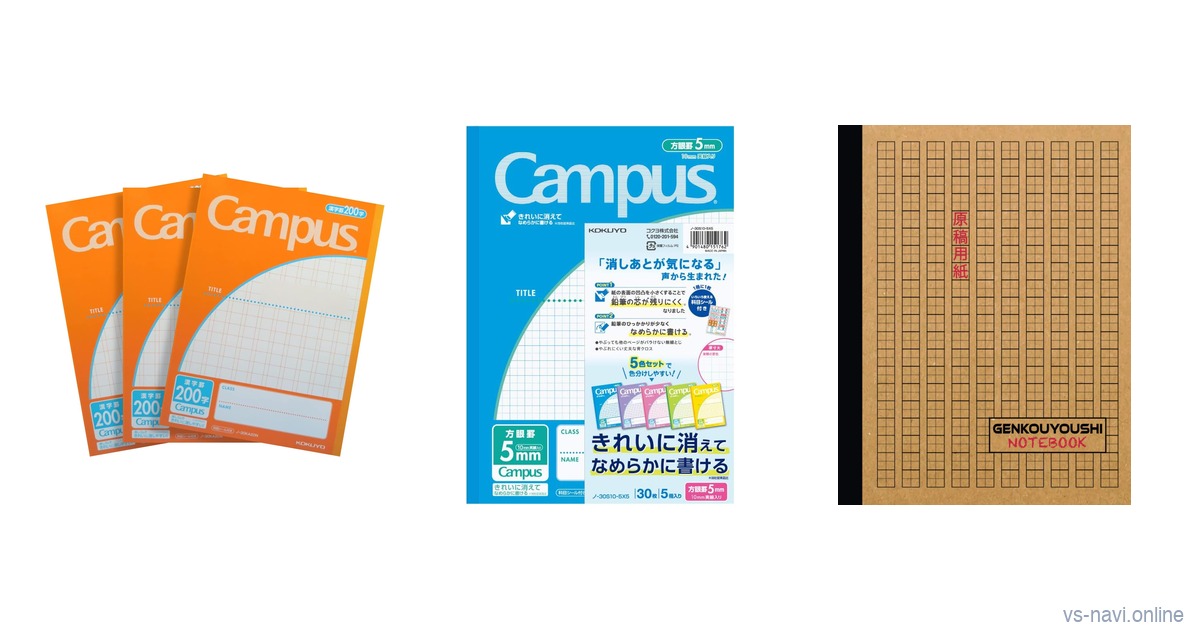
Learning Japanese means learning to draw characters in a square. Every kana and every kanji is written to fill the same invisible box, which is why ordinary ruled paper makes practice feel harder than it is.
Japanese schools solve this with dedicated paper: kanji practice notebooks with large squares, grid notebooks for everyday notes and manuscript paper called genkouyoushi for vertical writing.
We compared three options a learner outside Japan can order on Amazon.com in November 2026. This guide is a desk comparison built from the product listings, maker information and the public ratings on each listing.
Our Picks: Which Practice Notebook for Which Learner
- For drilling kanji: Kokuyo Campus kanji notebook with 200 squares. Large character boxes on Kokuyo paper made to erase cleanly.
- For daily notes in kana and kanji: Kokuyo Campus B5 notebook with a 5 mm grid. Solid lines every 10 mm turn four small cells into one character box.
- For vertical writing and a big page: Genkouyoushi Notebook by City Dreams Publishing. A US letter-size paperback of 120 manuscript-paper pages with quadrant guides.
Check price on Amazon →Amazon affiliate link
Why Square Paper Matters for Japanese
English handwriting sits on a baseline. Japanese characters do not. Each one is centered in its own square and the balance between strokes is judged against the edges of that square.
That is why Japanese elementary schools use notebooks printed with boxes instead of lines. The box shows how wide a radical should be, where a stroke should stop and how much space a small kana such as a little tsu should take.
Genkouyoushi goes one step further. It is the manuscript paper used for school essays and compositions, written in vertical columns that run from top to bottom and are read from right to left. Learners who want to read or write tategaki, the vertical style used in novels and newspapers, practice on it.
For a beginner the practical question is simple. Do you need big boxes for repetition, a flexible grid for notes or vertical columns for compositions? The three notebooks below each answer one of those needs.
Kokuyo and the Campus Notebook in Japan
Kokuyo is an Osaka-based maker of stationery and office furniture. Its official history traces the company to 1905, when Zentaro Kuroda opened a shop making covers for Japanese-style account ledgers.
The Campus name dates to 1965 on Kokuyo’s own timeline and the adhesive-bound Campus notebook for students across Japan followed in 1975. Campus notebooks are widely used by students in Japan and are sold in many rulings for different subjects.
Two of our three picks come from that Campus range. They are the same paper and the same binding, printed with different rulings. Our comparison of Kokuyo Campus, Maruman Mnemosyne and Stalogy covers the general-purpose side of the line.
Kokuyo Campus Kanji Notebook, 200 Squares (Pack of 3)
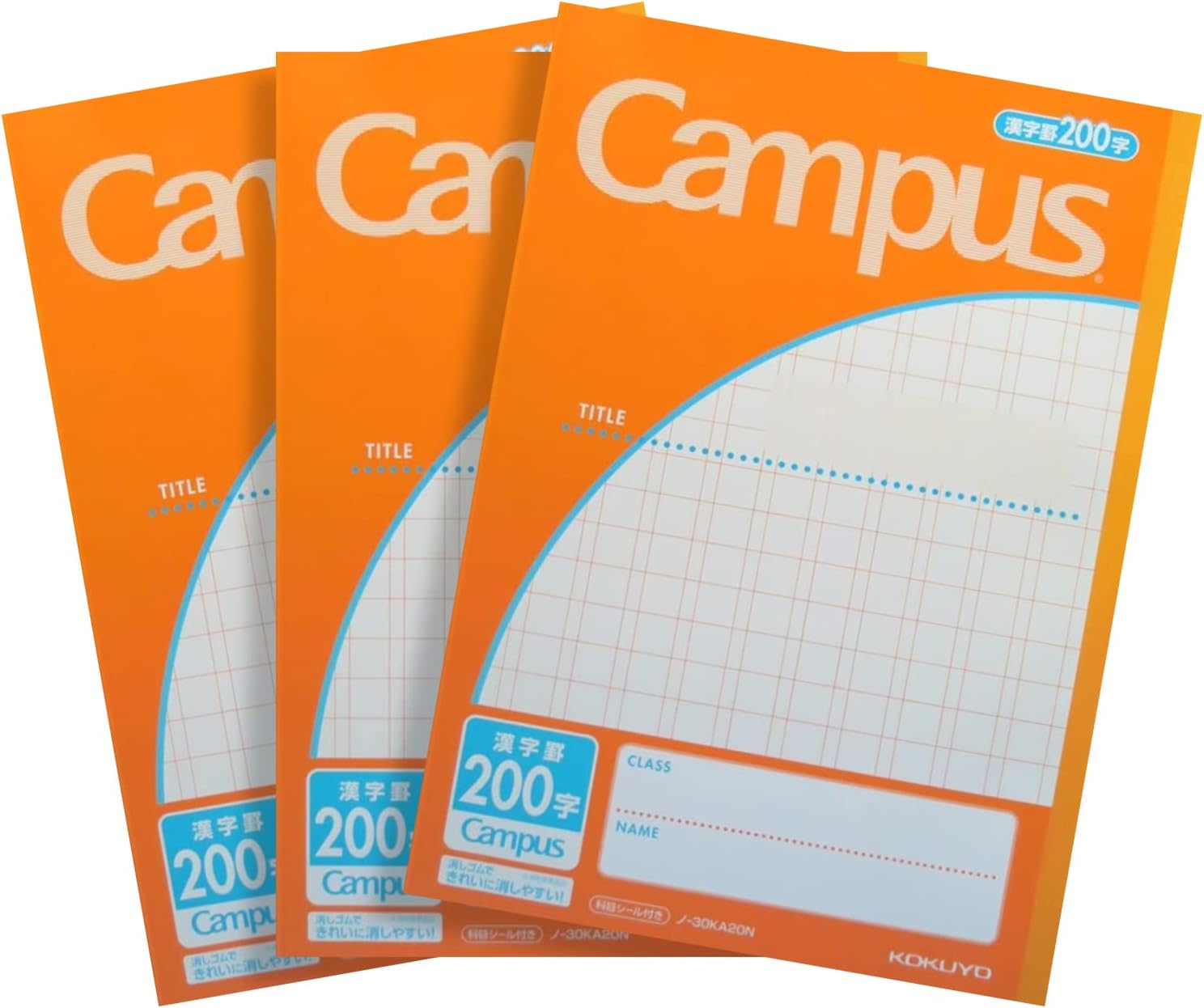
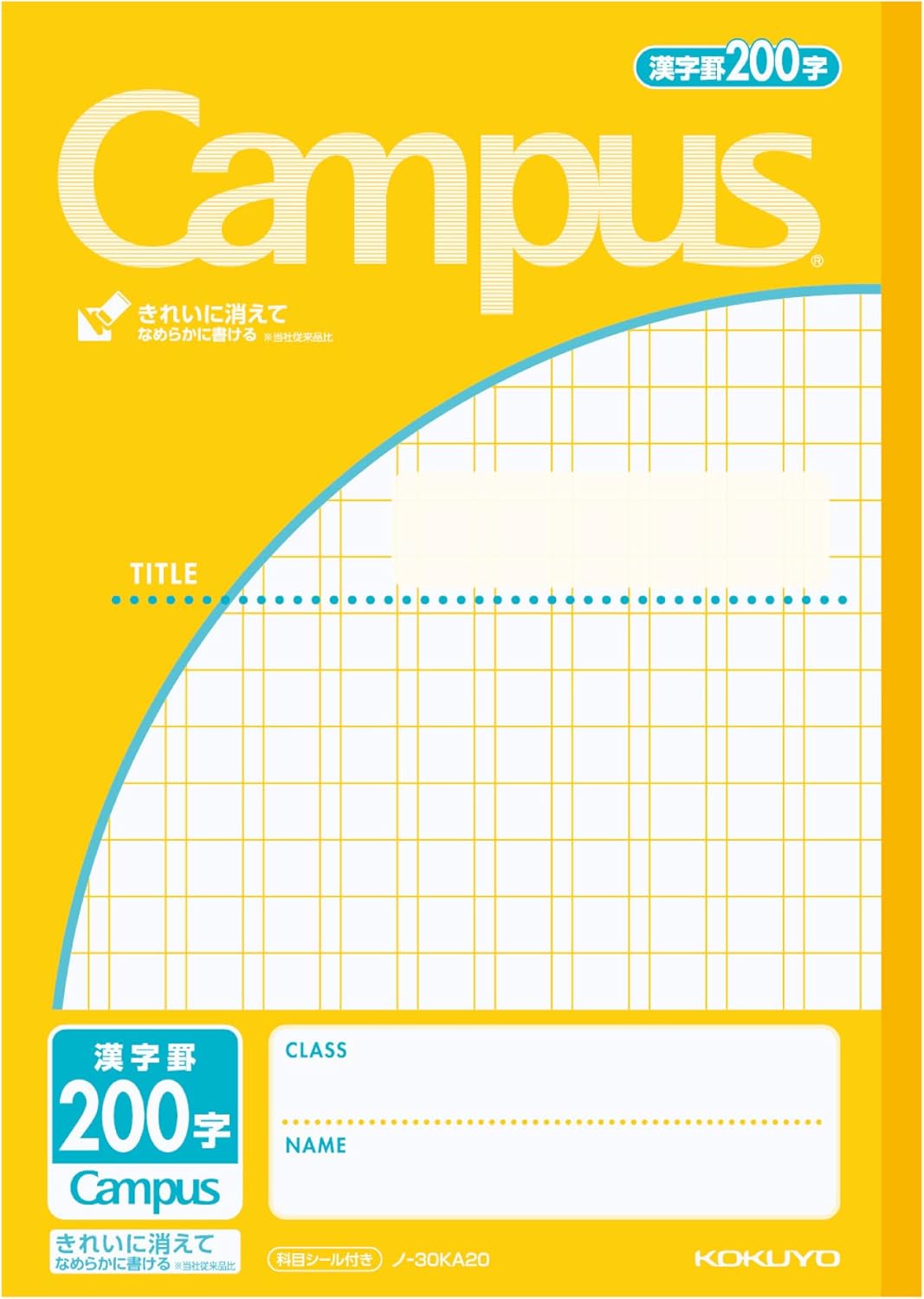
This is the notebook Japanese students use for kanji repetition. The cover reads 漢字罫 200字, which means kanji ruling with 200 character squares per page. The listing describes it as semi-B5 with 30 sheets, sold as a pack of three under the model number NO-30KA20.
The squares are large compared with a 5 mm grid, so there is room to write each character slowly and check the proportions of every stroke. That is what a learner needs in the first months of kanji study.
Kokuyo’s description focuses on the paper. It says the sheets are made to erase cleanly with an eraser, which matters when a character with many strokes has to be redrawn. It also lists bleed-resistant, acid-free paper, a white tone meant to reduce eye strain and a glued spine laminated with film that opens flat.
It held 4.8 out of 5 from about 410 ratings on the three-pack listing. Amazon’s AI summary of buyer reviews says customers like the paper quality and find it good for kanji practice, with comments that the character boxes are a good size. A single-notebook listing with a yellow cover is also available, with 4.7 out of 5 from about 430 ratings; it measures 179 x 252 mm according to that listing.
The limitation is flexibility. Large squares mean fewer characters per page, so the notebook fills quickly and is awkward for vocabulary lists or grammar notes. It is also a Japan import sold by third-party sellers, so delivery times vary.
It suits learners who practice kanji by repetition, children in Japanese heritage schools and anyone following a textbook that asks for each character to be written many times.
Check price on Amazon →Amazon affiliate link
Kokuyo Campus B5 Notebook, 5 mm Grid (Pack of 5)
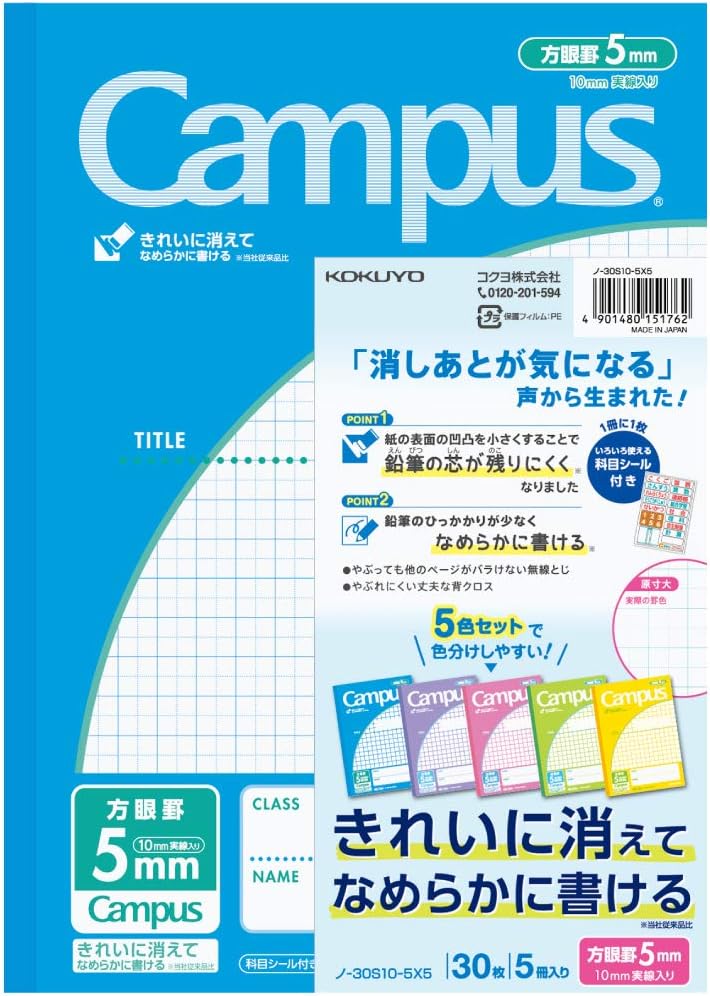
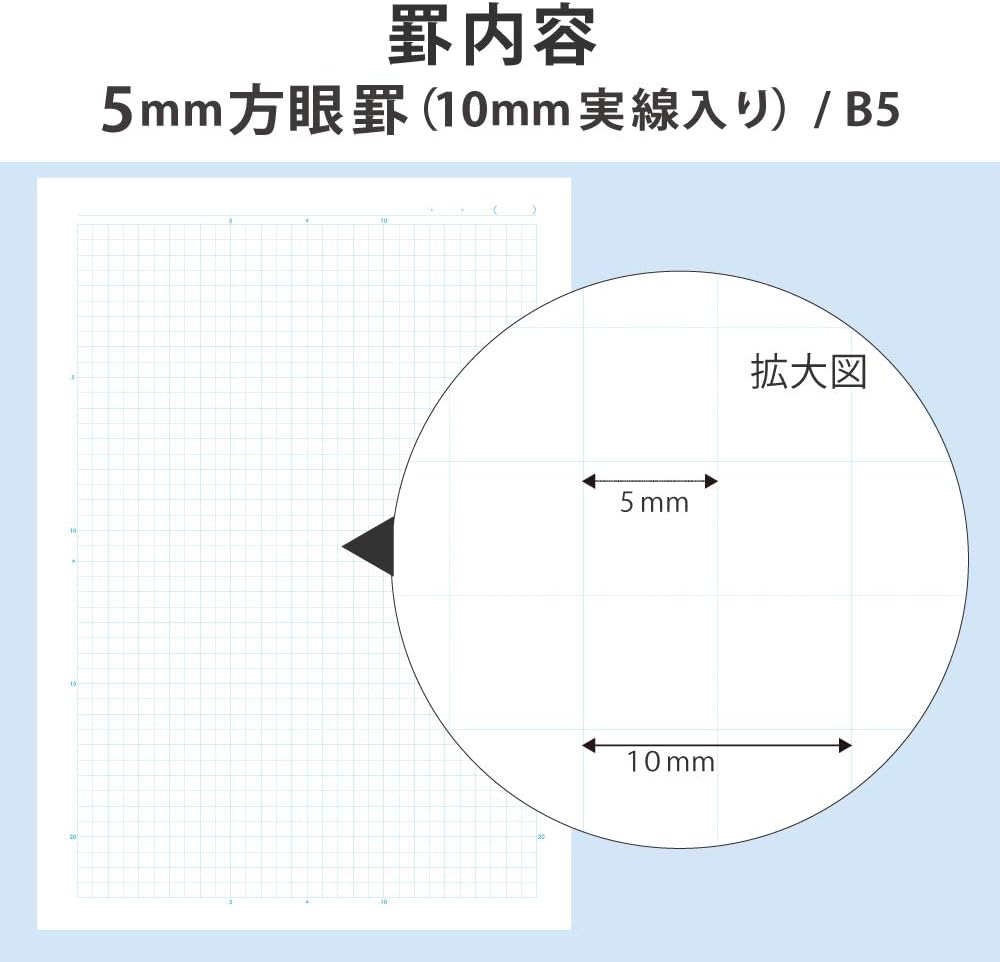
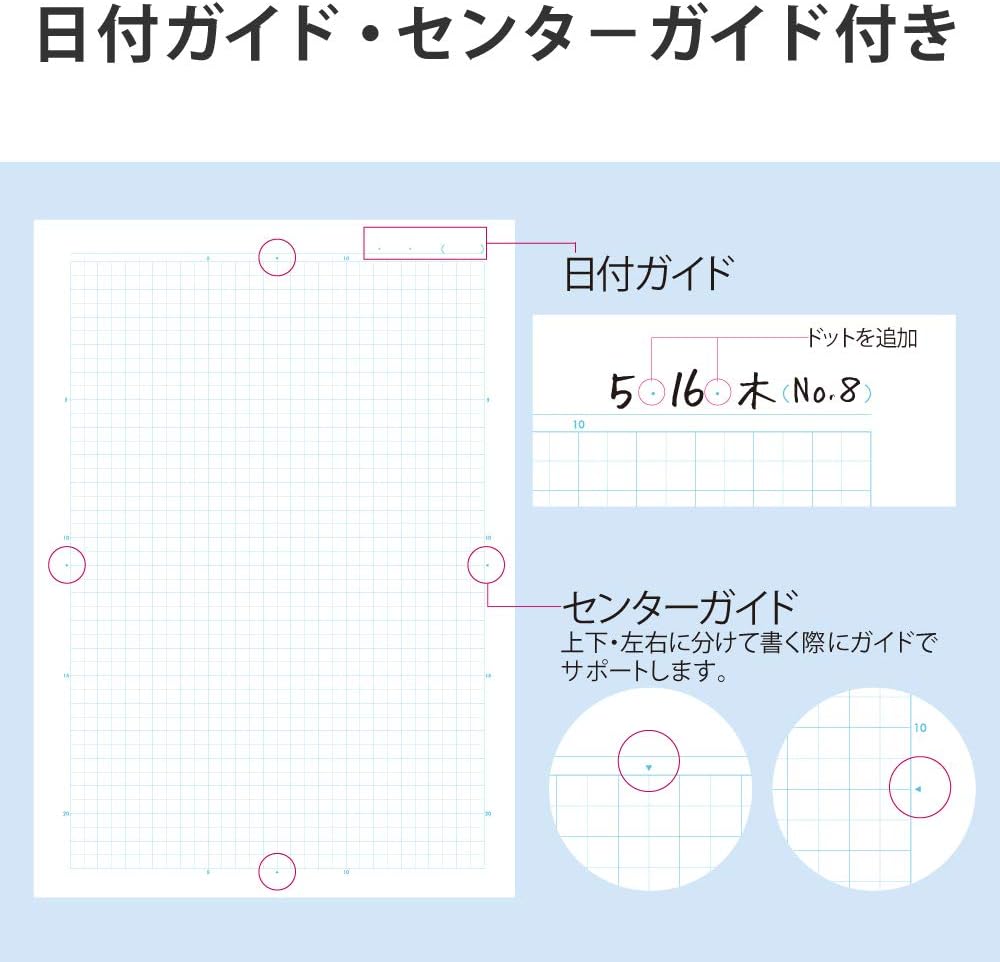
The grid notebook is the everyday choice. The product images show a 5 mm grid with a solid line every 10 mm, on B5 pages measuring 179 x 252 mm, 30 sheets per notebook, five notebooks per pack.
That 10 mm line is the useful detail for Japanese. Four 5 mm cells make one 10 mm square, so the page works as a character grid with a built-in cross guide in the middle. The same page also works for small handwriting at 5 mm per character, or for math and diagrams.
The images also show a date guide at the top of the page and small center guide marks on the edges, which help split a page into columns. The five covers in blue, light green, light pink, purple and yellow make it easy to keep one notebook per subject: kana, kanji, vocabulary, grammar and reading notes.
It held 4.8 out of 5 from about 3,000 ratings, the deepest record of the three. Amazon’s AI summary of reviews says customers find the paper very smooth and useful for practicing kanji. The same summary notes that customers find the notebooks very thin, which is expected with 30 sheets each.
The downside is that a 10 mm box is smaller than the squares in the kanji notebook. Beginners working on complex kanji may find it tight. It is also a Japan import with third-party sellers on the listing we checked.
It suits self-study learners who want one notebook type for everything and students who take notes in a mix of Japanese and English.
Check price on Amazon →Amazon affiliate link
Genkouyoushi Notebook by City Dreams Publishing
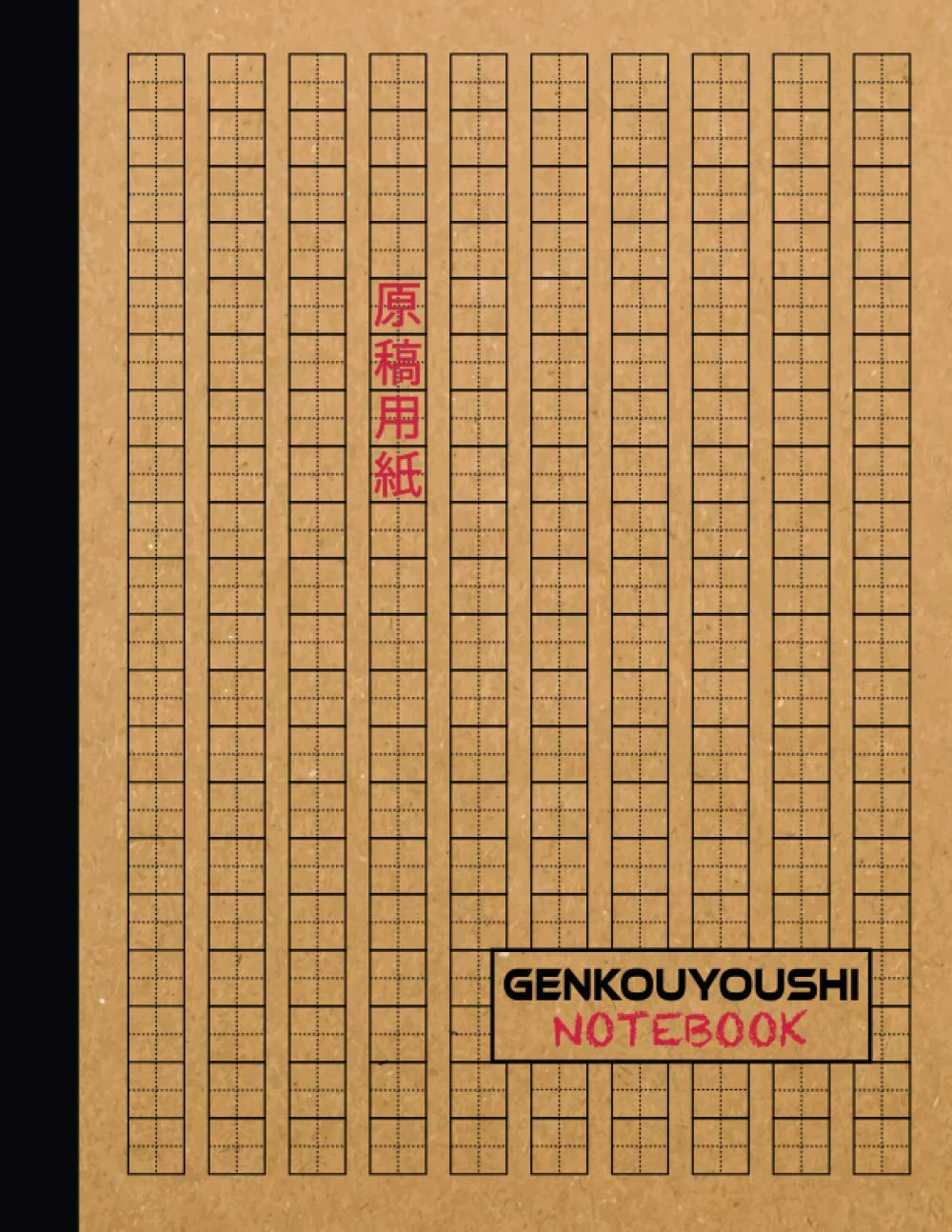
This is not a Japanese stationery product. It is a paperback workbook listed in the Books section of Amazon.com. That is its advantage: it was sold and shipped by Amazon.com itself when we checked, with no import wait.
The listing describes a blank workbook of genkouyoushi pages for vertical writing, 8.5 x 11 inches, 120 practice pages in a 122-page paperback. Each box is divided into quadrants to help place the parts of a character. One kanji, hiragana or katakana character fits in each square.
It also includes hiragana and katakana charts at the front, a cover page for a name and a soft cover. The publication date on the listing is July 14, 2020.
It held 4.8 out of 5 from about 330 ratings. Amazon’s AI summary of reviews says customers find it good for practice, with one review mentioning self-study for the JLPT.
The trade-offs are paper and format. A print-on-demand paperback does not claim the erasing or bleed-resistance features Kokuyo lists and a large US letter page is not a notebook you carry in a bag. It is a workbook for the desk.
It suits learners who want to practice vertical writing, students preparing compositions and anyone who would rather buy from Amazon.com directly than wait for an import.
Check price on Amazon →Amazon affiliate link
Compare the Three
| Kokuyo Campus Kanji 200 | Kokuyo Campus 5 mm Grid | Genkouyoushi Notebook | |
|---|---|---|---|
| Ruling | 200 large character squares | 5 mm grid, solid line every 10 mm | Genkouyoushi boxes with quadrant guides |
| Page size | Semi-B5 (179 x 252 mm) | B5 (179 x 252 mm) | 8.5 x 11 in |
| Pages | 30 sheets per notebook | 30 sheets per notebook | 120 practice pages |
| Pack | 3 notebooks (single also sold) | 5 notebooks, 5 colors | 1 paperback |
| Paper notes from the listing | Easy to erase, bleed-resistant, acid-free | Easy to erase, bleed-resistant, acid-free | White paper, soft cover |
| Seller on Amazon.com when checked | Third-party import seller | Third-party import seller | Amazon.com |
| Amazon rating | 4.8 (about 410) | 4.8 (about 3,000) | 4.8 (about 330) |
| Fits | Kanji repetition | Everyday notes | Vertical writing |
Most learners will get the most use from the Kokuyo grid notebook. It handles kana drills, kanji in 10 mm boxes and ordinary notes on the same page.
Add the kanji notebook when you start learning characters with many strokes and want bigger boxes. Choose the genkouyoushi workbook if vertical writing is part of your course, or if you need paper this week from Amazon.com.
Buyer’s Considerations
Pencil first. Japanese schools teach characters in pencil and the Kokuyo paper is designed around erasing. A 0.5 mm or 0.7 mm mechanical pencil works well in these boxes; our Kuru Toga, Orenz and DelGuard comparison covers three Japanese options. A clean eraser such as the ones in our Tombow Mono and Mono Zero guide keeps the grid from smudging.
Stroke order. A notebook does not teach stroke order. Use a textbook or a dictionary that shows it and copy each character into the boxes following those diagrams.
Box size. Larger boxes are easier at the start. As your handwriting settles, smaller boxes let you write more on each page.
Import listings. The two Kokuyo listings were sold by third-party sellers shipping from Japan when we checked. Prices may display in another currency depending on your address and change often, so check the listing before ordering.
Summary
For kanji repetition, the Kokuyo Campus 200-square notebook gives the most room per character.
For everyday Japanese notes, the Kokuyo Campus 5 mm grid pack covers kana, kanji and English in one ruling. For vertical writing, the genkouyoushi workbook ships from Amazon.com.
Check the current price and seller on each Amazon.com listing before ordering.
Check price on Amazon →Amazon affiliate link
FAQ
What is genkouyoushi?
Genkouyoushi is Japanese manuscript paper printed with a grid of squares. It is used for school essays and compositions written vertically, with columns running top to bottom and read from right to left. One character, small kana or punctuation mark goes in each square.
Can I learn kanji on ordinary lined paper?
You can, but squares make it easier to judge the size and balance of each character. A grid notebook with 10 mm boxes, such as the Kokuyo Campus 5 mm grid with its 10 mm solid lines, is a simple upgrade.
What does 漢字罫 200字 on the Kokuyo cover mean?
It means kanji ruling with 200 character squares per page. Kokuyo sells Campus notebooks in many rulings and this one is made for writing kanji repeatedly in large boxes.
Is the 5 mm grid too small for Japanese?
A single 5 mm cell is small for most kanji. The Kokuyo grid adds a solid line every 10 mm, so you can treat four cells as one character box and use the lighter lines as a center guide.
Are Kokuyo notebooks available on Amazon.com?
Yes. When we checked in November 2026, both Kokuyo listings in this guide were available on Amazon.com through third-party sellers shipping from Japan. The genkouyoushi workbook was sold by Amazon.com.